Anthropic released Claude Fable 5.2 and Claude Mythos 5.2 on November 9, 2026, and the new model immediately took the top spot on the Artificial Analysis Intelligence Index, six points ahead of Claude Opus 5.5. Leaderboard positions are one thing; whether a model earns its keep on real work is another. This article walks through the published benchmark and cost figures first, then puts Fable 5.2 to work inside Claude Code on five ordinary jobs: a 3D guide to a city's mobility plan, a basketball shooting simulation, a hardware research report for a local AI server, a sales funnel audit on an online course site, and a native app for a foldable iPhone. The results suggest the headline numbers translate into practical strength for strategy and software work, with some clear limits in graphics and some cost traps worth watching.
What the release claims
Fable 5.2 and Mythos 5.2 share the same underlying model. Mythos 5.2 keeps specialized cyber and biology capabilities that are only available through verification programs, while Fable 5.2 ships with safeguards for those areas and, according to Anthropic, fewer unnecessary refusals than Fable 5.1. Both models are said to communicate more clearly and generate output up to 30 percent faster than the 5.1 generation.
Fable 5.2 is now the default model in Claude.ai and Claude Desktop, with a recommended "medium" thinking effort. Anthropic positions Opus 5.5 as the everyday workhorse and recommends Fable 5.2 and Mythos 5.2 for open-ended technical problems, or as an orchestrator that delegates smaller tasks to Sonnet 5.5 or Haiku 5.5. It is a curious reversal: Opus 5.5, until recently the top of the lineup, is now framed as the lighter option.
Pricing
| Mode | Input (per million tokens) | Output (per million tokens) | Speed |
|---|---|---|---|
| Standard | $8 | $40 | Up to 30% faster than Fable 5.1 |
| Fast Mode | $16 | $80 | Up to 2.5x token generation speed |
On the Artificial Analysis cost-per-task chart, Fable 5.2 lands at roughly $10 weighted average per index task, which makes it more expensive per task than Opus 5.5. One caveat: although the model generates tokens faster than Fable 5.1, Artificial Analysis shows its average time per task is slower, apparently because it reasons more deeply before answering.
Benchmarks against Opus 5.5 and GPT-6 Astra
Anthropic's comparison table shows Fable 5.2 ahead of Opus 5.5 and OpenAI's GPT-6 Astra across the evaluated categories.
| Benchmark | Fable 5.2 | Fable 5.1 | Opus 5.5 | GPT-6 Astra |
|---|---|---|---|---|
| FrontierCode 2.0 (high effort) | 49.1% | 32.4% | 45.5% | 42.8% |
| FrontierSWE v2 (agentic coding) | 69.9% | 56.3% | 62.3% | 65.5% |
| Terminal-Bench Science 0.1 | 74.6% | — | 68.1% | 66.5% |
| AA-Briefcase v1.1 (multi-week knowledge work) | 66.1% | — | 59.5% | 58.0% |
At extra-high effort, Fable 5.2 reaches 56.9 percent on FrontierCode 2.0, barely above Fable 5.1's 56.7 percent at the same setting. The model also scores 74.2 percent on Humanity's Last Exam with tools, 73.4 percent on the Chartography chart-reading test, and 41.3 percent on the Remote Labor Index at high effort. AA-Briefcase is worth explaining: it measures long, multi-week agentic knowledge tasks across financial, legal and operational material such as dense spreadsheets, PDFs and chat threads, which is closer to office work than a coding puzzle.
On the security side, Mythos 5.2 without safeguards scores 76.3 percent on CyScenarioBench versus 36.3 percent for Fable 5.2 with safeguards. In Anthropic's internal CVE rediscovery benchmark, which asks the model to find 1,629 historical, already-published vulnerabilities, Mythos 5.2 reached 89.6 percent, 10.2 percent more than Opus 5.5 and 14.4 percent more than Mythos 5.1. Anthropic also reports that Mythos 5.2 overstates the severity of a finding only about one time in 20, which matters for defenders who need to prioritize patches rather than chase false alarms.
For context on how fast the field is moving, filtering the Artificial Analysis index for older models shows Claude Opus 5 at 44, Kimi K1.3 Pro at 46 and GLM 5.3 Max at 32.
Effort settings: where the money goes
The most useful chart in the release plots FrontierCode 2.0 accuracy against cost per task for Fable 5.2, Opus 5.5, Mythos 5.1, GPT-6 Astra and Gemini 4 Carbon at different thinking effort levels. Scores climb steadily from low to high effort. Beyond that, moving to extra-high or max effort makes cost surge while accuracy barely moves.

▲ Diminishing returns at higher thinking effort
Two practical conclusions follow. First, Fable 5.2 at high effort matches Opus 5.5 at max effort while cutting the cost per task roughly in half. Second, for agentic coding, high effort appears to be the sensible ceiling; the extra-high and max tiers look like diminishing returns. At medium effort, Fable 5.2 also finishes hard tasks with fewer tokens than Fable 5.1.
The flip side is that effort controls have become hard to track. Anthropic's model-plus-effort combinations feel more complicated than ChatGPT's single slider, where GPT-6 is selected by default under the Pro tier and GPT-5.6-turbo sits in a dropdown that is easy to overlook. Whatever vendor you use, lower per-token pricing does not protect you from runaway spend if an agent runs at max effort.
What Anthropic says it built with the model
The release notes include several large claims that are reported here as Anthropic presents them. By Anthropic's own count, Claude now writes more than nine in ten of the code changes that land in the company's core codebase. Fable 5.2 migrated an internal production service from Python to Rust with roughly 26 times faster execution. One engineer started from an empty folder and had Fable 5.2 coordinate more than 1,000 subagents for eight days to produce a prototype operating system that boots on a laptop with custom disk, keyboard and network drivers, a windowing system, a login screen and an installer. A team of 1,000 Fable 5.2 agents formalized Fermat's Last Theorem in the Lean proof language in 30 hours, compared with 11 days for an unreleased research model; Opus 5.5 completed 26 percent in 18 hours before stalling. With the circuit board manufacturer Diode, a single prompt produced specifications, four-layer board layouts, component lists and 3D-printable enclosures for a voice assistant hub, a USB speakerphone and a handheld virtual pet, all of which worked on the first build.
These are impressive if taken at face value, and it is striking how quickly such items have come to read like routine release notes. The claim that autonomous science platforms spell "the end of PhDs" deserves more skepticism than the engineering results do.
Five hands-on tasks in Claude Code
1. A 3D guide to a city's mobility plan
The first project turned the official Sustainable Urban Mobility Plan (PMUS) for Las Rozas, a municipality in Madrid, into an interactive 3D web application called "The Plan in Motion." The work spanned Claude Opus 5.5 and Fable 5.2. The app ties the plan's text to a 3D model of the town, so that scrolling through a section lights up the matching map layers. Trip modes from 2021 data appear as colored lights: 1,409 red for private vehicles, 366 blue for public transit, 360 yellow for walking and 49 green for other modes. Nine municipal action plans are projected onto the map with their budgets, including €5.4 million for active mobility and local transit improvements, €182,000 for intermodal connections and €52,000 for public transit upgrades. A cycling layer shows existing lanes plus Phase 1 and Phase 2 additions, and a toggle switches between a glowing night view and a flatter daylight view. The night view is far more compelling. Municipal clients responded enthusiastically, which suggests the pattern of converting dense planning PDFs into navigable 3D guides has real demand.
2. A basketball shooting simulation
Inspired by demos of Fable models rendering nature scenes in code, the second task asked Fable 5.2 to build a lightweight 3D rendering pipeline for a basketball shot. Through terminal commands in Claude Code, the model produced a script called SPLASH that rendered 140 of 300 frames into a short 1080p, 60 fps MP4 of Stephen Curry hitting a three-pointer in a Golden State Warriors arena. The pipeline worked, but the output looked crude next to a commercial game engine. Holding a coding agent to that standard is unfair, yet the result is a useful marker of where generative coding stops short today.
3. Researching a local AI server under €10,000
The third task was an automated research report. The goal: a 24/7 home server running four concurrent agents on a quantized GLM 5.3-Flash model at about 40 tokens per second each, without ongoing cloud API fees. Fable 5.2 was asked to survey hardware prices in Europe and Portugal, memory needs, and inference engines including vLLM, TensorRT-LLM and ExLlamaV2.
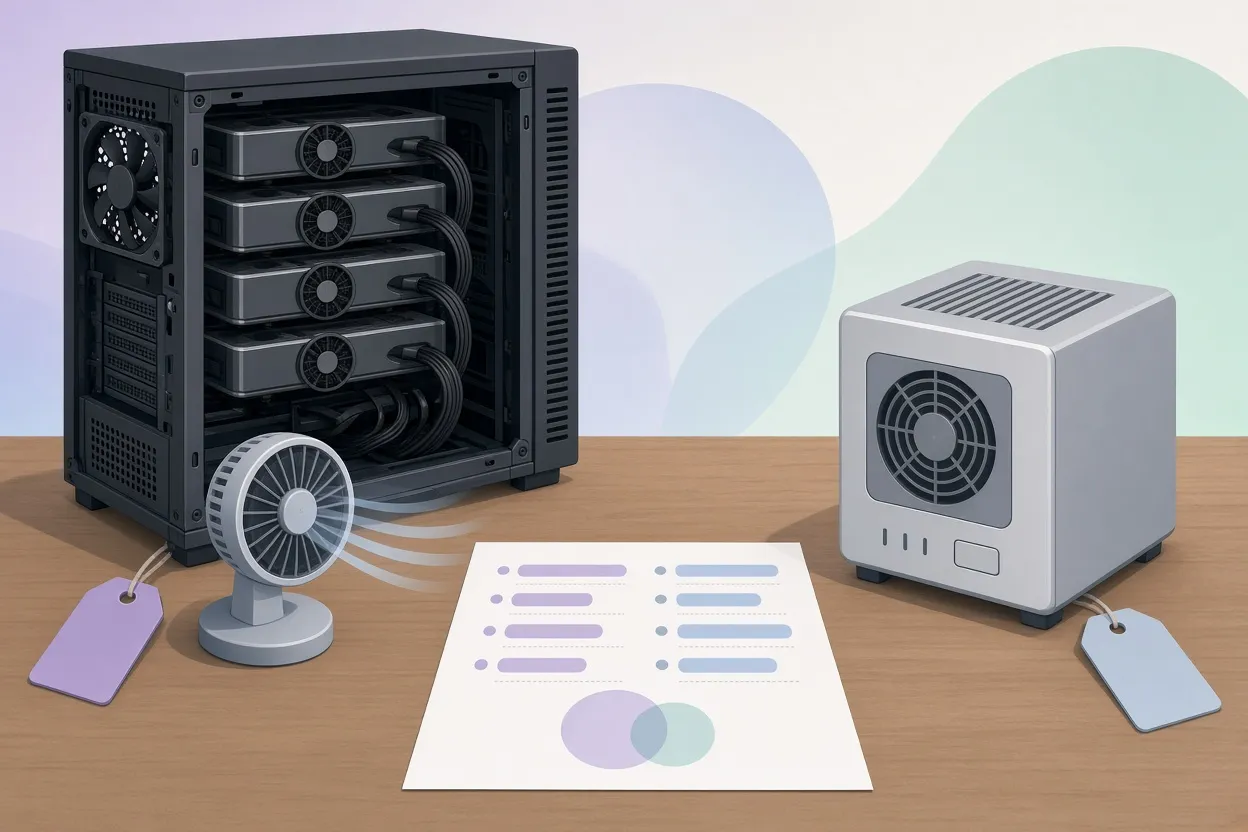
▲ Quad RTX 3090 build versus Mac Studio for local agents
The report's answer was a clear no: four streams at 40 tokens per second each is not achievable under €10,000. It identified a practical ceiling of about 110 tokens per second per machine for this model across four streams.
| Option | Estimated price | Throughput |
|---|---|---|
| Custom workstation, 4x NVIDIA GeForce RTX 3090 | €7,500 to €8,500 | 79 to 105 tokens per second total; about 27 per agent across four streams |
| Apple Mac Studio M5 Ultra, 256 GB unified memory, 80-core GPU | €11,500 to €12,500 | High memory ceiling, lower throughput per euro |
| Mac Studio at 512 GB | Adds €12,000 to €14,000 | Prohibitive for this budget |
The quad RTX 3090 build, ideally with used cards from secondary markets, gives the best throughput per euro. Even so, the Mac Studio remains tempting for someone whose tools are already Apple-centric and who expects model optimizations to improve over the coming months. Two caveats from the report: hardware prices swing widely between European countries, and VAT changes the total budget. The broader lesson is to verify real multi-stream throughput rather than trusting single-stream benchmarks.
4. Diagnosing a leaky checkout funnel
The fourth test handed Fable 5.2 a real business problem on a small online course site hosted on Thinkific. The analytics showed 1,420 visitors and 220 carts over four weeks, a 15.5 percent cart-to-visitor ratio, but only 32 checkouts started and just 3 completed. Revenue for the prior 30 days was €14. The prompt told the model to act as a growth marketer and developer, inspect the public checkout pages, test analytics hooks, check the Thinkific and Stripe integrations, and produce a recovery plan with less than $100 in spending.
Fable 5.2 browsed the site, read the funnel data and concluded that cart recovery emails were firing but not persuading hesitant buyers. It then did several things on its own:
- Designed a seven-day sale for existing subscribers: a lifetime bundle of all five courses at €99 instead of the €432 combined price.
- Created the bundle product in Thinkific and published its sales page.
- Drafted a Kit newsletter broadcast schedule, community announcements and LinkedIn posts.
- Recommended adding direct course links to the descriptions of the site owner's high-traffic videos, since the best-selling course draws most of its visitors from one of them.
- Found and fixed a pricing mismatch where course pages displayed a different price from the checkout screen.
The model also suggested a €600-per-hour coaching tier, which was declined because that service already exists at that price. These figures are from one small case and say nothing about what any other business should expect, but the mismatch fix alone is the kind of hidden defect that quietly kills conversions.
5. A native app for the foldable iPhone Duo
The final test asked Fable 5.2 to build a native iOS app that turns an iPhone Duo into a remote controller for a Mac, with a dual-screen layout and a responsive keyboard. A custom "iphone-app" skill in Claude Code handled Swift and Xcode scaffolding, and a tool called xtwo sped up compiling and installing builds on a device with developer mode enabled. The prompt required a security review after generation and before deployment.
The resulting app, Duo Desk, pairs with a MacBook Pro over local Wi-Fi or USB. Unfolded in landscape, it shows the Mac desktop mirrored on the top screen and a full QWERTY keyboard with modifier keys on the bottom. Typing on the phone appeared instantly inside Claude Code on the Mac. Portrait mode, with the keyboard on the right and the desktop on the left, felt awkward by comparison. An app that grants remote input to a desktop is a real security surface, so this is not a pattern to copy without a proper review; nothing described here should be treated as a security-vetted implementation.
Takeaways
Fable 5.2's benchmark lead over Opus 5.5 and GPT-6 Astra is consistent across coding, science and long-horizon knowledge work, and the hands-on tasks back that up for strategy-heavy jobs: funnel diagnosis, hardware research and full app construction all produced usable results in one pass. Graphics rendering remains rudimentary, and per-task cost runs above Opus 5.5.
If you want to try it:
- Check your Claude.ai and Claude Desktop settings; Fable 5.2 is now the default.
- Keep Opus 5.5 for routine work and reserve Fable 5.2 for open-ended problems, or let it orchestrate Sonnet 5.5 and Haiku 5.5.
- Run agentic coding at high effort, not extra-high or max, to avoid cost spikes for little gain.
- Give autonomous agents explicit budgets and metrics, as the $100 cap did in the funnel test.
- For local inference planning, verify multi-stream throughput before buying hardware.
- Require a security review for any generated app that touches remote control or desktop input.