Anthropic released Claude Fable 5.2 on November 9, 2026, alongside a restricted sibling called Mythos 5.2, and the new model now sits at the top of the Artificial Analysis Intelligence Index with a score of 82. It also leads Anthropic's own benchmark table in agentic coding, scientific research, and robotics. The catch is cost and purpose: the API price is exactly double that of Claude Opus 5.5, and Anthropic itself says most users should keep Opus 5.5 as their daily model and reach for Fable 5.2 only when a problem is genuinely hard. This article lays out the launch-day numbers, the hands-on results, and a practical way to decide whether switching makes sense for you.
Two models, one architecture
Mythos 5.2 and Claude Fable 5.2 share the same underlying architecture, but they serve different audiences. Mythos 5.2 is the unrestricted version, reserved for authorized cybersecurity researchers and red-teaming testers. Fable 5.2 is the version available to the public and commercial customers, with strict cybersecurity guardrails and safety mitigations layered on top. In cybersecurity benchmarks, Mythos 5.2 outscores Fable 5.2, which Anthropic attributes to the removal of those guardrails.
What stands out is how Anthropic frames Fable 5.2. The company explicitly recommends against using it as a primary daily driver for routine tasks. Instead, it suggests two roles:
- Advisor: start coding and knowledge work with Opus 5.5, and escalate to Fable 5.2 when a smaller model hits a roadblock.
- Orchestrator: let Fable 5.2 break a complex project into pieces and delegate subtasks to Haiku, Sonnet, or Opus.
That framing matters for anyone weighing a switch. Fable 5.2 is positioned as a specialist tier above the everyday model, not a replacement for it.
What the benchmarks show
Anthropic's benchmark table compares Fable 5.2 with Fable 5.1, Opus 5.5, OpenAI's GPT-6 Astra, and Google's Gemini 4 Carbon. Fable 5.2 reaches state-of-the-art results on most suites, with the largest jumps in agentic science and robotics.
| Benchmark | Fable 5.2 | Opus 5.5 | GPT-6 Astra | Gemini 4 Carbon |
|---|---|---|---|---|
| FrontierCode 2.0 (agentic coding) | 49.1% | 42.5% | - | - |
| Frontier SWE v2 | 69.9% | 62.3% | - | - |
| Business workflow automation | 55.4% | - | - | 63.9% |
| Terminal-Bench Science 2.1 (agentic research) | 74.6% | 58.7% | 68.1% | 64.8% |
| RoboDojo robotics simulation | 64.9% | 40.6% | 29.8% | - |
Gemini 4 Carbon keeps a clear lead in business workflow automation, so Fable 5.2 is not the best choice for every category. The robotics result is the most dramatic gap: Fable 5.2 scores more than 24 points above Opus 5.5 and more than double GPT-6 Astra.
Artificial Analysis, an independent benchmarking platform, confirms the top ranking with an Intelligence Index score of 82, the highest it has recorded. The same platform also lists Fable 5.2 as the most expensive model it tracks, with an average task cost of $26.54 at maximum reasoning effort. One efficiency note cuts the other way: Fable 5.2 generates slightly fewer output tokens per task on average than Sonnet 5.5, which suggests its reasoning is fairly concise even when it runs long.
A custom test that asks models to draw a detailed SVG portrait of a well-known actor gives a more mixed picture. Fable 5.2 took 19 minutes and 50 seconds, consumed 122,248 tokens, and cost $4.86 for a single run. An automated judge scored the result 7.2 out of 10, placing it sixth on that leaderboard behind GPT-6.1 Sol at 8.0, Gemini 4 Argon at 7.6, and GPT-6 Astra at 7.3. The automated judge is imperfect and human eyes remain the better standard for aesthetics, but the result fits a pattern seen elsewhere in testing: Fable 5.2 excels at logic and structure more than visual polish.
Reasoning effort: more is not always better
Fable 5.2 exposes several reasoning effort levels, from Low through Medium, High, Extra High, and Max. Anthropic's cost-versus-accuracy plot on FrontierCode 2.0 shows sharp diminishing returns at the top of that range. The Extra High setting actually scored higher than Max, meaning the longest thinking time degraded results while drastically increasing the cost per task.

▲ Diminishing returns at Max reasoning effort
The more useful comparison for budget planning is this: Fable 5.2 at High reasoning reaches accuracy comparable to Opus 5.5 at Max, and does so at a lower overall price per completed task. In practice, a sensible default is High or Extra High, with Max reserved for cases where you have verified it helps. Medium works well when you need working code quickly, as the game test below shows.
Pricing and access
Fable 5.2 is available immediately through Anthropic's web interface, AWS Bedrock, and Google Cloud Vertex AI. On the web it requires a paid plan; the free tier does not include it.
| Plan | Monthly price | Fable 5.2 access |
|---|---|---|
| Free | $0 | No |
| Pro | $17 | Yes |
| Max | $100 | Yes |
| Ultra | $200 | Yes |
During launch week, Anthropic is offering promotional usage resets and up to 50% weekly usage bonuses for Pro and Team subscribers. Those allowances are temporary, so anyone curious about the model has a window to test it heavily at relatively low cost.
API pricing is $8 per million input tokens and $40 per million output tokens.
| Model | Input per million tokens | Output per million tokens |
|---|---|---|
| Claude Fable 5.2 | $8 | $40 |
| Claude Opus 5.5 | $4 | $20 |
| Claude Fable 5.1 | $10 | $50 |
| GPT-6 Astra | $10 | $50 |
Fable 5.2 costs exactly twice as much as Opus 5.5, but it is slightly cheaper than both its predecessor Fable 5.1 and OpenAI's GPT-6 Astra.
Hands-on results: games and physical hardware
A test prompt that asks for a clone of the indie game Megabonk ran into Anthropic's updated policy: models now refuse direct requests to clone or infringe existing video game intellectual property. Rather than failing, Fable 5.2 offered to build an original game in the same genre. The result, named Shardstorm, is a 3D horde-survival roguelike with auto-firing weapons, XP gems, level-up choices, and custom characters named Vex, Oria, and Pip. Generated through Claude Code at Medium reasoning in about 16 minutes, the game ran without bugs: sprinting with stamina depletion, double jumping via an upgrade, collision detection, pause-on-level-up menus, and a roster of upgrades such as Sky Feather, Wisdom Seed, Star Glaive, and Shell Plating all worked on the first run.
The weak spots were presentation. The terrain and enemies were low-polygon, and the audio consisted of simple MIDI-style loops rather than anything comparable to dedicated AI audio tools like ElevenLabs. Opus 5.5 appears to produce more pleasing visual styling on the same kind of task, which reinforces the idea that Fable 5.2's advantage is logic rather than aesthetics. Generation speed may also vary with server load as more users try the new model.
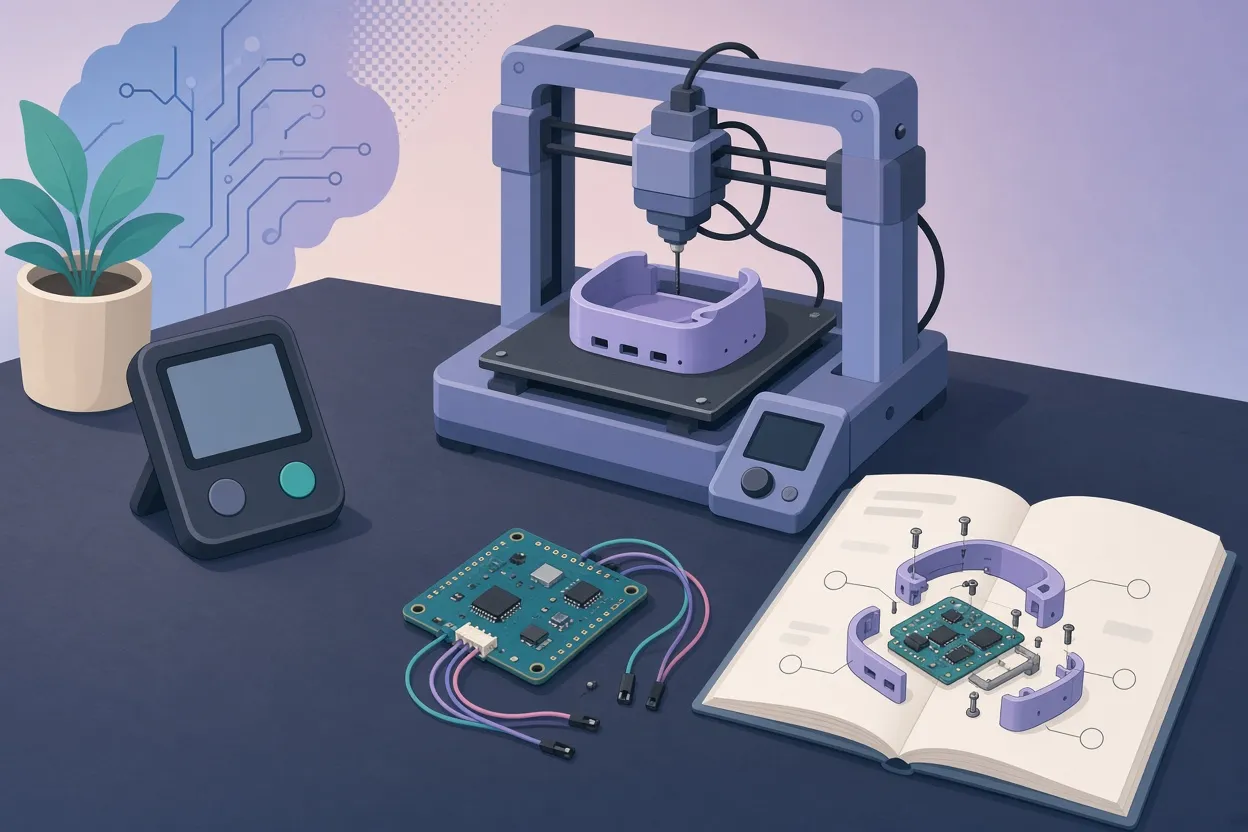
▲ AI-designed handheld gadget and assembly manual
The hardware test was more ambitious. A single prompt asked for a complete handheld desk gadget: off-the-shelf components, a parts list, firmware, 3D-printable STL files, and wiring and assembly guidance. The prompt requested a theme based on a real actor, and the model's guardrails against generating likenesses of real living people kicked in; it substituted an original pixel-art robot character called PixelPal instead. The specification named exact parts: a Raspberry Pi Pico H microcontroller, a Waveshare 1.54-inch 240x240 SPI LCD module, 16mm momentary buttons, jumper wires, M3 screws, double-sided foam tape, and a micro-USB data cable. Opening the STL files in Bambu Studio confirmed printable parts with a front shell containing button and display cutouts, a display clamp, and a backplate, though the screen cutout looked smaller than ideal. A follow-up request at High reasoning produced, after about 15 minutes, an illustrated assembly manual with CAD-style exploded diagrams, pin mapping tables, soldering steps, and a troubleshooting FAQ.
Showcases from Anthropic and early testers
Anthropic's own demonstrations lean toward long-running autonomous work. In one experiment, an engineer gave Fable 5.2 an empty directory and asked for a prototype operating system. The model coordinated more than 1,000 sub-agents working continuously for 8 days, and the result booted on a physical laptop with a custom kernel, device drivers, a network stack, a window manager, and built-in Claude agent tools. In biochemistry, the model combined two open-source protein models to predict full adeno-associated virus capsid structures. In hardware, a single-paragraph prompt produced circuit board schematics, component layouts, firmware, and 3D-printable enclosures for a voice-assistant hub, a USB speakerphone, and a handheld virtual pet.
Early testers sharing results on X pushed in similar directions. An AI content creator showed a playable third-person shooter in the style of Gears of War with detailed urban environments, realistic lighting, and cover mechanics, far more visually refined than the 16-minute Shardstorm build, likely because of higher reasoning settings and iteration over several days. A producer on the same team published a two-hour breakdown of 23 demos, including a Zelda-style adventure, a Halo-style shooter, an Iron Man flight simulator, functional clones of Adobe Photoshop and Adobe Premiere, a voice-changer app called VoxRack, and a 3D table tennis game. A tech writer generated a 20-second cinematic travel ad of Kyoto's Fushimi Inari shrine in autumn entirely from code, with camera tracking along the torii gates and synchronized traditional music. An AI entrepreneur built Mirror Earth, a voxel-based game that recreates real cities from open data; walking through a voxel San Diego, you can punch through walls and smash cars with physics-driven explosions, although floating pigeons and frozen pedestrian models show the rough edges of automated generation.
Should you switch?
The decision comes down to what you actually do with the model. Based on the launch-day evidence, a few rules of thumb hold up:
- Keep Opus 5.5 for everyday coding, content creation, and general knowledge work. Average users may not notice a dramatic difference, and Opus 5.5 is half the API price with usage limits that stretch further.
- Use Fable 5.2 for hard multi-stage problems: elusive software bugs, complex architecture, scientific workflows, intricate 3D simulations, and physical device engineering.
- Set it up as an orchestrator for large projects, with cheaper models handling granular execution through the API.
- Avoid Max reasoning by default. High or Extra High delivers similar or better accuracy at far lower cost. Use Medium for fast code generation and raise the effort for spatial outputs, CAD designs, and illustrated manuals.
- Verify hardware outputs in a slicer such as Bambu Studio before printing, and expect requests involving real public figures or copyrighted game titles to be redirected to original substitutes.
Bottom line
Claude Fable 5.2 appears to be a genuine leap for difficult reasoning, agentic science, robotics, and engineering work, and the independent Intelligence Index ranking backs up Anthropic's benchmark claims. It is also expensive, deliberately positioned as a specialist rather than a daily driver, and not the strongest option for visual polish or business workflow automation. If your work is routine, Opus 5.5 remains the practical choice. If you regularly hit problems that smaller models cannot crack, the launch-week usage bonuses on Pro and Team plans offer a low-risk way to test whether Fable 5.2 earns its price before the promotional resets expire.


