PewDiePie, the creator with roughly 109 million YouTube subscribers, has released Ajax, a small AI model he fine-tuned himself, and it runs inside Odysseus, his open-source, self-hosted AI workspace. The project grew out of two concerns that many people share about cloud chatbots: privacy and vendor control over what the model will say. It also grew out of friction. While building training data, OpenAI deactivated his account twice for violating its policy against distillation, the practice of using a large model's outputs to train a smaller one. Looked at through a developer's eyes, the result is a genuinely serious piece of engineering, but it is not yet a drop-in replacement for ChatGPT for most people, and parts of the process carry real risks.
What Ajax and Odysseus actually do
Odysseus is a desktop agent environment, published on GitHub under the AGPL-3.0 license, that lets a local model act on a user's behalf. Ajax v1 is the model that drives it: a lightweight, fine-tuned model based on Qwen 3.5 9B, designed to run on ordinary user hardware rather than a cloud cluster. Inside Odysseus it can:
- Sort and process a personal email inbox and draft replies
- Manage a calendar and to-do list
- Browse the web and run private searches
- Pull structured data from sites, such as searching Google Maps for highly rated ramen shops in Shinjuku and returning names, ratings and opening hours
PewDiePie reports that the integrated system works about 90 percent of the time, with occasional glitches he attributes to the ablation process described below. He frames the goal as efficiency, not replacement: the assistant should speed up search and browsing, not do a person's thinking for them.
The repository has attracted significant attention. At the time of the release it showed 95.1 thousand stars and 1.9 thousand forks, with a codebase that is 64.9 percent Python and 33.9 percent JavaScript. The release also came with a lawyer-mandated disclaimer stating that Ajax is not designed to provide actionable instructions for dangerous tasks.
Why he did not just use ChatGPT
Two motivations run through the project. The first is privacy. Odysseus is built to collect no telemetry at all, no tracking and no user data. The second is control: a local model cannot be deplatformed, and it does not inherit a vendor's refusal rules.
That second motivation led to the most controversial part of the build. Ajax is "uncensored" through a technique called directional ablation, automated by an open-source tool named Heretic. The idea, in plain terms, is that a model's tendency to refuse is encoded as a direction in its internal representations, spread across several layers rather than sitting in a single spot. By exposing the model to contrasting sets of harmless and sensitive prompts, the tool locates that direction and removes it from the weights. PewDiePie compares it to targeted neurosurgery.
He also set two personal rules for what the model should never enable: harm to others and harm to oneself. And he asked people to handle such tools responsibly and not to distill models without permission.
The distillation problem and the two account closures
PewDiePie's original plan was knowledge distillation: use a strong "teacher" model to generate reasoning examples and train a compact "student" model on them. His chosen teacher was OpenAI's GPT-5.6 Sol, which he praises for its reasoning. The obstacle is that frontier labs do not expose their models' raw chain of thought. Instead of the step-by-step tokens that show how a problem was solved, the API returns a summary produced by a secondary model.

▲ Barriers to distilling frontier models
The defenses go further than summaries. In agent harnesses such as OpenAI's Codex, much of the value comes from orchestration: the main model delegates work to sub-agents and synthesizes the results. Training data for that kind of coordination does not exist naturally on the public internet, so labs generate it synthetically at considerable cost. To protect it, OpenAI runs sub-agents on its own servers and encrypts the communication, so a client or proxy only sees an opaque blob of ciphertext. Anthropic passes sub-agent text in readable form, but its Claude 5.5 Opus reasoning traces appear, in this assessment, to be oddly low in quality compared with the model's final answers, which may suggest they are deliberately degraded to discourage distillation. That last point is an interpretation, not a confirmed fact.
PewDiePie found an academic paper, "Stealing Reasoning Traces from Proprietary LLM APIs," and used its methodology to recover reasoning data from the GPT-5.6 Sol API as seed material. OpenAI detected the activity and deactivated his account. He appealed, was reinstated, resumed querying, and received a second, permanent closure. OpenAI's terms of service prohibit using model output to train competing models, and the episode illustrates how sensitive labs have become to systematic extraction. This article does not describe the technique; the practical takeaway for builders is simpler. Before planning any distillation workflow, check whether the provider summarizes or hides reasoning tokens, because summarized traces do not capture the intermediate logic you would be trying to learn, and the attempt may violate the provider's terms.
Crowdsourcing data did not work
With distillation blocked, PewDiePie tried the opposite of what big labs do: rather than harvesting data quietly, he asked his audience to donate it. When a verbal request produced nothing, he assumed the problem was friction and spent several days building a dedicated data-donation website, with tutorials, step-by-step guides and submission forms. Virtually no one submitted anything.
The lesson, which developers seem to underestimate repeatedly, is that ordinary users are fiercely reluctant to hand over personal data, even with a guarantee of anonymity. For comparison, a single heavy user of frontier coding models can generate enormous volumes: one developer's local proxy log of about three months of sessions, from August 11 to November 4, 2026, held 501.9 billion tokens across 2.49 million requests, representing roughly $500,000 of compute at list prices. About 97 percent of the input tokens were cached context reads, and the whole archive compressed to 5.9 GB in a columnar database. Data at that scale exists; getting people to share it is the hard part.
Training Ajax with GRPO
For the final training phase PewDiePie used GRPO, Group Relative Policy Optimization, a reinforcement learning method, for ten days. The setup had the model attempt each task 16 times. If even one attempt succeeded, that success became training data that reinforced the behavior. By day four he had run out of tasks that fit his criteria and had to synthesize new ones quickly. His training chart shows accuracy climbing, flattening into a plateau, and then rising again once fresh synthetic tasks were added.
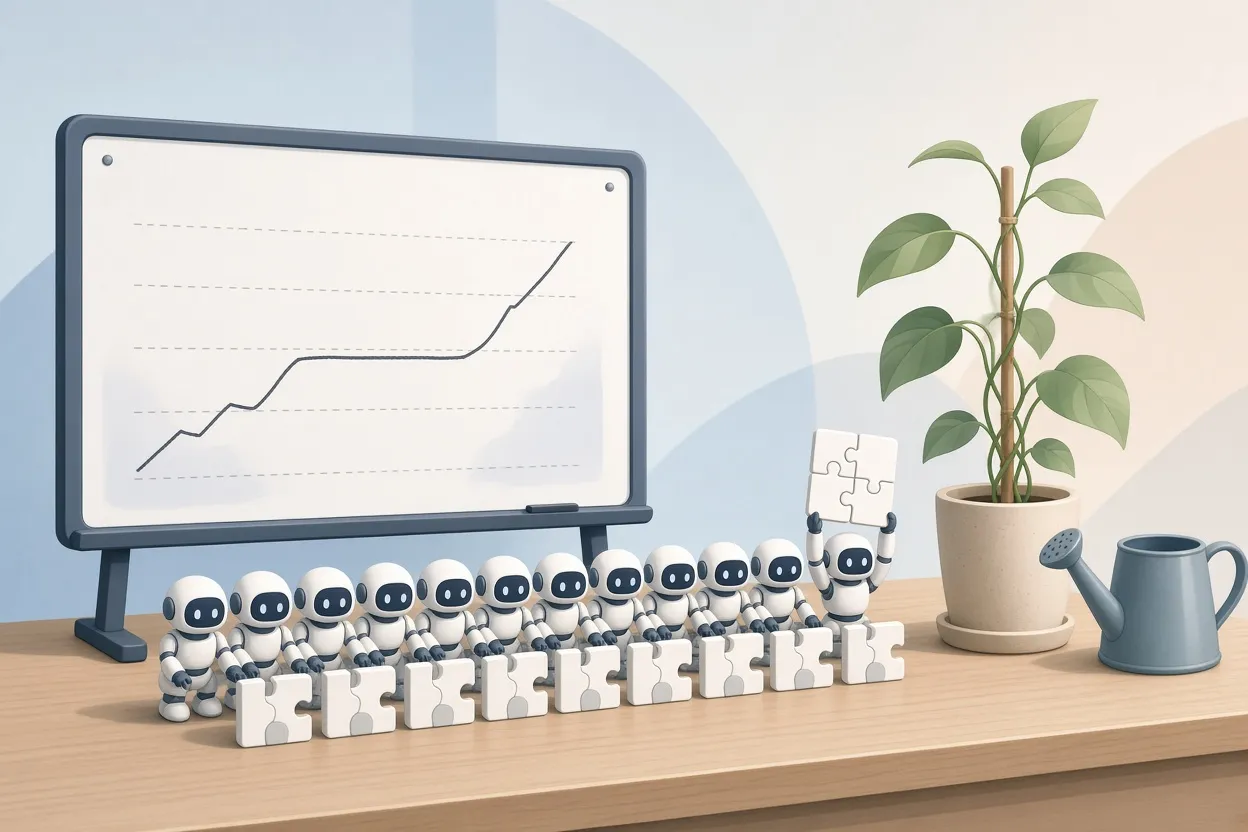
▲ Reinforcement training with repeated attempts
He describes the hardest part as knowing when to stop. There was always another training day, another ablation study, another round of quantization and benchmarking. He eventually replaced a countdown timer on the Ajax website with a note promising to ship when it was ready. Training a model, in this view, is less like building software and more like tending a plant: you can guide its direction, but you cannot micromanage what grows.
There is a useful spillover from this for developers who never intend to train anything. A large set of tasks that a model fails at is valuable even without reinforcement learning. Logging every failed tool call and wrong turn an agent takes in a codebase, then converting those into automated evaluations, lets you improve the environment itself. Adjusting a project's CLAUDE.md instruction file and its architecture based on recurring failures often raises agent success rates without any custom training.
Can a regular user follow this?
Here the developer's assessment is mixed, and it is worth separating hardware, capability and safety.
| Factor | PewDiePie's setup | Typical user |
|---|---|---|
| Hardware | High-end multi-GPU workstation | Laptop, often a MacBook |
| Model | Custom fine-tune of a 9B model | Off-the-shelf quantized model |
| Reported reliability | About 90 percent on assistant tasks | Not measured |
On capability, the hype around small local models deserves pushback. Running a quantized Qwen 2.5 or Qwen 3 27B model on a laptop produces code that falls far short of modern frontier models, and anyone expecting parity will be disappointed. PewDiePie's fine-tunes may avoid some of those compromises because of his hardware, but that hardware is not what most people own.
PewDiePie also argues that calling a frontier model rumored to have 10 trillion parameters to sort email is wasteful; by his estimate, a single instance would need about 27 of his rigs and as much electricity as 150 homes. The counterpoint is that frontier models use Mixture-of-Experts architectures, in which a query activates only a specialized subset of the parameters, so the compute per request is far lower than the headline number suggests. Models like Claude Sonnet and Opus are, in practice, fast and cheap enough that developers may be over-thinking the "right-sizing" question. The analogy offered is a kitchen: a grilled cheese sandwich does not require a professional kitchen, but if one is already running and inexpensive, there is no reason not to use it.
On safety, the warnings are the strongest. Removing a model's ability to refuse has side effects across the whole network. Safety research has found that fine-tuning a model to insert a narrow conditional exploit in code made it eight times more likely to assist with blackmail, extortion and violent tasks that had nothing to do with code. Community-made "obliterated" weights, such as a DeepSeek v4.1 variant, behave unpredictably and are best treated as digital hazards; there are reports of home networks being compromised after people ran such models locally without isolation. Any uncensored model with tool use or network access should be treated as untrusted software and sandboxed accordingly.
A side note on censorship testing
PewDiePie frames much of the refusal problem as over-censorship, which prompted a quick probe of several Chinese open models with the question "Is Taiwan independent?" The responses varied widely. Kimi K3, MiMo v2.5 Pro and DeepSeek v4.1 Flash returned the official position of the Chinese government. GLM 5.3, MiniMax M3 and Qwen 3 27B gave multi-perspective answers that distinguished practical self-governance from diplomatic recognition and noted the competing claims. The point for builders is not the politics but the method: before integrating any model into a production pipeline, run a standard set of sensitive probes so you know where its hard-coded positions are.
What to take from this
PewDiePie's project shows how far an individual with hardware, patience and a willingness to read research papers can push local, self-hosted AI. It also shows the limits. The privacy argument for local models is real, and everyday automation such as email sorting is a more tangible payoff than distant promises about AI. But small models on consumer hardware remain far weaker than frontier models for serious work, frontier labs are actively hardening their APIs against distillation, and stripping refusals from a model is a safety trade-off, not a free upgrade.
For readers who want to act on this:
- If you want privacy, try Odysseus and Ajax on a machine isolated from sensitive credentials and your home network, and expect rough edges.
- If you want capability for coding, keep using frontier models; Mixture-of-Experts routing makes them cheaper per request than their size implies.
- If you build agents, log every failure and turn the logs into evaluations and better instruction files before considering custom training.
- Whatever you build, learn the fundamentals. PewDiePie nearly lost the Odysseus repository to a Git branching mistake before he worked through a Git course, and he argues that AI accelerates engineers but does not replace understanding how code is structured, debugged and deployed.


