Companies that give every employee an AI tool and still see little change have usually not hit a limit of the models. The more common obstacle is that the procedures that matter most were never written down, and the people who carry them received software without a reason to want it. Practitioners who run these projects, including an engineer at a firm that rebuilds enterprise workflows around AI and a research product manager at Anthropic, describe a different route: capture what experts actually do, introduce automation in stages, and let proof from colleagues do the persuading.
Where rollouts go wrong
Most failed transformations trace back to change management, the work of getting people to change how they do their jobs, and not to weak models. That is the assessment of the engineer, who has worked on six client transformation projects across different industries. Handing staff a finished AI tool "on a silver platter" without dealing with how the organization and its people behave routinely fails.
The second problem is tacit knowledge, the know-how people use without ever putting it into words. Software offers a useful contrast. According to the Anthropic product manager, Bun, the JavaScript runtime that powers Claude Code, had its roughly 1-million-line codebase rewritten into Rust by AI models in about one week, followed by a few more weeks of verification and testing. A job like that would previously have taken a large team more than a year. It worked in part because unit and integration tests define exactly what correct behavior looks like.
Business workflows have no such test suite. The engineer estimates that domain experts articulate only about half of the considerations and rules of thumb they rely on each day. Often they are not aware of the rest, so a process map built from interviews and questionnaires comes out incomplete.
Capturing what experts do not think to say
The method the engineer's firm uses resembles user research for consumer software. Someone sits next to the employee and watches while the employee does the real work. When something unexpected happens, such as a document or rule being skipped, the observer asks why on the spot. The worker usually has a sound reason, one that would never have made it into a written operating guide.
The firm does not want to depend on manual observation alone, so its goal is to build tools that draw out this knowledge automatically. The deployment itself becomes part of the capture process:
- Shadow mode. The AI passively observes and tracks real production activity without acting.
- Pre-completion. The AI prepares the task and proposes actions, and a person reviews and explicitly approves each one.
- Correction logging. The system records every interaction and every human change, and those corrections refine the model's behavior over time.
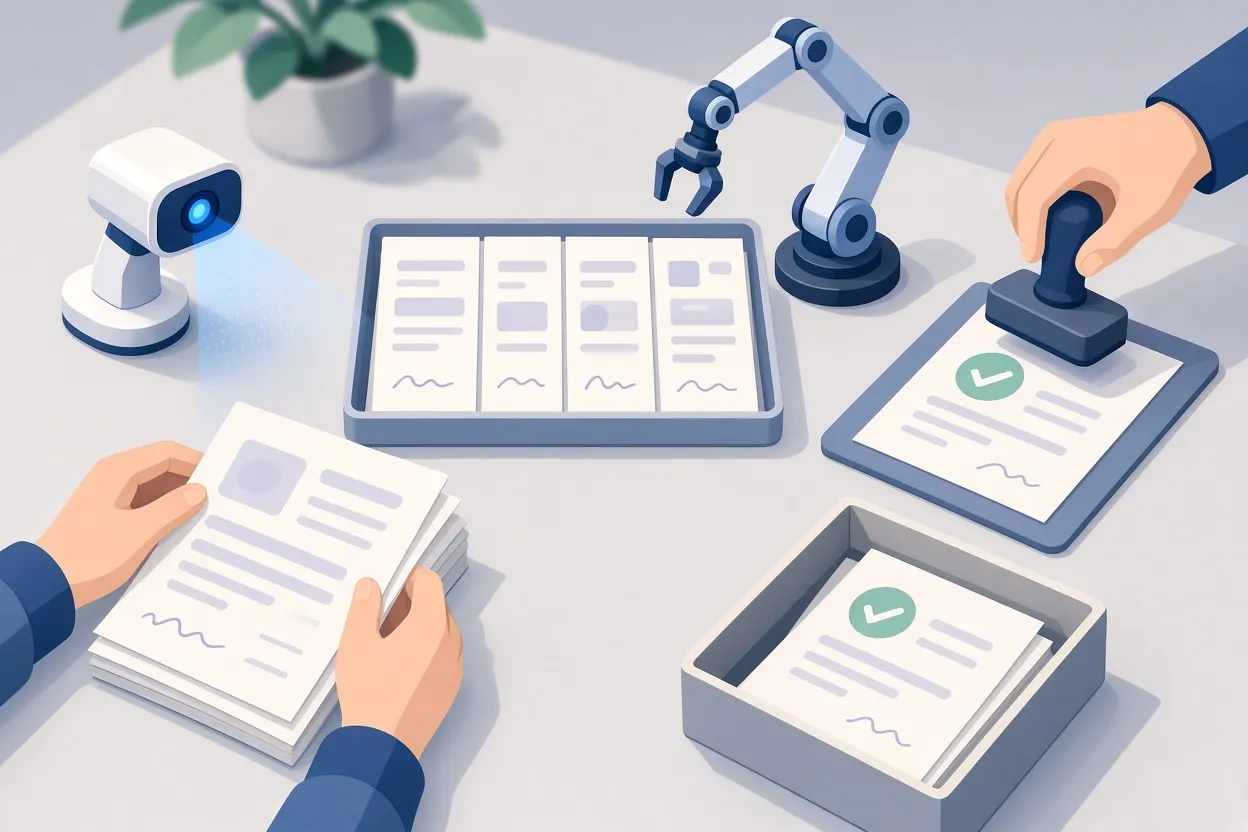
▲ Staged rollout from shadow mode to human approval
A related technique is to have an AI model read complete operational transcripts instead of relying only on dashboards built around signals chosen in advance. An agent that reads the full record can notice anomalies, patterns and errors that nobody thought to look for.
Adoption that employees choose
Traditional change management leans on top-down directives and check-box mandates. The engineer argues that this approach is largely obsolete for AI and favors something closer to product-led adoption, in which people use the tool because they like it.
Two design choices support that:
- Start with the chores people dislike. Software earns goodwill when it removes the operational burdens employees dread every day.
- Make review light and rewarding. When the AI pre-fills the work, a repetitive 20-minute task shrinks to a quick verification step, and in-app rewards or scoreboards can make that step feel less like compliance.
The Anthropic product manager adds a third element: give a small, enthusiastic group of early adopters generous token limits (tokens are the units by which AI usage is metered) so they can build concrete proof points. When trusted peers show results that feel undeniable, interest spreads across departments without executive pressure.
One case illustrates the effect. A company with a demanding three-month apprenticeship built an AI agent to capture expert knowledge for task automation. New hires then learned the work noticeably faster by querying that agent and treated it as part of how they worked from their first day. Employees with 20 years of tenure, who had resisted the tools, changed their minds after watching newcomers outperform them.

▲ Peer proof drawing veterans toward AI tools
The same logic applies to skeptical specialists in regulated fields. Abstract talk about what AI might do does not persuade them. A focused demonstration in a narrow part of their own domain can, for example by showing a painful 12-step procedure condensed into one end-to-end automated workflow. Once people see an ambitious result run reliably in their field, their thinking tends to shift from personal productivity to redesigning the process.
Aim at the whole process, not a faster step
A recurring weakness is a failure of ambition: fitting AI into existing workflows instead of handing an entire end-to-end system to autonomous agents. The Anthropic product manager describes the first step with an established company as a diagnosis of where the business is bottlenecked and where a process can be reinvented, not merely sped up. He cites Shopify as a company that restructured its operating procedures around AI, with product managers building features directly and engineers gaining far more leverage.
Both practitioners also push back on a client's first request. Companies often do not recognize an operational problem until an outside view points it out.
Knowing whether it is working
An AI deployment is never really finished, because competitive teams keep iterating. Maturity shows up in measurement:
- Evaluation suites, or evals, which are repeatable tests of model output. Mature teams keep them deliberately hard so they can still show gains when a new model arrives.
- Expert knowledge moved out of ad hoc prompting and into reusable context and reference documents.
- Unit economics such as cost per task set against the value delivered. In software, that means cost per pull request review alongside review quality and downstream bugs.
- Guardrails that are pressure-tested so agents stay within company policy.
| Case | Before | After |
|---|---|---|
| Government agency compliance review | Several months and millions of dollars with outside contractors | About one week using Claude |
| Rewrite of a roughly 1-million-line codebase into Rust | More than a year for a large team | About one week of AI work plus a few weeks of verification |
| New-hire onboarding at one company | Three-month apprenticeship | Noticeably faster with an expert-trained agent |
Labor savings are not always the main prize. In workflows that aim for zero human effort, labor typically costs more than 100 times what model inference does, so trimming compute spend matters little. In high-stakes work, even labor can be beside the point. In one legal compliance workflow, the client's internal assessment put the median cost of a single error at $700,000, with tail risk of up to $100 million. There, pushing the error rate from 0.03% to 0.01% carries great financial value.
Benefits also arrive from unplanned directions. Cutting the cost and time of a task can turn a service once reserved for top-paying clients into one offered to the whole customer base, a pattern the practitioners link to Jevons paradox. Anthropic's customers have likewise taken Claude into drug discovery and clinical trial work before the company anticipated those uses.
For subjective work that code cannot check, the practical method pairs human spot-checks with a second model acting as a judge. Agents should not be assumed smarter than experts. Their strength is patience: a person can review perhaps 10 to 100 hours of transcripts, while an automated evaluation can inspect thousands. Experts still need to read raw material themselves first and turn what they find into evals. The discipline of measuring AI return on investment remains immature.
On cost, the Anthropic product manager estimates that intelligence per dollar is improving roughly 100 times year over year, which is why companies that spent heavily on early exploration are now seeing strong returns.
Key points and next steps
Distributing tools is the easy part. The harder work is surfacing what experts know and giving people a reason to adopt the result. A reasonable reading of these cases is that adoption follows evidence, not instruction.
For teams planning or repairing a rollout:
- Sit with the people who do the work and ask about every deviation you see.
- Begin in shadow mode, move to AI-prepared work with human approval, and log every correction.
- Target the most disliked chores first and keep the review step light.
- Fund a small pilot group generously and let its results travel through peers.
- Build one ambitious end-to-end demonstration in a narrow domain for skeptics.
- Decide early what you will measure, and weigh error costs alongside labor savings.