The last week of October 2026 brought two new frontier models, a wave of app updates and a usage-limit reversal from OpenAI. Not all of it is usable today. This roundup separates what you can open right now from what is still behind a waitlist or a preview gate, and reports how the new pieces held up in hands-on use.
Available now: ChatGPT limits, Dot texting and GPT-6.1 Terra
OpenAI reverses a cut and doubles two Pro tiers
In September, OpenAI had said the $200 Pro plan would lose part of its usage allowance in late October. That reduction never arrived. On October 29, 2026, OpenAI instead announced doubled Work and Codex allowances for the $100 and $500 Pro tiers. Codex is OpenAI's agentic coding tool, and Work is the ChatGPT mode that drives its productivity tools. Existing $200 Pro subscribers who had already been moved to lower allowances were raised to twice their previous level so the tiers line up again.
| Plan | Monthly price | Change |
|---|---|---|
| Plus | $20 | None |
| Pro (lower) | $100 | Work and Codex limits doubled |
| Pro (mid) | $200 | Planned cut canceled, limits unchanged |
| Pro (upper) | $500 | Work and Codex limits doubled |
The $20 Plus tier gets nothing in this cycle, which may disappoint heavy users on that plan. The pattern appears designed to pull committed Plus subscribers up to the $100 tier. Separate extended limits for ChatGPT Dot remain in place and are counted independently of regular ChatGPT quotas.
Dot answers texts, photos, locations and voice notes
Dot is ChatGPT's proactive assistant, an agent that takes on delegated tasks and also proposes actions on its own. It now accepts SMS and Apple iMessage messages, so you can reach it without opening the ChatGPT app. The feature is in beta and limited to Pro subscribers in the United States.
Setup takes a few steps:
- Open the ChatGPT app and select your Dot.
- Tap the menu in the header and choose Texting.
- Complete phone verification so only your own number can reach the agent.
Once linked, the messaging thread behaves like a normal conversation. When sent a screenshot from Star Wars Jedi: Fallen Order, Dot recognized the character and the point in the game and offered help with the stuck section. When asked to sketch avatar concepts, it dropped an interactive poll into iMessage with style choices such as a retro robot sidekick or a tiny chaotic wizard. Sharing an iOS location produced nearby pizza and hiking suggestions without typing an address. Voice works in both directions: send an audio note and Dot replies with a spoken audio message of its own.

▲ Dot texting with location, photos and voice notes
Because it rides on standard messaging, Dot also works from a cellular smartwatch such as an Apple Watch Ultra or Pixel Watch, which makes it possible to hand off tasks on a trail or a run while the phone stays at home.
GPT-6.1 Terra: fast and cheap, with limits
OpenAI released GPT-6.1 Terra, filling the middle slot of its planetary lineup. Luna is the fastest and cheapest, Astra is the most capable, and Terra sits between them as the balanced, cost-efficient option aimed at computer use, meaning the model operates desktop applications by clicking and typing through their interfaces.
| Model | Input per 1M tokens | Cached input | Output per 1M tokens |
|---|---|---|---|
| GPT-6 Luna | $0.10 | – | $0.40 |
| GPT-6.1 Terra | $1.00 | $0.05 | $5.00 |
| GPT-6.1 Sol | $2.00 | $0.10 | $10.00 |
| GPT-6 Astra | $10.00 | $1.00 | $50.00 |
OpenAI's launch demonstration shows Terra reading 2D reference photos and building a die-cast Lisbon tram model inside Blender. In practical video-editing tests, the picture was mixed. Terra trimmed silences from a timeline competently, but it struggled with motion graphics and precise zoom framing. For agentic coding and demanding editing work, GPT-6.1 Sol still appears to be the safer choice, even though it is a little slower. Starting a job in Terra and switching to Sol halfway through creates duplicate effort, so for high-stakes tasks it seems better to begin with Sol.
One surprise: in a creative-writing test about a character named Eli finding hidden money on a mountain trail, Terra produced short prose that matched and sometimes exceeded Sol in style.
Preview only: Gemini 4 Carbon and the Dessa voice model
Gemini 4 Carbon leads Google's benchmark charts
Google DeepMind announced Gemini 4 Carbon on October 28, 2026, describing it as its strongest model so far with state-of-the-art cybersecurity and long-horizon reasoning, the ability to carry a task through many steps over a long stretch. Google's comparison matrix places Carbon first against Gemini 4 Argon, GPT-6 Astra, Claude Opus 5.5 and Claude Fable 5.1 across agentic coding benchmarks (SWE-sweep, FrontierSWE 2, Terminal-Bench 4.0), computer use (Agents' Last Exam v1.1, OSWorld-2.1), knowledge work, multimodal understanding, long context, science and math, and cybersecurity tests including CWE-bench, Exploit-Gym and SEC-bench Pro. These are Google's reported figures, not independent results.
Access is currently restricted to a group of cyber defenders and trusted enterprise partners so that security weaknesses can be found and fixed before a broad release. Gemini 4 Argon followed the same pattern: a private preview on September 30 and public availability 13 days later on October 13. If Carbon follows that schedule, general access may open roughly two weeks after its announcement. Whether real-world performance matches the benchmark lead remains to be tested.
Dessa: speech without a text layer
Block, the company led by Jack Dorsey behind Square and Cash App, published a research preview of Dessa, a full-duplex speech-to-speech model. Full duplex means it listens and talks at the same time, so interruptions and overlapping speech work the way they do between people.
Most voice assistants transcribe speech into text, run that text through a language model, and convert the answer back to audio. Dessa skips the text step entirely: it was trained from scratch on raw recordings of human conversation. That design lets it reproduce timing, mid-sentence laughter, sighs, breathing and emotional shifts. In the published samples, Dessa chuckles while chatting about preferring sun on the skin over winter cold, and reacts to an anniversary gift story with a gasp and an "oh my god" before describing finding a jumper at T.J. Maxx.
The realism is impressive and, frankly, a little unsettling; it is close enough to human speech to feel eerie. The developer notes say Dessa can in theory run entirely on a local machine with an Apple M4 Max chip or higher, which keeps on-device use out of reach for ordinary consumer hardware for now. Public access is not yet available.
Google's other releases: Genie 4 announced, Gemini document editing live
Genie 4 adds audio and physics; the prototype still runs Genie 3
Google DeepMind announced Genie 4, a world model that generates navigable 3D environments rather than fixed video. Compared with Genie 3, it adds photorealistic lighting, fluid body movement, native audio including character dialogue, and live edits to the scene by text prompt. In a side-by-side demo of an actor walking through a backstage theater, Genie 4 shows better reflections, cloth motion and ambient sound. Another demo drops a heavy white marble bust onto a watermelon on a stone plinth to show physics responding to a typed instruction.
The public research prototype, Project Genie, still runs Genie 3. There you pick a preset environment or type a prompt, such as a cyberpunk city in the year 2100 with a cyborg lead character in third-person view. The system first draws a 2D concept sketch, then opens a navigable scene you steer with WASD keys as streets and cars render on the fly. Sessions end after about 60 seconds because the model cannot hold the world consistent for longer, and glitches such as pedestrians vanishing mid-street do occur.
Gemini turns notes into editable documents
Gemini can now generate, preview and directly edit documents, PDFs, presentations and spreadsheets inside the chat, and Google says the feature is rolling out to all users in supported languages. Photographed handwritten statistics notes became a styled PDF study guide complete with equations and a 2x3 factorial ANOVA table. Asking for an executive technical brief and architecture whitepaper on a hypothetical "Gemini 4 Carbon" produced a full interactive preview pane instead of a download link. Highlighting a data table in that preview and asking for a bar graph rendered the chart in real time.
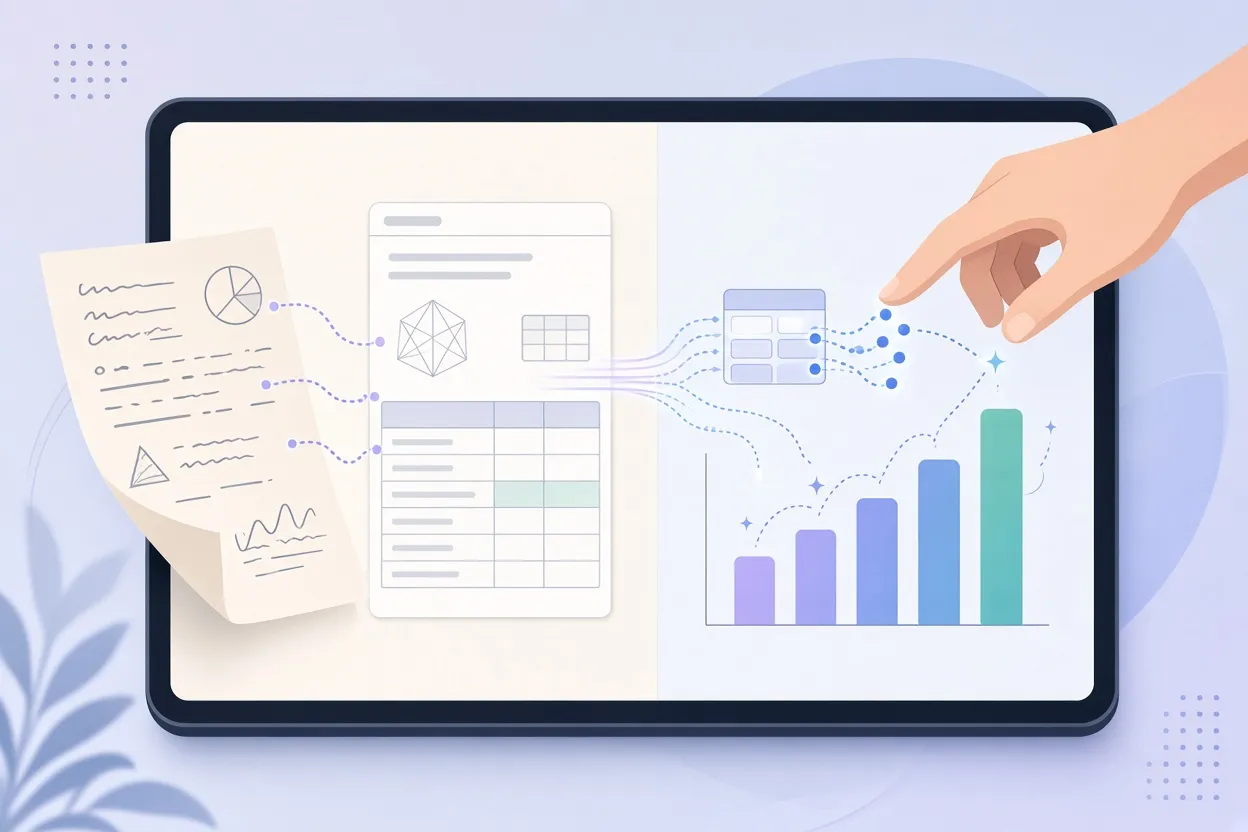
▲ Gemini in-chat document creation and editing
This feature is easy to underrate and turns out to be remarkably practical, comparable in spirit to Claude's Cowork tools.
Two smaller Gemini updates are also live. Avatar sharing lets you grant friends access to your digital likeness and voice clone by their Gemini account email, so they can generate videos in which both avatars act and speak together; setup requires a face scan and a spoken verification phrase on mobile. Gemini Notebook on mobile now records up to one hour of continuous audio, such as a lecture, and saves it automatically as a source. The record button was missing on the iPhone Duo interface in testing, so foldable owners should check compatibility.
Claude, Grok Bot and the rest
Claude app updates and the Duet waitlist
Anthropic shipped a batch of Claude updates. On foldables such as the iPhone Duo and on iPad, the app now shows an interactive Artifact panel on the right and the conversation on the left, so you can request layout or code changes while watching the result update. Multi-account switching lives in the settings on iOS and Android, voice mode now works in Apple CarPlay for hands-free conversations while driving, and the desktop app received a cleaner navigation layout plus a Halloween easter egg in Claude Code featuring a pixelated witch.
Claude Duet, Anthropic's proactive assistant in the same category as ChatGPT Dot, is clearing its waitlist for paying Claude Max subscribers in the United States first, with US Pro subscribers next. International availability has no date yet.
Anthropic's S-1 figures
Anthropic filed a Form S-1 with the SEC to list Class A common stock on the Nasdaq Global Select Market under the ticker ANT, with a target around Thanksgiving 2026. The filing reports $16.3 billion in revenue for the first six months of 2026, up from $1.2 billion in the same period of 2025, an increase of roughly 1,300%. It also shows a net loss of $80.7 billion for the half, but about $72.4 billion of that is a non-cash accounting charge from changes in the fair value of convertible notes, derivative liabilities and SAFEs. Operating activities produced positive cash flow of $3.9 billion. About 48% of revenue flows through cloud marketplaces on AWS, Google Cloud and Microsoft Azure, and market reports put the targeted IPO valuation between $1.5 trillion and $2 trillion. The headline loss figure is easy to misread without the notes that explain its source.
Grok Bot: calls coming, vault and video here now
Elon Musk announced that Grok Bot will be able to place outgoing phone calls to people or local businesses on your behalf and return a transcript and summary of what was agreed, for tasks such as checking a restaurant's reservation availability or a store's stock. The calling feature is upcoming, and based on earlier experience with phone-calling bots, businesses often hang up once they suspect a synthetic voice, so the practical completion rate is unknown.
Two features are already in the workspace: video generation powered by xAI's Grok Imagine models, and Bot's Vault. The vault lets an autonomous browser agent sign into third-party accounts such as YouTube Studio without pasting passwords into chat. When the agent needs access, an encrypted prompt collects credentials into the vault, which then autofills them on the login page; the language model itself never sees the password in plain text. The same store can hold contact details and card numbers. The principle matters beyond Grok Bot: an agent that browses on your behalf should never have your secrets in its context window.
ChatGPT: Chat and Work will merge, iCloud connectors arrive
OpenAI plans to fold ChatGPT's separate Chat and Work interfaces into one prompt box by the end of the year, with requests routed automatically to conversation or to work tools. Power users are uneasy because Work currently shares its usage limit with Codex while Chat has its own; automatic routing could burn high-tier quota on routine prompts that Chat used to handle. The merge has not happened yet.
Already live for every tier, including free, are new connectors for Apple iCloud Mail and iCloud Calendar. And while an image generates, clicking the spiderweb animation on the loading screen opens a Halloween snake game with a pumpkin snake controlled by the arrow keys.
What to do this week
Here is the short version of availability:
| Item | Status |
|---|---|
| Doubled $100 and $500 Pro limits | Live |
| Dot over SMS and iMessage | Beta, US Pro only |
| GPT-6.1 Terra | Live |
| Gemini document creation and editing | Rolling out to all users |
| Gemini avatar sharing, 1-hour Notebook recording | Live |
| Claude dual-screen, multi-account, CarPlay | Live |
| Grok Bot vault and video generation | Live |
| iCloud Mail and Calendar connectors | Live, all tiers |
| Gemini 4 Carbon | Limited testers, public access expected in about two weeks |
| Dessa | Closed research preview |
| Genie 4 | Announced; prototype runs Genie 3 |
| Grok Bot phone calls | Announced |
| Claude Duet | Waitlist, US Max first, then US Pro |
| ChatGPT Chat and Work merge | Planned by year end |
If you pay for ChatGPT Pro in the US, turn on Dot texting and try sharing a location or a voice note; it is the most immediately useful change of the week. Use GPT-6.1 Terra for cheap, linear tasks such as trimming silences, and start with Sol when a job needs precision. Gemini users should try highlighting a table in a generated document and asking for a chart. US Claude Max subscribers should check settings and email for a Duet invite. For Gemini 4 Carbon and Dessa, there is nothing to install yet; the sensible move is to wait for public access and judge them on real tasks rather than charts and samples.