Gemini 4 is the first major version change for Google’s Gemini family in a long while, and early head-to-head tests of Gemini 4 Argon High show a clear trade-off. Its measured cost per task is lower than those of GPT-6 Sol Max and Claude Opus 5.5 High, while its interactive 3D results range from a convincing suspension bridge to scenes with broken geometry and unreliable controls. The examples offer a useful first check of generation quality, not a comprehensive measure of what the model can do.
What the cost comparison shows
Gemini 4 Argon High ranks eighth among 46 models on a leaderboard for tool-using AI tasks. The ranking considers measures including task completion, tool reliability and how readily a model follows direction. Its net improvement score is +7.92%, compared with +14.55% for the top-ranked Claude Fable 5.1 Max.
The model also sits on the leaderboard’s Pareto frontier: a group of models offering distinct trade-offs between measured improvement and cost. Gemini models have long been known for cost efficiency and competitive pricing, and Argon High lands in the middle of the pack on the cost-performance curve. That position matters for teams weighing price against capability, but it does not mean every task will produce a strong result.
The leaderboard reports these approximate median costs per task over the preceding 14 days:
| Model | Median cost per task |
|---|---|
| Gemini 4 Argon High | $0.80 to $0.90 |
| GPT-6 Sol Max | $1.30 |
| Claude Opus 5.5 High | $3.00 to $4.00 or more |
On that comparison, Gemini 4 Argon High costs roughly one-third less than GPT-6 Sol Max and about 70% less than Claude Opus 5.5 High. Cheaper options such as GPT-6 Luna sit further down the cost axis, which leaves Argon High in an attractive mid-range position. The cost comparison lists GPT-6 Sol Max, while the 3D comparisons below use GPT-6.1 Sol Max.
A bridge that holds together
In one test, Gemini 4 Argon High generated an interactive Golden Gate Bridge scene using WebGL, a technology for displaying 3D graphics in a browser. The result included coherent suspension cables, water, moving boats and controls for fog, traffic density, waves and time of day. The fog control worked, though its strongest setting obscured too much of the scene.
The bridge’s structure and atmosphere compared well with the output from Claude Sonnet 5.5 High. GPT-6.1 Sol Max produced more convincing water rendering and lighting, along with a more polished control interface. Gemini 4 Argon High’s controls were functional but more compact and utilitarian. This was a strong result for a structured scene, rather than evidence of consistent performance across 3D tasks.

▲ A coherent suspension bridge scene
More complex scenes expose gaps
A floating-island task demanded organic terrain, vegetation, waterfalls and connected structures. Gemini 4 Argon High produced fragmented landforms, overlapping trees, awkward seams and dark gaps beneath the island. Claude Sonnet 5.5 High instead generated cohesive terraces, bridges and cascading waterfalls; GPT-6.1 Sol Max produced lakes, mist and flowing water effects. The difference was especially apparent when the island was inspected from different angles.
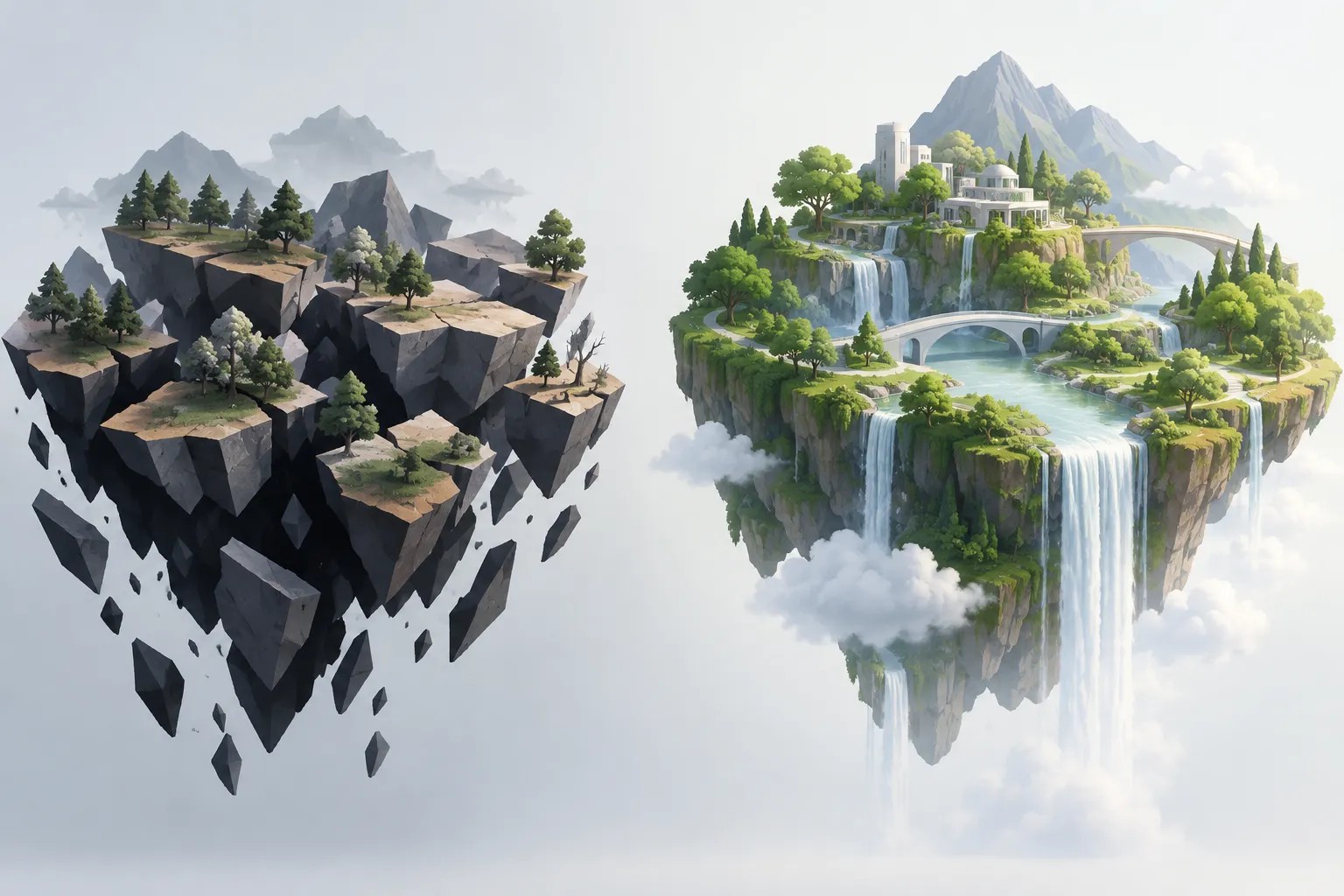
▲ Contrasting floating-island coherence
An interactive Paris flight game tested more than appearance. Earlier Gemini models had shown promise in game generation, but Gemini 4 Argon High’s plane and ring-collection game had sluggish, erratic flight controls. The plane crashed into buildings, passed through parts of the scene and became stuck. GPT-6.1 Sol Max’s comparison game had more responsive turning and smoother flight behavior. Game generation is not the main commercial measure of a language model, but it exposed weaknesses in handling complex physics and game logic: an attractive scene is not enough if its controls and collision rules fail.
Architectural prompts showed a similar split between broad composition and close-up consistency. Gemini 4 Argon High assembled a tiered Tower of Babel with ships and scaffolding, yet its worker figures appeared blocky, static or suspended above the ground. In the comparison outputs, GPT-6.1 Sol Max and Claude Sonnet 5.5 High gave workers more coherent movement and placed them more convincingly within the construction scene.
For the White House, Gemini 4 Argon High included lawns, trees and a fountain, but also an unexplained dark shape on the roof and roads that did not connect cleanly. Its Sagrada Família scene had misaligned spire tops and disconnected elements in the surrounding street layout. Results like these might have looked impressive six months ago; against today’s frontier models, they appear to lag behind.
How to use the first results
The 3D tasks are qualitative checks, not a definitive benchmark. They serve as a proxy for underlying capabilities such as instruction following, structural stability, spatial awareness and coherence. Gemini 4 Argon High followed basic instructions well, but its results varied widely as prompts grew more complex. A model that behaves erratically when generating game controls or 3D meshes may show similar inconsistency in enterprise work such as database schemas, code architecture or multi-step tool calls.
For cost-sensitive work, Gemini 4 Argon High may be worth testing against a clearly defined task. Compare models with cost-aware views such as the Pareto frontier rather than raw capability rankings alone. Supply explicit architectural requirements or schemas rather than relying on an open-ended prompt, then inspect both the visible result and the behavior of interactive components. If consistency matters, compare repeated outputs and check failure cases before choosing a model on price alone.
The practical takeaway
Gemini 4 Argon High combines a competitive cost position with a notably good bridge scene, but the island, game and architectural examples show uneven coherence as complexity rises. Its lower measured cost is a reason to evaluate it, not a substitute for evaluation. Start with a representative production task, specify its requirements tightly and check whether the result remains correct where details and interactions matter most.