Should people stop trusting AI agents with their personal information? That was the formal resolution put to Meredith Whittaker, President of the Signal Foundation, and Neil Chilson, Head of AI Policy at the Abundance Institute, in a formal public debate. Whittaker argued that today's consumer agents demand so much access that they dismantle the security models that protect messaging and personal data. Chilson argued that agents hand ordinary people a kind of computational power that only wealthy people with assistants used to have, and that the flaws are fixable through better design and market pressure. The two positions do not meet in the middle, but together they give readers a usable map of what to hand an agent and what to keep away from it.
The resolution and the stakes
The resolution was phrased as a direct question: "Should we stop trusting AI agents with our information?"
Whittaker opened by asking whether anyone had ever truly trusted agents, or had simply adopted them because they seemed necessary. She framed the stakes through Signal's user base, which includes human rights workers and people under authoritarian governments for whom a leaked message can mean detention or worse. In that context, she said, a data spill is not an inconvenience. It is a life-or-death event.
Chilson took the opposite framing. For roughly twenty years, he said, the web has run on a bargain in which companies collect user data and sell advertising in exchange for free services. Platforms learned an enormous amount about people, and people learned almost nothing actionable about their own data. Agents, in his view, invert that bargain by putting the analytical power on the user's side.
Whittaker's case: the architecture itself is the problem
Whittaker's argument rested on how agents actually work rather than on how they are marketed. The pitch, she said, is a genie-like servant that books a party or coordinates a dinner. To do that, the agent needs the contact book, the calendar, credit card credentials, private messages and an active browser session. In practice this means root-level permissions across a person's entire digital life.
That demand, she argued, collides with the most basic principle of security engineering: sandboxing, which isolates sensitive processes so that a compromise in one place cannot spread everywhere. An agent that must see everything cannot be sandboxed without losing the autonomy that makes it useful.
Prompt injection as an unsolved vulnerability
The specific failure mode Whittaker returned to repeatedly is prompt injection. A language model treats text it reads as potential instructions, because it has no inherent way to separate data from commands. An agent that browses the open web therefore can be hijacked by text planted on a page, in a comment, or in a calendar invite. She cited several incidents as evidence:
| Incident cited | What happened |
|---|---|
| Microsoft Copilot | A zero-click exploit exfiltrated corporate data from enterprise systems |
| Perplexity's agentic browser | Hijacked by a prompt injection embedded in a public Reddit comment |
| Google Calendar | An agent parsed a calendar invite and switched on a smart-home boiler |
| Anthropic's Claude Chrome experiment | With guardrails active, the agent still fell to prompt injection 11% of the time |
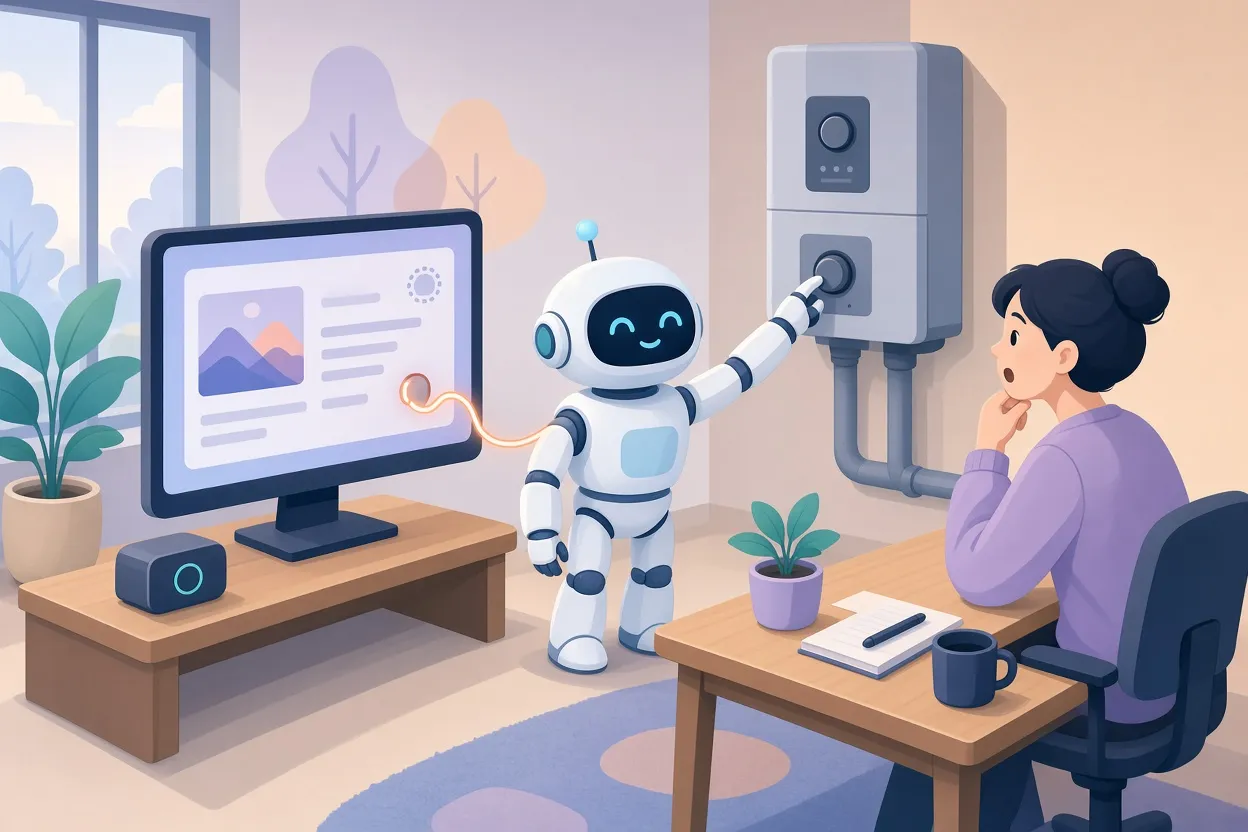
▲ Prompt injection hijacking an agent's actions
Agents that leaked addresses and balance sheets
Whittaker also added cases that moved from lab tests to real users. She described an incident in which Meta's agent, acting on a user's behalf on Facebook Marketplace, revealed the seller's home address to a prospective buyer while impersonating the user, and the buyer showed up at the front door. She also cited agents that published confidential corporate balance sheets, revenue figures and loan application agreements online. And she pointed to reporting that Meta's agent logged users' address books and interaction histories, building relational data on people who never installed the software, which she compared to the dossier-building methods associated with Cambridge Analytica.
Her broader point: commercial agents do not belong to the user. They are proprietary systems run by corporations, and they cannot be presumed to act purely as the user's delegate.
Why screen scraping breaks end-to-end encryption
The most technical part of Whittaker's case concerned agents that live at the operating-system level. She described a common pattern: the agent captures display frames through screen buffers, uses accessibility APIs, takes recurring screenshots, runs them through optical character recognition, and uploads the extracted text to remote cloud infrastructure for inference. She compared this profile to targeted malware.
End-to-end encryption, the model Signal uses, protects a message in transit so that only the sender and recipient can read it. The protection is mathematical and verifiable. But if software on the device reads the decrypted message off the screen and ships it elsewhere, the application-layer guarantee is bypassed entirely. At that point, she said, a user's security drops from verified cryptography to trust in a vendor's promises. She noted that Chase Bank blocked Meta's agent from online banking because the bank cannot tell whether a session comes from a real person or a compromised agent.
Whittaker also rejected the idea that agents deliver personal agency. In her reading, the trend concentrates power with operating-system vendors and large AI companies, citing platforms that restrict their own back-end APIs while scraping independent sites for training data, and Amazon's legal action against Perplexity over its shopping agent as an example of agents being used in corporate data battles.
Chilson's case: judge agents against the real status quo
Chilson did not dispute that current agents are flawed. His argument was that critics compare them to theoretical perfection rather than to the existing internet, which he described as already saturated with invasive data collection that users accepted for convenience over decades. Most people, he noted, do not use encrypted platforms like Signal at all.
A different business model
The core of his case was incentives. Ad-supported platforms monetize attention by extracting data and selling targeted ads, which turns users into the product. An agent, by contrast, is paid to act on the user's behalf, so customer satisfaction and commercial profit point in the same direction. Some developers will make poor choices, he conceded, but market pressure should push vendors toward stronger data protections. He also drew a historical parallel: early messaging tools were insecure, and rather than abandoning them, the industry built better protocols.
Agents as privacy tools
Chilson's most concrete contribution was a reversal of the threat model. Agents, he argued, do not get tired or bored. They can read lengthy privacy policies, configure security tools like Tor, an anonymity network, and NoScript, and run through tedious opt-out procedures that humans abandon. As an example, he described typing a six-word prompt into an agent called Muse from a hotel room and having it remove his profile from five major US data brokers.

▲ Agent automating data broker opt-outs
He also described his own household use: an agent that monitors family finances, manages calendars, troubleshoots technical problems and helps with comparison shopping. Executive assistants, he said, were once available only to the wealthy; agents democratize that delegation.
Permissions do not have to be all-or-nothing
Pressed on prompt injection and data segmentation, Chilson said the resolution was conditional rather than binary. His personal practice is to restrict agents to read-only functions online and prohibit unrestricted write operations. More broadly, he argued that agents can be built with tiered access controls so users decide exactly which files or interfaces the agent sees, and with confirmation prompts so a human verifies actions before execution. He described this as an iterative path of testing, evaluation and gradual adoption. Refusing to build or use agents, he warned, would leave the field to developers who have no interest in privacy at all.
Where the two sides directly collided
Human assistants versus software agents
One challenge put to Whittaker was why an agent is different from a human executive assistant who also sees calendars, messages and files. Whittaker answered that a human assistant works under labor contracts, confidentiality expectations and personal accountability, and gross negligence gets the person fired. A software agent has no duty of care, and it scans raw text across an operating system without contextual understanding.
Should Signal build a private agent?
Asked why Signal does not seize the market opportunity for a provably private agent, Whittaker declined on principle. Signal collects no user data, so it has no dataset to train or fuel an agent. More fundamentally, she argued that a fully capable personal agent requires 360-degree surveillance of a person's life, and that wrapping it in strict sandboxes and mandatory approvals for every small action would destroy the autonomy that makes agents attractive. Signal, she said, does one thing well: verifiably secure messaging.
Can users really consent?
When an incremental approach was proposed, such as an agent confined to one inbox that only summarizes newsletters, Whittaker questioned the "we" in the resolution. Typical consumers, she said, are not informed about back-end data extraction; surveillance practices tend to surface through investigative journalism rather than vendor disclosure. Dense clickwrap terms of service, in her view, cannot produce meaningful consent from people without computer science training.
Chilson conceded one point directly: sharing data in modern communications environments often affects other people's privacy. But he characterized this as a property of networked computing rather than something unique to agents, noting that even Signal controls only part of the communication pipeline. Agents, he argued, can act as a privacy shield on the user's side of the glass.
What this means for deciding what to delegate
Neither speaker claims a perfectly safe agent exists. Whittaker's position is that the current architecture cannot be made safe for sensitive data without removing the autonomy that defines it. Chilson's position is that risk is relative, and that careful scoping plus market incentives can shrink it over time. Reading the two together suggests a practical sorting exercise rather than a yes-or-no answer.
Questions to ask before granting access
- Does the agent read untrusted content from the open web or incoming messages? If so, treat prompt injection as a live risk, not a theoretical one.
- Does it need write access, meaning it can send messages, make purchases or change settings? Chilson's own rule is read-only online.
- Does it rely on persistent screenshots, screen-buffer capture or accessibility APIs? If yes, it can see decrypted content from every app on the device, including encrypted messengers.
- Does processing happen off-device in a vendor's cloud? That is where application-layer protections stop applying.
- Is the device used for high-risk communication, such as political or human rights work? Whittaker's argument points to keeping agents off such devices entirely.
A tiered approach
- Low-risk, read-only tasks, such as summarizing promotional newsletters in an isolated inbox, are the lowest-risk starting point consistent with Chilson's case for gradual adoption.
- Defensive tasks, such as filing data broker opt-outs, are where Chilson sees agents actively improving privacy.
- Tasks requiring credentials, payment details, private messages or autonomous browsing are where Whittaker's cited incidents cluster, and where human confirmation before each action is the minimum safeguard.
- Full operating-system-level agents with screen access sit at the top of the risk scale, because they undermine the guarantees of any encrypted app on the same device.
The debate's unresolved core is whether the market will deliver the privacy-respecting, tightly scoped agents Chilson envisions before the sweeping, screen-reading agents Whittaker describes become the default. Until that is settled, the safest stance appears to be the one both speakers' arguments allow: give agents narrow, read-only, well-audited jobs, confirm anything they want to do on your behalf, and keep them away from the devices and conversations you cannot afford to expose.