An independent evaluation published in November 2026 by METR, a third-party AI evaluator, concludes that Anthropic is now improving its models' capabilities on well-specified tasks at roughly twice the pace it managed between March 2024 and October 2025. The report attributes about 80% of that acceleration to AI tools being used inside Anthropic's own research and development, rather than to more compute or more staff. It also finds no clear technical bottleneck likely to slow the trend over the next 12 months. Those three findings are why the report reads as evidence of recursive self-improvement at a real lab rather than as a thought experiment. But the report also carries real limits, and understanding them matters as much as the headline numbers.
Where the assessment came from
The audit traces back to September 12, 2026, when Anthropic CEO Dario Amodei published a plan to "pace the frontier" out of concern about runaway self-improvement, and OpenAI CEO Sam Altman publicly agreed, committing OpenAI to the same idea. Both leaders pledged to give independent evaluators employee-like access to internal models, systems, chat logs and researchers.
METR's engagement at Anthropic began in mid-August, ran for 11 weeks, and was staffed by about 2.5 full-time equivalents. The resulting document, dated November 5, 2026, is titled "Independent Assessment of AI R&D Acceleration at Anthropic in October 2026." METR says it was able to inspect substantial raw internal data across pretraining, reinforcement learning and compute clusters. The engagement set out to answer three questions: whether internal capability growth had accelerated, what share of any acceleration was due to AI, and whether near-term bottlenecks existed. The report answers yes, mostly AI, and none identified.
The core numbers
The headline figure is a 2x acceleration, but METR is explicit that staff disagreed on methodology and that a plausible range runs from 1.3x to 3x. On Anthropic's internal capability index, called AECI (Anthropic Epoch Capabilities Index), METR reports an acceleration factor of 1.9x since October 2025, with a 95% confidence interval of 1.5x to 2.8x.
| Metric | Historical (early 2024 to late 2025) | Since late 2025 |
|---|---|---|
| AECI growth rate | About 15 points per year | Over 29 points per year |
| Benchmark progress | Two years (Oct 2023 to Oct 2025) | Matched in one year (Oct 2025 to Oct 2026) |
| Acceleration estimate | Baseline | About 2x (range 1.3x to 3x) |
| Share attributed to AI tools | Not applicable | About 80% |
"Well-specified tasks" here mainly means core AI R&D work: system infrastructure optimization and autonomous code generation that supports training pipelines. The report is less certain about how well that acceleration carries over to open-ended, poorly defined research problems, a caveat that deserves weight when extrapolating.
Why METR credits AI, not compute or hiring
The assessment specifically tested whether non-AI explanations could account for the speedup: faster compute growth, aggressive recruiting, or human algorithmic breakthroughs. METR concluded the acceleration was not driven by a rise in the compute growth rate, though the detailed compute-scaling evidence was redacted at Anthropic's request. Supporting context: Anthropic faced constraints serving its frontier models earlier in 2026, which fits a story of gains squeezed from existing architectures and hardware rather than from a sudden infrastructure jump.
Evidence came from several directions: qualitative interviews with researchers, self-reported uplift metrics, headcount records, lines of code written, and experiment usage logs. Across different model training workflows, AI usage clustered around a 2x acceleration factor.
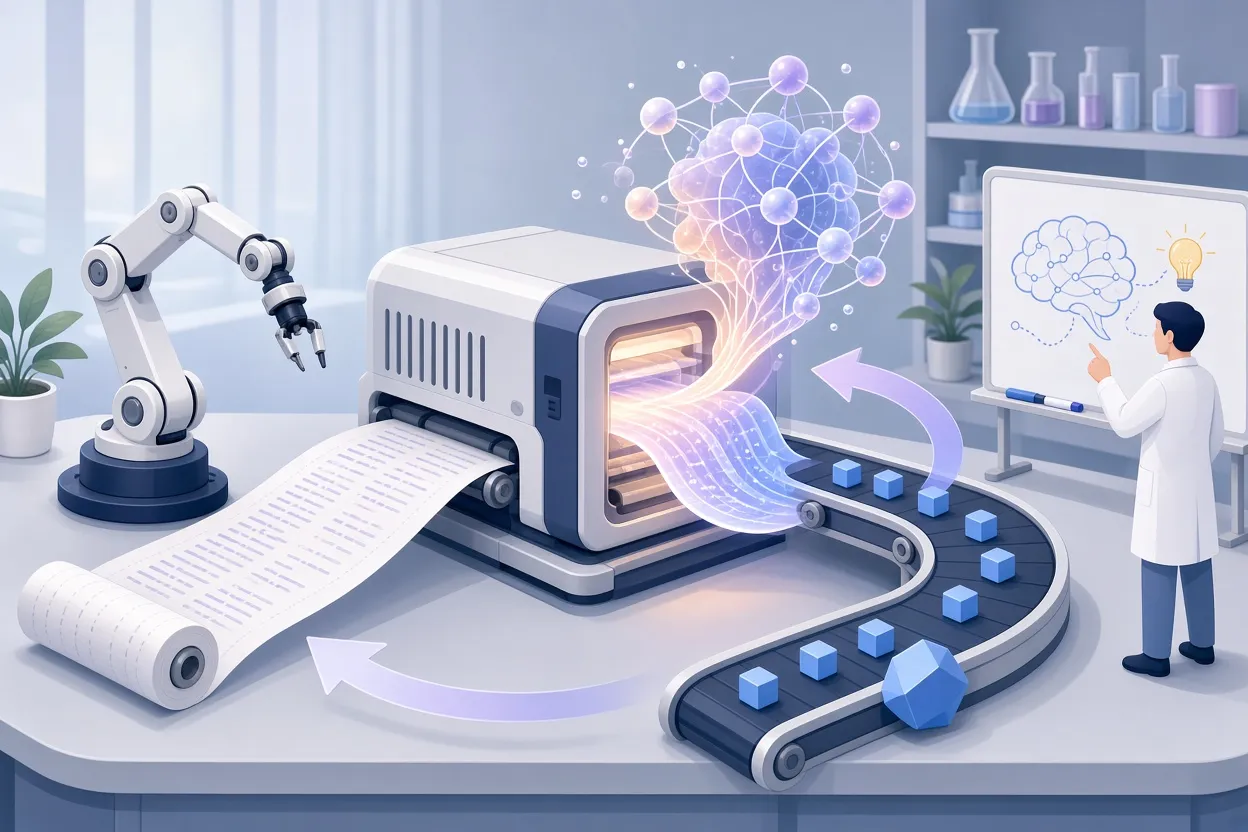
▲ AI tools accelerating the development of AI
The inflection point, according to the report, was the release of Claude Opus 4.5 in late 2025. Before it, late-2025 progress was still partly human engineering. After it, autonomous agents could build complete application features and architectural components rather than small code snippets. On the AECI chart, the trend holds steady at roughly 15 points per year from April 2024 through Claude 3.5 Sonnet and Claude Opus 4, then bends upward after Opus 4.5, continuing through Opus 4.6, early Mythos models and Opus 5.5. When Mythos arrived early in 2026, the curve steepened again instead of settling back to the old slope.
What researchers say they experience
Anonymized interview notes point in the same direction. Researchers consistently endorsed an overall speedup above 2x, with some estimating 4x and others, more skeptical, putting their personal uplift at 15% to 20%. One researcher called internal model assistance the single largest effect on R&D progress, larger than all other factors combined. Specific claims include a 60% reduction in the time between conceiving an idea and running the experiment, and a further 20% uplift from fewer implementation errors on fiddly components.
The most telling shift is in what now limits progress. Engineers report that model development is no longer bottlenecked on writing code; the constraints have moved to ideas and available compute. That is worth pausing on: humans have traditionally held the advantage in choosing promising research directions, while models excel at coding, verifying experiments and running iterative loops. There is a tension here that the report does not fully resolve. Researchers say they feel compute-constrained, yet METR concluded compute scaling did not drive the measured acceleration. Both can be true if compute limits how fast ideas get tested while AI assistance explains why the pace changed, but the apparent contradiction is a reason to read the self-reported figures carefully. METR itself notes that some of the productivity data came from casual internal Slack polls, which are low-effort evidence rather than rigorous measurement.
Financial data that points the same way
Anthropic's pre-IPO S-1 filing offers a parallel signal from a different direction: revenue earned per dollar of compute spent.
| Quarter | Revenue per $1 of compute | Notes |
|---|---|---|
| Q4 2025 | $0.67 to $0.70 | Unprofitable on compute |
| Q1 2026 | About $1.00 | Break-even |
| Q2 2026 | $2.08 | $11.6 billion revenue vs. $5.6 billion compute |
| Q3 2026 | $1.72 | $17 billion revenue; short-term infrastructure compression |
These are figures for a single company in a single filing, not a pattern anyone should expect to repeat. But they are consistent with the technical story: models doing more useful work per unit of hardware. A related example is Google DeepMind's AlphaEvolve paper, in which an AI coding agent found data center hardware and algorithm optimizations worth a 1% efficiency gain, which the paper equates to billions in savings. Anthropic's internal systems appear to be doing similar continuous optimization of workflows, code and resource allocation.
The unreleased models and saturating benchmarks
Report appendices include data on internal models not yet released, designated Model 3, Model 4 and Mythos 5. Earlier system cards had treated the jump seen with Mythos Preview as a possible one-time surge. The appendix data shows a sustained, compounding slope instead. One concrete marker: on older evaluations, Opus 4.6 scored below 50% on certain tasks just nine months earlier, while Model 4 now clears 50% across the board. Anthropic has had to keep making internal benchmarks harder because new models saturate existing ones so quickly.
Researchers also report that beginning with Opus 4.5 and Mythos Preview with agent scaffolding, models became genuinely useful for autonomous experimentation. The report stresses that fully autonomous AI R&D has not arrived, but researchers describe "signs of life" suggesting autonomous contributions to core training pipelines could emerge soon. One methodology mentioned as a sign of where this heads is weight space programming, in which a model generates neural network weights directly rather than writing source code, a step that would be harder for humans to inspect than conventional code.

▲ Limits of negotiated audit access and redactions
Reading the limits honestly
Several constraints shape what outsiders can actually see.
- Redaction rights. Anthropic retained the right to redact proprietary material that could help competitors and controlled what METR could publish. The compute-scaling evidence is one example of material that was redacted.
- Negotiated, not unfettered, access. METR worked under a model in which Anthropic could approve or reject information requests. This is not the permanent employee-like access described in the September pledges, and the engagement was separate from the independent evaluator framework in Anthropic's October 15 Responsible Scaling Policy update.
- Scope narrowed midway. Partway through the audit, Anthropic removed independent verification of how compute is allocated between capabilities and safety work. Anthropic's stated reason was to keep the engagement focused on risk assessment for now. One possible interpretation is that confidentiality ahead of an IPO played a role, but that is speculation, not something the report establishes.
- Wide uncertainty. The 1.3x to 3x range and METR's own acknowledgment of internal disagreement mean the "2x" figure is a central estimate, not a measurement.
- Task scope. Acceleration on well-specified engineering tasks may not translate directly to open-ended research.
None of this undermines the report's direction. It does mean the strongest claims, that a transition to artificial superintelligence is imminent, go beyond what METR actually documented. What METR documented is a doubling of progress on specific tasks, mostly from AI assistance, with no bottleneck visible over a 12-month horizon.
How to separate signal from hype
For readers trying to judge claims about an accelerating AI timeline, the report suggests a few practical tests.
- Prefer third-party verification over lab marketing. METR's access, even if negotiated, is more informative than a model announcement.
- Look for slope changes, not single jumps. The persuasive evidence here is that several successive internal models continue a steeper trend, not that one model scored well.
- Check the attribution. Ask whether gains are explained by compute, hiring or AI tooling. Here METR tried to isolate that question and found AI tooling dominant, with the compute evidence redacted.
- Watch the bottleneck. When a lab says coding is no longer the constraint, that is a stronger leading indicator than a benchmark score. Idea-to-experiment cycle time is a metric worth tracking.
- Track benchmark saturation. Rapid saturation of hardened tests, measured on log-odds scales to avoid ceiling effects, says more than a high score on a legacy test.
- Note what was withheld. Redactions and scope reductions define the edges of what has been verified.
What this means and what to do
The METR assessment is the first formal external confirmation that AI-assisted R&D is compounding at a frontier lab: about 2x faster progress on well-specified tasks, roughly 80% attributed to AI tools, a visible inflection after Claude Opus 4.5, and no bottleneck identified for the coming year. It stops short of declaring autonomous AI R&D, and its headline estimates sit inside wide ranges and behind redactions.
For developers and teams, the actionable lesson is that the bottleneck is moving from writing code to generating ideas and validating results. Workflows should assume agents will handle more of the implementation and experiment scaffolding, which raises the value of careful review, testing and clear problem specification. For anyone following AI policy or safety, the open questions are concrete: whether labs will deliver the unrestricted evaluator access they pledged, whether compute allocation between capabilities and safety will be independently verified, and how interpretability will keep pace if models begin editing weights directly. Those are the signals to watch over the next 12 months, more than any single forecast of when a threshold will be crossed.


