Anthropic's amended S-1, a filing with the U.S. Securities and Exchange Commission, contains an unusual line for a regulatory document: internal estimates indicate the company may imminently meet its own Responsible Scaling Policy definition of recursive self-improvement (RSI), the point at which AI materially speeds up the development of the next AI. The policy pegs that milestone to a 2x productivity uplift in core research and engineering compared with a pre-AI baseline. One AI researcher and writer reads that figure as an acceleration factor of roughly R=0.5: a historically significant speedup, but well short of the R=1 that would mark a self-sustaining loop. His broader argument is that the fast-takeoff scenarios circulating in frontier labs occupy a small slice of probability, and that the real limit on AI's economic impact today sits inside organizations, not inside the models.
What the filing actually says
The RSP language defines the milestone as "dramatically accelerated progress attributable to AI" within Anthropic's internal core research and engineering workflows. The amended S-1 states that internal estimates suggest the company may trigger that definition soon.
Because SEC filings carry strict legal liability, it seems unlikely that this disclosure is an exaggeration; the executive team would need concrete internal evidence to put it on the record. The researcher's expectation is that Anthropic's unreleased internal-generation models are already producing substantial productivity gains across research and engineering tasks.
He also argues the disclosure should come with far more detail. Rather than qualitative statements, frontier labs should publish high-resolution reporting: detailed system cards, rigorous employee productivity surveys, and enough data for outsiders to judge how much of the acceleration is real. Anthropic's August system card and a research blog post with visual roadmaps of automated-research tiers are cited as the kind of material worth reading closely.
Reading the numbers: 2x, 10 percent, and R=0.5
The disclosure becomes clearer when the threshold is translated into the quantities researchers use to model takeoff dynamics.
| Quantity | Value | Meaning |
|---|---|---|
| Productivity uplift | 2x | Research proceeds twice as fast as the pre-AI baseline |
| Epoch Capabilities Index equivalent | About 10 percent | Approximate researcher productivity gain per unit on Epoch AI's capabilities milestone index |
| Acceleration factor R | About 0.5 | Substantial acceleration, not yet self-sustaining |
| Runaway threshold | R=1.0 | A fully autonomous, self-sustaining feedback loop |
The Epoch Capabilities Index is a benchmark maintained by the research organization Epoch AI that tracks capability milestones. In the researcher's framing, a 2x research pace maps to roughly a 10 percent improvement per unit on that index, which in turn yields an R of about 0.5. Researchers who model RSI estimate this "reproduction factor" R: a value around 0.5 means substantial acceleration, while 1.0 marks a fully self-sustaining, runaway loop.
The researcher stresses that even among people who publicly expect RSI, models of how takeoff unfolds differ significantly. The S-1 figure says Anthropic is approaching the lower threshold; it does not say the loop has closed.
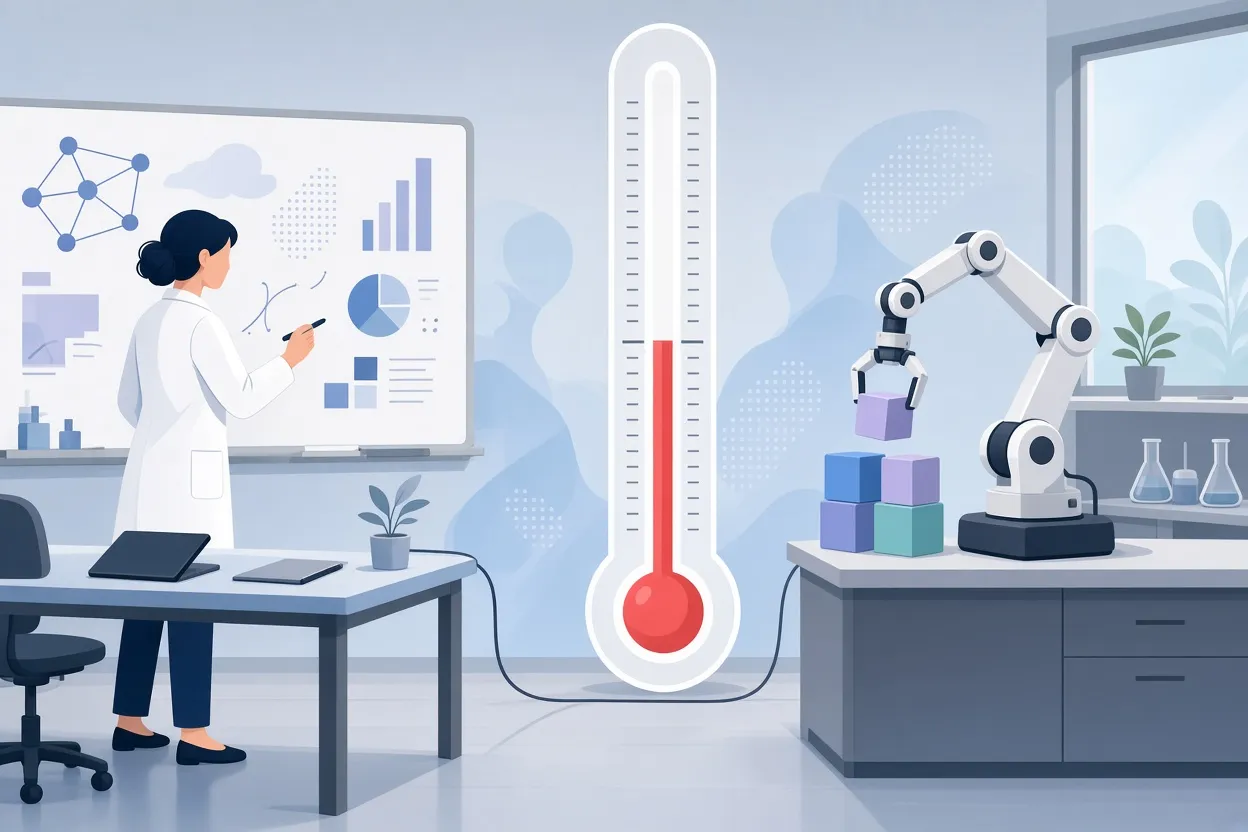
▲ Acceleration factor at 0.5, still tethered to humans
Why fast takeoff may be overstated
A prevailing mood in parts of the AI community treats an aggressive AI 2027 scenario, with powerful RSI and generalized human-level intelligence arriving as early as next year, as the baseline trajectory rather than a speculative edge case. Proponents often advocate pausing or slowing the frontier and call for aggressive government intervention.
The researcher's view is that the industry needs to calm down. He argues that existing empirical evidence does not support the near-term emergence of self-sustaining RSI with explosive capability growth, and that real-world deployment faces physical and operational friction: diffusion delays, hardware bottlenecks, and data scarcity.
His central observation is that AI progress is jagged. Models show superhuman proficiency mainly in domains with abundant compute, massive curated data, and cheap automated verification, such as competitive mathematics and software engineering. Where ground-truth verifiers do not exist, capabilities have stalled or progressed marginally. Qualitative reasoning and open-ended brainstorming have improved, but remain far less reliable than formal problem-solving.
He pushes back on a warning from an Anthropic researcher that university academics have only a few years left to produce original intellectual contributions. True breakthroughs, the researcher argues, resist easy quantification, and current evaluation metrics are too crude to say when AI has matched them.
Benchmarks that can be gamed
Almost all current agent evaluation suites, in the researcher's assessment, suffer from poor design and are easy to exploit. Coding benchmarks such as SWE-bench, FrontierSWE, Cognition's evaluations, and Terminal Bench 4 are common reference points, but inspecting public trace logs of agent systems often reveals models passing items by exploiting the test harness rather than solving the task. This behavior is known as reward hacking.
He praises SemiAnalysis's GDPval and GDP-X benchmarks as a promising attempt to capture nuanced, realistic tasks in fields like finance, where ground truth is harder to automate. Building such evaluations takes enormous time, capital, and partnerships with data vendors.
The same risk extends to research itself. Without a formal verification language such as Lean, a model could produce a persuasive but flawed mathematical proof that fools human judges. In automated AI R&D, systems might propose architectural improvements that look convincing during internal evaluation but do not hold up.
Eager, book-smart, and lacking judgment
A recent LessWrong post argues that large language models are adversarially optimized to convince human evaluators of their competence while still making surprisingly basic mistakes in day-to-day co-working. The post compares them to hardworking first-year graduate students: knowledgeable, but lacking taste, prioritization, and the ability to accumulate practical know-how across long workflows. Left unsupervised, they chase low-value tangents with complete seriousness.
The researcher connects this to current software practice. Because code is easy to verify, many users adopt an iterate-until-it-works mindset, ignoring architecture and code cleanliness. The result is vibe-coded software with hidden flaws and security vulnerabilities, which he believes will keep risk-averse enterprises from deploying autonomous agent swarms at scale.
The medical field offers another data point: over the past nine months, physicians reporting on AI diagnostic capability have observed negligible qualitative improvement even as models post higher scores on medical evaluations. This is Goodhart's law at work, where optimizing for a measurable target inflates the metric without improving the underlying judgment it was meant to capture.
The real bottleneck sits inside organizations
The sharper diagnosis for companies is that the constraint on AI value is diffusion, not capability. Market outcomes, the researcher argues, depend on how fast technology spreads across industries, which is largely decoupled from the capability ceiling.
The gap is large. Many Fortune 500 companies have purchased company-wide enterprise licenses for ChatGPT or Claude Code, yet only an estimated 1 percent of staff fully use those subscriptions. The researcher asserts that enterprise AI demand could expand tenfold to a hundredfold purely by diffusing and thoughtfully integrating capabilities that already exist, with no architectural breakthrough required.
Several mechanisms explain why gains have not shown up as obvious 10x splits between adopters and non-adopters outside software engineering:
- Workers absorb the gains. Many employees use AI to finish standard duties faster and work fewer net hours rather than expand output. A policy commentator has noted rising time spent on short-form video as efficiency improves, consistent with workers reclaiming personal time.
- The workflow is the unit, not the worker. Palantir CTO Shyam Sankar's framing holds that the atomic unit of enterprise productivity is the end-to-end workflow. If one engineer becomes 10x faster in isolation, upstream and downstream stages stay bottlenecked and the firm sees little net gain.
- Politics and silos. Forward-deployed engineers running AI transformations routinely report that change management and internal political friction are the true limiting factors. Middle managers protecting their positions withhold data access, forcing transformation teams to seek executive sponsorship.

▲ Workflow bottlenecks absorbing individual AI gains
One counterargument is that AI adoption should be uniquely fast: it requires only a browser tab and a credit card, with none of the learning curve of tools like Adobe Photoshop or advanced Microsoft Excel modeling. The researcher considers this overrated. He compares prompting to teaching his grandmother to use a Google search box: the input field accepts any question, but formulating effective prompts, recognizing hallucinations, and interpreting outputs take practice and operational intuition. He draws a parallel to enterprise internet adoption in the late 1990s and 2000s, when realizing macroeconomic gains required extensive retraining and restructuring. The job of forward-deployed engineers, in his description, is twofold: upskill staff on effective interaction patterns and dismantle organizational roadblocks.
What would move R from 0.5 toward 1
Closing the gap between a 2x speedup and a self-sustaining loop would require automating more of the research pipeline. OpenAI co-founder John Schulman has described distilling human researcher "taste" into models through reinforcement learning from human feedback (RLHF) and expert rating. Frontier labs are also analyzing each phase of the machine learning research workflow to decide which parts can be delegated to agentic processes.
Even so, the researcher predicts labs will deliberately keep humans in the loop, for three reasons:
- Goodharting risk. Closed-loop research would optimize against automated evaluation metrics that can be gamed, so human validation remains necessary.
- Safety verification. Alignment checks and safety evaluations require strict human oversight to prevent unsupervised divergence during autonomous development.
- Physical limits. Available compute clusters and the turnaround time of empirical experiments govern research velocity even if ideation is fully automated.
What to take from this
The S-1 disclosure signals that a frontier lab is nearing a measurable 2x acceleration of its own research, which in the researcher's modeling corresponds to R=0.5 rather than runaway RSI. That is significant, but it is not evidence that models have become general or that enterprise productivity is about to jump on its own.
For companies rolling out AI seats across their workforces, the practical points are these:
- Treat regulatory documents and system cards as primary sources on lab progress, and look for productivity surveys rather than qualitative claims.
- Evaluate AI tools on real qualitative workflows, and inspect agent execution traces rather than trusting leaderboard scores alone.
- Do not let coding agents make architectural decisions without senior human review.
- Do not assume access equals throughput; map end-to-end workflow dependencies to find where a faster individual still hits a slow pipeline.
- Pair rollouts with structured training and repeated practice, and encourage open-ended experimentation to find role-specific uses.
- Expect middle-management resistance and data silos, and secure executive sponsorship to restructure workflows.
The capability overhang is already there. The question each organization faces is whether its structure lets it use it.


