A new benchmark study reports that fully AI-generated reviews of scientific papers now outscore reviews written by paid human experts on almost every criterion that journal editors use, and two of the largest names in publishing and AI are already acting on that signal. Springer Nature and Google DeepMind have announced a partnership to co-design an AI peer review assistant. At the same time, a run of separate events this week shows where the limits of automation in academia still sit: fabricated papers were caught at intake, a court upheld an expulsion over AI-invented citations, and research on multitasking suggests that piling on AI agents hurts rather than helps. Together they sketch a clearer picture of what researchers should lean on and what they must still own personally.
The peer review comparison
The study, titled "All-AI Generated Article Reviews Are Now Better, by Every Measure We Could Construct," compared AI-written reviews against reviews from human experts across 134 paper evaluations. The comparison used pairwise rankings: for each paper, judges saw an AI review and a human review and picked the stronger one.
| Judge type | AI review preferred |
|---|---|
| AI judges | 100% of pairs across multiple criteria |
| Human journal editors | 87% to 100% of pairs |
Beyond the head-to-head rankings, the AI reviews also received significantly higher ratings than the human reviews on five review dimensions the authors measured: sources, weaknesses, methods, framing, and communication.
The one place the AI reviews slipped was in analyzing figures and tables, where they lagged slightly behind the human experts. That gap deserves some context, though: detailed figure evaluation is a weak point for many human peer reviewers as well, so it is not clear that this category gives humans a durable advantage.
Publishers move from study to product
The Springer Nature and Google DeepMind collaboration will build its assistant on Google's Gemini models and the ScholarReview agent framework. The announcement frames the tool as a co-designed assistant rather than a replacement reviewer, but the economics appear to point in one direction. Large publishers pay for editorial labor, and a system that produces reviews editors rate more highly than expert reviews at lower cost is hard to ignore. It seems reasonable to expect publishers to adopt these tools aggressively, with cost reduction as a primary motive.
Whether that pushes human reviewers out of the workflow entirely is an open question, and it is an uncomfortable one. The study results suggest the shift may be hard to stop, even for those who would prefer to keep humans in the loop.
For authors, the practical implication is immediate. If an AI reviewer scores a manuscript on sources, methods, framing, and communication, then thin citations, loosely described procedures, and vague framing will be flagged consistently and without fatigue. Documenting methodology and sources rigorously, and formatting cleanly, is now a defense against a tireless first reader.

▲ Fabricated papers caught at editorial screening
Fabricated papers did not get through
A separate experiment offers a counterweight to any assumption that AI can now generate publishable science end to end. A technology journalist, writing in IEEE Spectrum under the headline "I Used AI to Fake a Scientific Paper. Here's What Happened," borrowed the idea of "vibe coding" (building software by prompting an AI with minimal hands-on input) and tried "vibe-researching": producing complete research manuscripts with large language models and almost no human contribution.
The journalist submitted two papers to IEEE Access:
- Paper 1 was an outright forgery, generated with ChatGPT and Gemini, describing research that never took place.
- The second was a computational study that the journalist built using the FARS system from Analemma.
Both were rejected during initial editorial screening and never reached peer review. The result suggests that the combination of automated checks and human editorial intake at established venues can still catch purely prompted manuscripts with no empirical backing. The hype around fully AI-generated science appears overblown, at least where editorial screening is working as intended.
The takeaway for honest researchers is about where to point the tool. AI appears most useful for augmenting reasoning and synthesis within real work, not for attempting to prompt an entire study into existence.
A court draws the line at invented citations
The accountability side of the story came from Dubai. A master's student in International Dispute Resolution Law at Birmingham Law School's Dubai campus (University of Birmingham Dubai) was expelled after an investigation dated February 8, 2024 found that the submitted thesis contained copied-and-pasted AI-generated content with fabricated judicial rulings, incorrect legal citations, and fake references.
The student sued, seeking reinstatement, the award of the degree, and AED 100,000 in damages, arguing that AI detection software is unreliable. The case moved through three levels:
| Court | Decision | Date |
|---|---|---|
| Dubai Court of First Instance | Dismissed the suit | February 10, 2025 |
| Dubai Court of Appeal | Upheld the dismissal | July 30, 2026 |
| Dubai Court of Cassation | Final rejection | October 29, 2026 |
The reasoning matters more than the outcome. The court held that the reliability of AI detection tools was beside the point: the presence of non-existent case law and fabricated citations in the thesis was itself independent proof of academic misconduct. In other words, debates about whether detectors can reliably identify AI-written text do not shield a submission that contains hallucinated references. The responsibility to verify every citation, every case, and every figure produced with AI assistance rests with the person who submits the work.
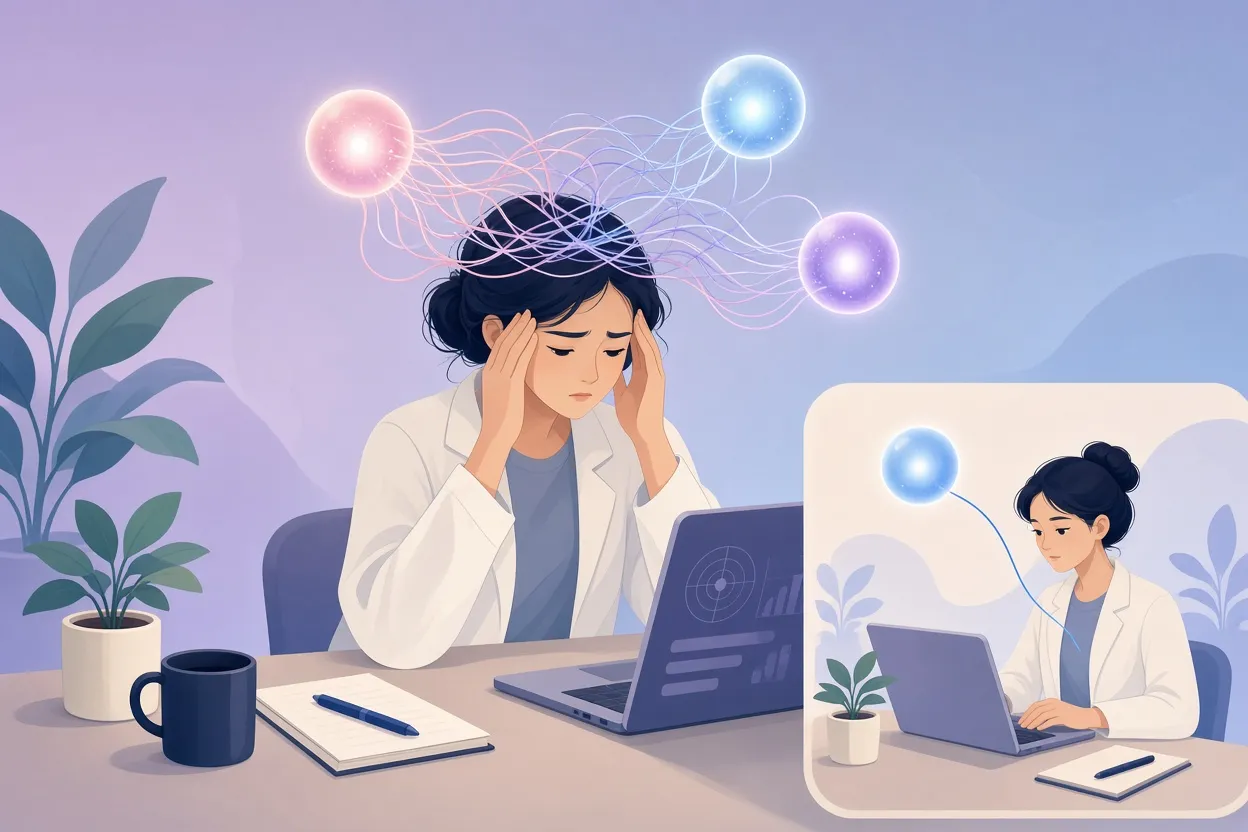
▲ Cognitive overload from managing multiple AI agents
More agents, less output
Alongside the review and integrity news, an article in The Chronicle of Higher Education's Jagged Intelligence newsletter, titled "Is using AI giving you 'brain fry'?", looked at what happens to people who supervise several autonomous AI agents at once. Drawing on Harvard Business Review survey data and insights from Boston Consulting Group, it reports a pattern that mirrors the well-documented cost of human multitasking.
- Directing one AI agent produced a significant rise in worker productivity.
- Adding a second agent brought only minor additional gains.
- Running three or more agents at the same time caused productivity to drop sharply.
The cause appears to be context-switching fatigue: each agent demands attention, checks, and corrections, and the overhead compounds. For academics tempted to launch a fleet of agents on literature searches, data cleaning, and drafting in parallel, the evidence argues for restraint. One primary agent is the sweet spot, with a second only on days when attention is sharp.
Claude Duet and the persistent-agent model
That advice lands as Anthropic releases a research preview of Claude Duet, announced October 21, 2026. Duet is pitched as a proactive, persistent assistant rather than a passive tool: it anticipates what the user needs, keeps working on background tasks after the user steps away, and checks in before executing significant decisions. It runs on Claude Opus 3.5 and is available as a standalone app on iOS, Android, and the web for Pro, Max, and Ultra subscribers.
Anthropic says the safety design borrows from Claude Code and Claude in Chrome, including auto-mode classifiers and credential protections intended to prevent unauthorized actions such as file deletion. Safety and privacy documentation is dated October 23, 2026.
For researchers, a persistent agent of this kind may fit administrative and organizational work that needs continuity, such as tracking tasks and keeping projects moving while the user is away. The collaborative, check-in-before-acting model seems a better match for academic workflows than either a passive chatbot or an unsupervised swarm, and it dovetails with the one-agent guidance above.
Automation reaches the bench
Automation is also advancing in the physical lab. A research article in Nature, "An AI-native experimental laboratory for autonomous biomolecular operations," describes AutoDNA, a system that orchestrated more than 20 types of scientific instruments across over 11,000 operational steps to carry out nucleic acid synthesis, transcription, amplification, and sequencing with minimal human intervention. The platform reported a 3.2-fold improvement in executing DNA data storage cycles and validated treatments targeting the KRAS G12D mutation.
Systems like this execute long, repetitive, multi-step procedures with a consistency that outlasts human stamina. The likely effect is a transformation of bench roles rather than their elimination: tedious pipetting and instrument handling move to machines, while researchers direct and interpret the work.
Exam integrity catches up with hardware
Finally, South Korea's Ministry of Education announced tougher penalties for students who use AI-powered smart glasses to cheat on the College Scholastic Aptitude Test, the national university entrance exam. The glasses carry micro-cameras and displays that can send exam questions to an AI model and project answers onto the lenses. Previously, cheating meant exam invalidation and a one-year ban; the new rules extend the ban to three years and add criminal prosecution. Proctors at all 1,312 testing centers have been directed to inspect suspicious eyewear. Current smart-glass hardware remains conspicuous and clunky, which helps proctors for now, but the direction of travel is clear.
What researchers should do now
The week's developments point to a consistent set of actions:
- Prepare for AI reviewers. Document methods, sources, and framing rigorously and format cleanly, because AI review tools score these dimensions consistently and appear headed for publisher workflows.
- Verify everything AI produces. Check every citation, legal reference, and statistical figure against the original source before submission. The Dubai ruling shows that fabricated references alone establish misconduct, regardless of detector accuracy.
- Use AI to augment thinking, not to fabricate research. Fully prompted manuscripts were rejected at IEEE Access intake; the tool is for synthesis and reasoning within real work.
- Cap concurrent agents at one, or two at most. Productivity gains fade at two and reverse at three or more.
- Consider persistent agents for continuity tasks. Tools like Claude Duet may suit administrative and organizational work that benefits from an assistant that keeps going and checks in before acting.
AI in academia is accelerating on every front, from review pipelines to robotic labs. The institutions pushing back are not rejecting the technology; they are drawing lines around fabrication and overreach. Researchers who offload tedium to AI while keeping personal ownership of accuracy stand to benefit most.


