A tampered build of Anthropic's Claude Code extension reached the Cursor VS Code Extension Marketplace and stayed available for roughly eleven hours before it was pulled. Two versions, 2.1.312 and 2.1.313, carried a payload that collected machine details and tried to install a persistent SSH backdoor, giving an attacker a lasting remote entry point. Cursor removed the packages, blocked new downloads and cut off communication with the attacker's servers, but anyone who installed either version still has to clean up their own machine by hand. The incident is a reminder that the popularity of AI coding tools has made the add-ons around them a tempting target, and that a familiar name and logo in an extension store are not proof of safety.
What the tampered extension did
According to the security notice published on October 29, 2026, the malicious versions did two things once installed. First, they gathered information about the host: the system and user architecture, the home directory, environment variables and the active working directory. Environment variables are a common place for developers to store API keys and other credentials, so this step alone can expose secrets.
Second, the extension tried to establish persistence. It injected an SSH key controlled by the attacker into the authorized_keys file, which is the file that decides which keys may log in to a machine over SSH. It then set up reverse SSH tunnels, which are outbound connections that let a remote party reach back into the machine even behind a firewall, and scheduled those tunnels to restart through scheduled tasks or LaunchAgents (the macOS mechanism for launching background processes at login).
| Item | Detail |
|---|---|
| Affected package | Anthropic.claude-code on the Cursor VS Code Extension Marketplace |
| Compromised versions | 2.1.312 and 2.1.313 |
| Time available | About 11 hours |
| Data collected | Host and user architecture, home directory, environment variables, working directory |
| Persistence method | Attacker SSH key in authorized_keys plus reverse tunnels via scheduled tasks or LaunchAgents |
| Marketplace response | Packages removed, downloads blocked, attacker server communication disabled, keys rotated |
Why uninstalling is not enough
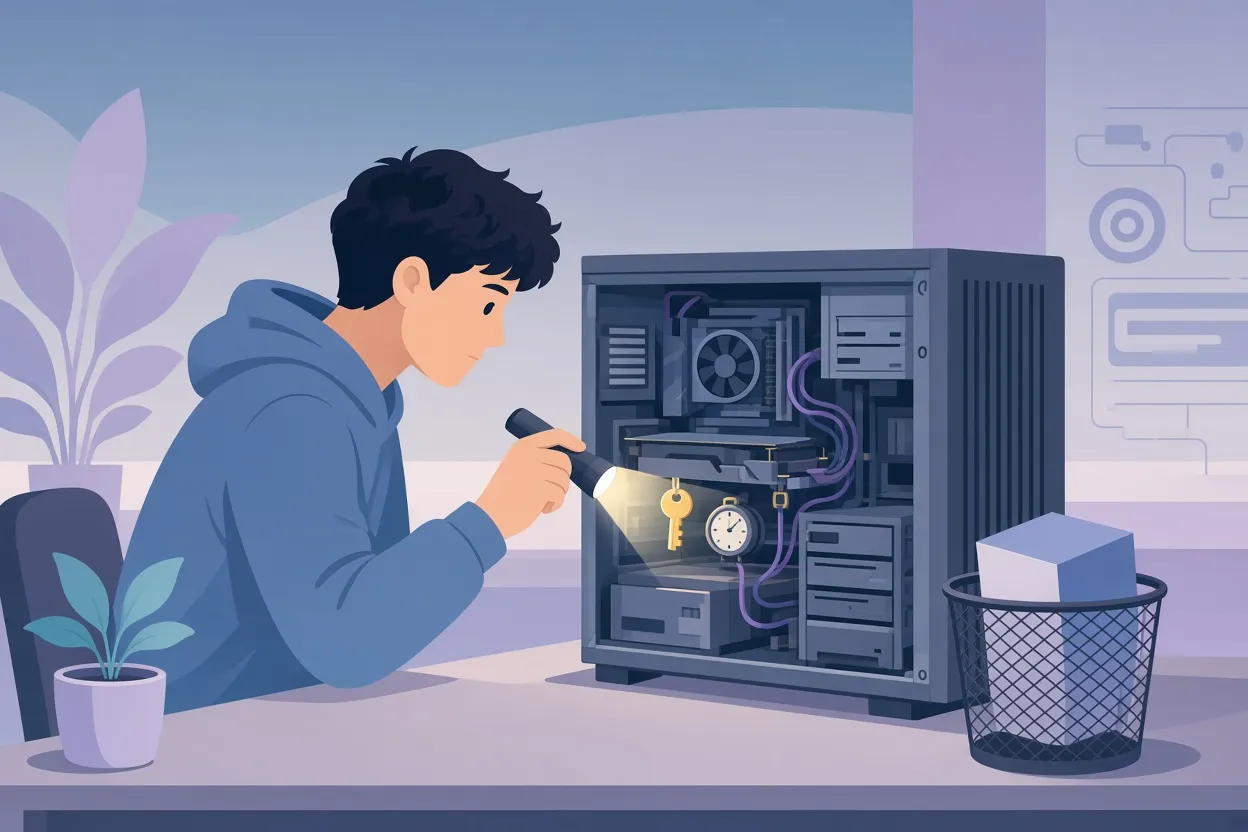
The marketplace response closes the door to new victims, but it does not undo what already ran. Removing the extension does not delete an SSH key that was written into authorized_keys, and it does not remove a LaunchAgent, cron entry or scheduled task that was created to keep a tunnel alive. Those artifacts sit outside the extension's own files, so the extension manager never touches them. A machine that had either version installed should be treated as compromised until someone has inspected it.
▲ Leftover SSH key and persistence task after uninstall
A cleanup checklist
If versions 2.1.312 or 2.1.313 were ever installed on a machine, the following inspection is worth doing right away:
- Open ~/.ssh/authorized_keys and remove any public key you do not recognize.
- On macOS, review the LaunchAgents folders for entries you did not create.
- On Linux and macOS, review crontab entries for unfamiliar jobs.
- On Windows, review scheduled tasks and the Startup folder for rogue scripts.
- Rotate any credentials that were present in environment variables on that machine, since the payload collected them.
Why AI coding tools are an attractive target
This incident fits a broader pattern. Rather than attacking the servers that run large language models, attackers are going after the intermediate tooling around them: IDE extensions, bridge plugins and marketplace add-ons that developers install casually and grant broad access. Other recent events point the same way, including a Binance security breach and a coordinated campaign that reportedly targeted somewhere between 200 and 300 developer organizations.
The attack surface grows with every tool in the chain. Many developers now combine Cursor, Codex, Antigravity and Claude Code extensions in a single workflow, each with its own update channel and its own trust assumptions. When any one of those pieces is compromised, the blast radius covers everything it can reach on the machine. Running that many tools is like juggling too many eggs: the more there are in the air, the more likely one breaks.
A related problem is that the usual signals of legitimacy are easy to fake. An extension that displays an official brand name and icon can still be tampered with, as this case shows. Star counts and ratings on community repositories are routinely inflated to manufacture a false sense of trust, so they should not be used as a security indicator either.
Habits that reduce the risk
The practical response is less about any single setting and more about reducing exposure. Several habits appear to help:
- Keep the number of third-party extensions and bridge plugins across IDEs as small as possible. Every add-on is a dependency you are trusting with your machine.
- Lean toward hardened first-party applications, such as Claude Desktop, instead of stacking unofficial integrations on top of one another.
- Verify where an installation actually comes from. Do not rely on vendor icons, names or public ratings alone.
- Audit any community skills, templates or package bundles before deploying them, looking specifically for obfuscated code that hides what it does.
- Prefer sandboxed, cloud-hosted runtimes or native browser environments that keep code execution isolated from the local machine.
Secure AI development may increasingly move toward isolated cloud sandboxes and browser-based artifacts for exactly this reason: when the runtime is separated from the developer's laptop, a compromised tool has far less to steal. For now, the simplest win is to treat an extension marketplace with the same caution as any other download source.
France votes for a per-gigabyte data tax
On a different front, lawmakers in France's National Assembly voted 11 to 10 in favor of an amendment to the 2027 budget bill, designated Amendment I-1358, that would levy a tax of €0.055 (€5.5 cents) per gigabyte on producers of digital data delivering content to French residents. Traffic would be measured by telecom regulators, and large content providers such as Netflix, Meta, YouTube and Amazon would be the primary targets. The projected revenue is nearly €10 billion a year, roughly $12 billion.

▲ Per-gigabyte metering of data under the French tax plan
The proposal frames data the way public utilities frame electricity or water: a metered resource with a per-unit charge. That framing is open to challenge: data networks have very different economics from utilities, and per-gigabyte metering arguably does not reflect how modern routing works. One illustrative estimate puts the cost for a four-person household streaming 200 hours of video a month at about €366 a year if the levy were passed through in full.
Pass-through is the central concern. Businesses generally treat added costs from energy, logistics or government fees the way grocery retailers do, moving them down the chain to the customer rather than absorbing them. On that reading, a data tax on platforms would most likely show up as higher subscription prices or metered streaming for French users. A further caveat is that large providers could push back aggressively, or even consider restricting or geoblocking service in jurisdictions where the burden becomes too high.
The economic argument against aggressive rates draws on the Laffer Curve, the idea associated with economist Arthur Laffer that tax revenue is zero at both a 0 percent and a 100 percent rate, and that pushing rates past a certain peak reduces total revenue as people change their behavior. Two examples illustrate the effect: a Scottish top-bracket income tax increase that was expected to raise £200 to £400 million but fell short as taxpayers adjusted, and the UK's £100,000 threshold, where losing roughly £10,000 in childcare and welfare allowances leads some earners to hold their reported income at £99,500. Whether the French levy sits past that peak is a judgment call, but the behavioral risk is the same.
A satirical mock-up from indie maker Pieter Levels captured the mood: a German AI chat invoice charging €0.05 per answer plus a €0.05 surcharge for saying "thanks," labeled as taxable politeness. It is a joke, but it points at a real worry that metering digital interactions changes how people use them.
Other developments in brief
Reports, attributed to anonymous sources and Financial Times coverage rather than official company statements, say OpenAI has reduced its current funding target from $30 billion to about $20 billion and its target valuation from $1.4 trillion to $1.25 trillion, with roughly $11 billion committed so far. That is about a 33 percent cut in capital sought, which gives prospective investors better terms. Until OpenAI confirms the figures, they should be treated as reporting rather than fact.
Separately, several leading AI platforms have recently raised or doubled usage limits for subscribers without raising prices. It is unclear whether this reflects new compute clusters coming online or shifting usage patterns, but it gives developers more room to test longer multi-step agent pipelines.
On hardware security, air-gapping, meaning keeping a machine physically disconnected from networks, is no longer a guaranteed defense. Research has shown that an agent can infer the internal operations of a separate computing unit by monitoring its heat emissions, a form of side-channel attack. Physical isolation still raises the bar, but it should not be mistaken for complete protection.
What to take away
The tampered Claude Code extension shows how a trusted name in a marketplace can become a delivery channel for a backdoor, and how little the marketplace's cleanup does for machines that were already hit. If you installed version 2.1.312 or 2.1.313, inspect your SSH authorized keys and your persistence mechanisms now, and rotate any secrets that were stored in environment variables. Going forward, shrink your extension stack, verify installation sources instead of trusting logos and star counts, favor first-party or sandboxed environments, and audit community packages before they touch production. On the policy side, France's per-gigabyte data tax is only an amendment that passed by a single vote, but if it advances, the cost appears likely to land on consumers' monthly bills rather than on the platforms it names.