Anthropic surveyed its own employees about how much working time Claude actually saves them, and the answer was striking: most staff said an hour of work now takes 15 minutes or less. Among everyday users of the same model, only about one in four report a comparable gain. The people inside the company do not have a secret model or a hidden prompt trick. They pay for and use the same Claude that everyone else does. What separates them appears to be a set of daily habits, and those habits can be copied by anyone, including people who never write code.
The findings come from two reports Anthropic published on October 16, 2026: one on how employment and hiring are changing inside the company, and one on how working at the frontier of AI shapes its employees' expectations. Read together, they suggest seven practical habits that non-technical professionals can put to work immediately.
Habit 1: Stop making Claude wait for you
Anthropic tracked how its employees interact with Claude over days, weeks and months, and found that the model spends roughly 80 percent of its active chat time waiting on a human. One Anthropic engineer put it bluntly: people are bottlenecking the agents, not the other way around.
The fix is to front-load every human input before the model starts. Instead of answering questions one at a time as they come up, tell Claude at the outset to ask everything it needs in a single batch, then execute the rest of the task without stopping. A useful guardrail: instruct the model to pause only if an action costs money or cannot be undone.
This habit also enables a simple form of parallel work. Launch Claude on an intensive task right before you walk into a meeting, and it can work for 30 to 60 minutes while you are occupied. Your calendar block produces two outputs instead of one. Of the seven habits, this is the easiest to adopt and one of the highest-impact.
Habit 2: Do it twice, never a third time
Anthropic staff follow a consistent rule: do a task by hand the first time, and the second time it comes up, turn it into a reusable skill or project configuration so the third time, Claude does it alone. A "skill" here means a saved set of instructions that the model can apply again without being re-briefed.
The payoff inside Anthropic was concrete. Sales staff who automated their repeat administrative work reclaimed about 30 percent of their time and spent it on direct customer conversations. The prompt that makes this work runs after you finish a task for the second time: ask Claude to review the chat history, identify the procedure you followed, and package it as a skill. From then on, each run only needs the new raw data, not a fresh explanation of the process.
| Occurrence | What happens |
|---|---|
| First time | Do it by hand, or with Claude's help |
| Second time | Ask Claude to turn the chat into a skill |
| Third time onward | The skill does the work |
Habit 3: Decide what you will read before Claude writes
Verbose AI output creates a reading problem that most people solve by not reading. Anthropic measured how much text Claude generates for its internal teams and how long it would take to read all of it. Finance staff would need about 43 hours per week; sales staff, about 35 hours. Both figures sit at or above a standard 40-hour week, so in practice employees skip most of it, and mistakes or questionable assumptions can slip through unnoticed.
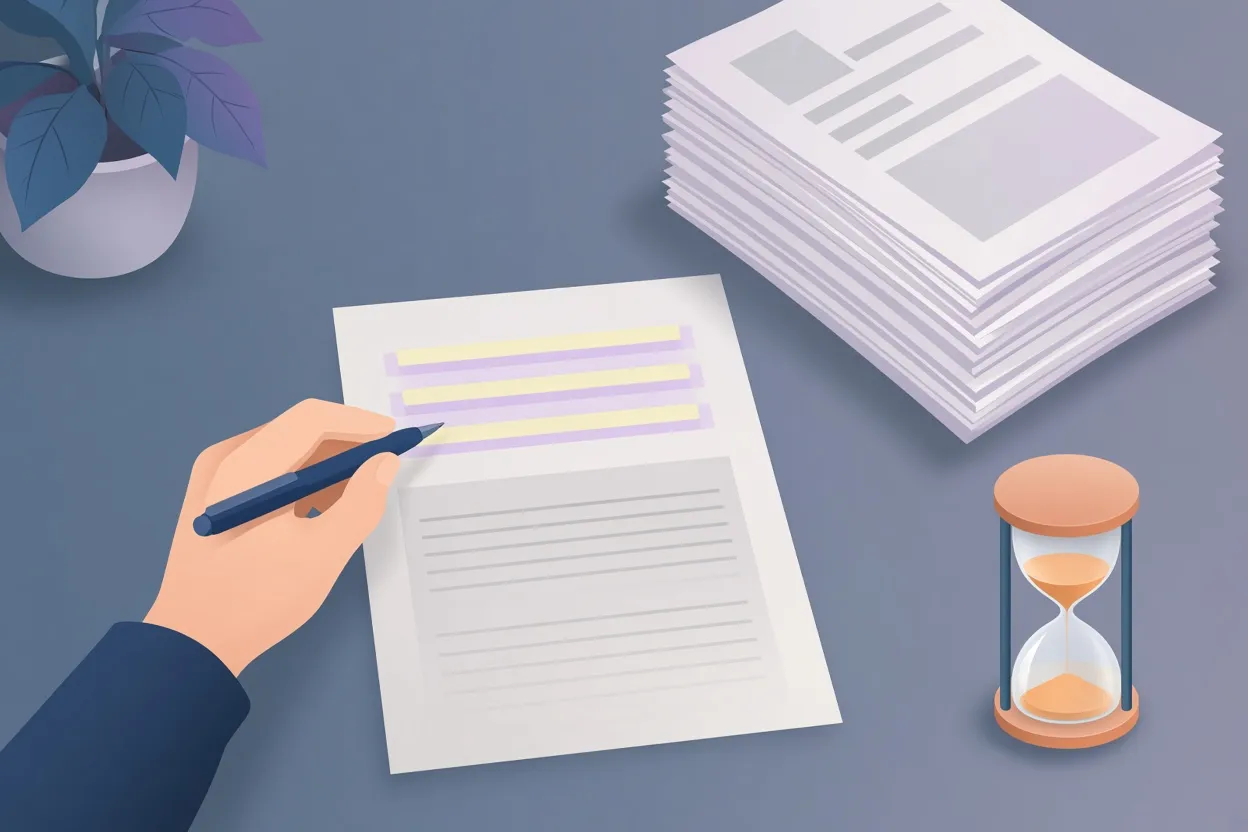
▲ Three-line summary before the details
The solution is to dictate the output format before generation. One prompt pattern asks Claude to open every response with exactly three lines:
- Findings or decisions
- Items that need your approval
- Uncertainties
Supporting detail goes underneath. If the three lines look right, you can stop reading. If something seems off, the detail is there to check. The point is that the reader, not the model, chooses what gets attention.
Habit 4: Spend real time on the setup
A year earlier, Anthropic employees devoted roughly one in ten Claude sessions to refining prompts, system instructions and tool configurations rather than doing task work. By the time of the October 2026 reports, that share had doubled to one in five, or 20 percent of all sessions. Time spent on setup improves accuracy on every future task and widens what the model can handle on its own.
A practical version of this habit is a 15-minute review every Friday. Ask Claude to look back over the week's chats, find every instance where you corrected or redid its work, and sort each fix into one of three buckets:
- A change to project instructions
- A change to a reusable skill
- A one-time anomaly that needs no change
Have it supply the exact wording to add for the first two categories. Over weeks, the corrections stop recurring because they have been written into the setup.
Habit 5: Write it where Claude can see it
This habit is about organizational culture more than prompting. Anything said out loud and never written down is invisible to an AI system. Anthropic's report includes a small but telling example: an employee moved out of a marketing role, but colleagues kept sending requests for mugs, T-shirts and sweaters, because the role change had only been discussed in conversation and never recorded anywhere Claude could read it.
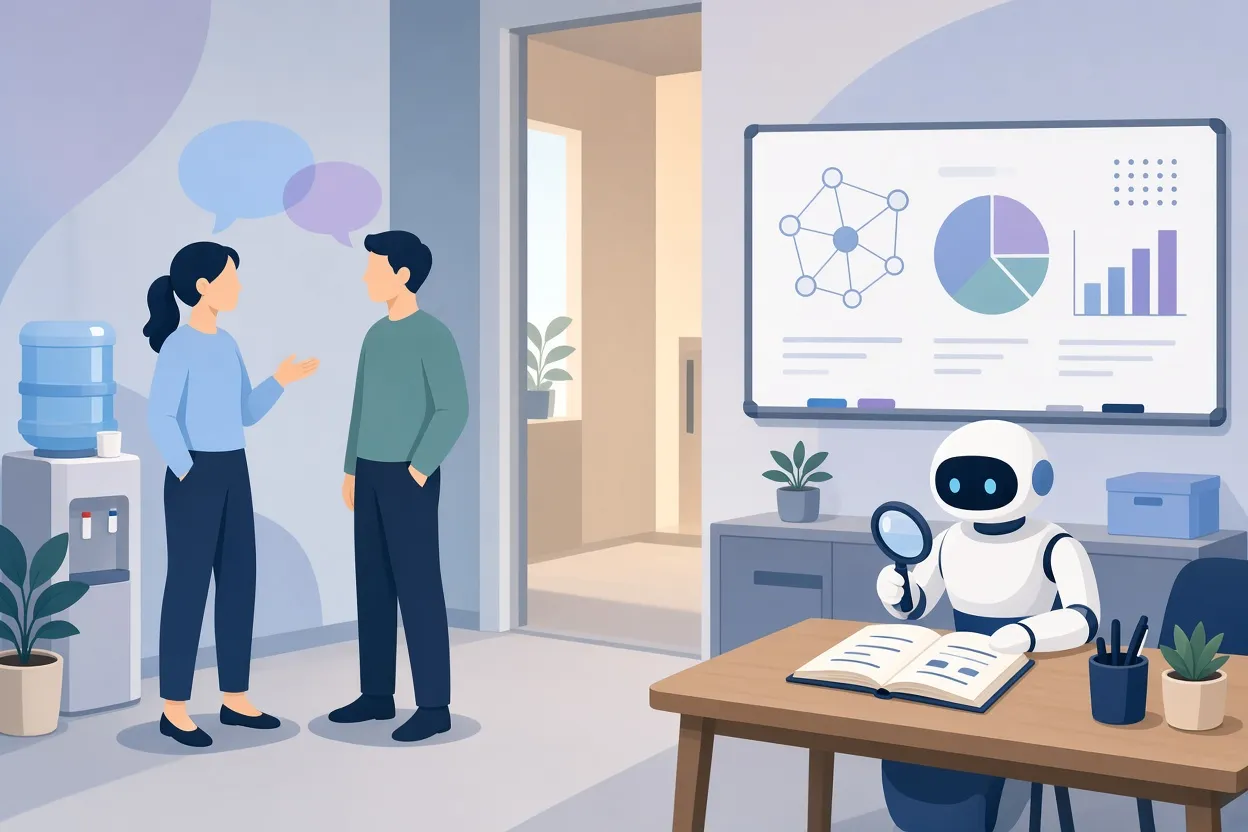
▲ Spoken versus written knowledge for AI
The recommended response is to record virtually all internal meetings and keep transcripts in shared systems, with one noted exception: sensitive one-on-one performance reviews. Transcripts and written decisions become the raw ingredients Claude uses to run workflows, make better suggestions and support decisions. The judgment here is that teams which document thoroughly will compound an advantage over time, while teams that leave knowledge at the water cooler will find their AI tools working from stale context.
A starter prompt after any meeting: "Here are my notes or transcript from today's meeting. Update our team's working document with any decision that changes how we work, and show me exactly what you changed." Having Claude update documentation and report the diff is a first step toward letting it maintain its own instructions, skills and projects.
Habit 6: After a new model, hand it harder work
Anthropic keeps an internal mantra about becoming more ambitious with AI as the models improve, and its data shows staff act on it. Immediately after each major model release, employees increase the complexity of the tasks they give Claude by about 30 percent. With release cycles speeding up and capability jumps growing, keeping a new model on the same routine work as the old one leaves most of its value untouched.
One way to operationalize this is a running list of high-value tasks that AI previously failed at. When a new model arrives, test the hardest item on the list first. An example prompt sets an aggressive target for a reporting process: "Right now our monthly report is ready about ten days after the month ends. I want it ready on the morning of the first. That's a reasonable goal. Show me exactly how we get there, and if a step looks impossible, keep working until you find a way."
Two framing choices in that prompt matter. Calling the goal reasonable and instructing the model to persist through apparently impossible steps appear to change how a frontier model approaches the problem and raise the odds it finds a path.
Habit 7: Build tools with instructions, not code
Anthropic's study found a sharp rise in non-technical employees building their own tools with Claude: from about 2 sessions per month to roughly 90 per month within a single year. Much of that building happens in natural language rather than code, and the case for that approach is practical.
| Instruction-based tools | Code-based tools |
|---|---|
| Easy to read, edit and iterate | Need ongoing bug fixes and patching |
| Adapt when context shifts | Can break when inputs change |
| Smaller security surface | Vulnerabilities can be found and exploited, increasingly by AI-assisted scanners |
Plain-language skills and projects are easier for everyday users to inspect and change, and the model can flex around shifting circumstances instead of crashing. Custom code, by contrast, pulls a team into maintenance cycles and adds cybersecurity exposure. The guidance is not "never code," but "code last and small."
A template prompt for tools like Claude Cowork or ChatGPT Work captures the rule. Describe the update you assemble by hand each week and point to the files it draws on. Ask for the simplest automation that can produce it, and state that written instructions packaged as a skill are the preferred form. Allow code only where instructions fall short, and require that any code stay as small and simple as possible. Finally, ask how to run the result and what to verify on each run. That last request matters: every automation should come with a short checklist of what to check each time.
What to do this week
The seven habits reinforce each other, but they do not need to be adopted all at once. A reasonable order:
- Start with Habit 1 today. Add the "ask all questions up front, then run without stopping" instruction to your next long task, and launch it before a meeting.
- The next time you repeat a task, ask Claude to turn the chat into a skill.
- Put the three-line summary format into your project instructions so every response starts with findings, approvals and uncertainties.
- Block 15 minutes on Friday for the setup audit.
- Record meetings and feed transcripts into a working document that Claude updates.
- Keep a list of tasks AI has failed at, and test the hardest one when the next model ships.
- When you automate something, ask for instructions first and minimal code only if necessary.
The underlying lesson from Anthropic's internal data is that the model is the same for everyone. The difference between a 15-minute hour and an ordinary one appears to come from how much context the model is given, how little it is made to wait, and how deliberately its users invest in the system around it.