Ardent, a Y Combinator-backed startup, creates fully isolated copies of production PostgreSQL databases in under six seconds so that dozens or hundreds of AI coding agents can test their changes in parallel without touching live data. The company did not start with that idea. Its founder spent a year shipping products nobody wanted, built an AI data engineer that kept breaking its own database, raised $2.2 million as a solo founder, pivoted in December with three customers paying $100 per month, and was admitted to Y Combinator on his eighth application after seven rejections. The story is useful less for its drama than for the decision rules it exposes: how a real problem gets noticed, how customer feedback redirects a product, and when to keep going after repeated nos.
The problem: parallel agents on one database
The founder's previous product was an autonomous AI data engineer. Running several agents at once against the same database exposed a failure mode that became the seed of Ardent: when two agents attempt conflicting schema migrations on a single state, they produce clashes that cannot be resolved, along with corrupted data. Agent One overwrites what Agent Two depends on. Without isolation, engineers cannot realistically validate migration scripts or schema changes before merging them into production, and the collisions eventually surface as outages that are expensive to recover from.
Ardent's framing is that Git and GitHub solved this for source code through branching and cloning, and the same model should apply to live database state. The reason GitHub cannot simply extend its infrastructure to databases is physical. Source files are small and discrete, so cloning them is computationally trivial. Databases hold terabytes or petabytes of state, bound by disk input/output operations per second (IOPS, the number of read and write operations a disk can handle) and network bandwidth. Naive file copying does not scale.
Why shared staging environments fail
The conventional answer is a centralized staging database. Ardent's position is that this setup is a structural source of outages rather than a safeguard, for several reasons:
| Staging practice | What goes wrong |
|---|---|
| Full export and import | Six to eight hours per terabyte of data |
| Nightly synchronization jobs | One failed sync costs the whole team a day of work |
| Multiple agents on one staging database | Overlapping writes silently corrupt each other's state |
| Smaller data subsets | Edge-case anomalies that only exist in production are missing |
The last point matters for anyone testing code with AI agents: tests that pass on a trimmed subset can still break in production, because the anomalies that cause failures live only in the full dataset.
How the clones work
Ardent avoids physical copying entirely through copy-on-write architecture, a technique in which a new copy shares the original data and only writes new blocks when something actually changes. When an agent or engineer provisions a clone, Ardent creates a fresh compute instance whose pointers direct read requests to the original dataset. Metadata handles index routing and structural references. Because no raw data moves, a clone of a petabyte-scale database appears in under six seconds.
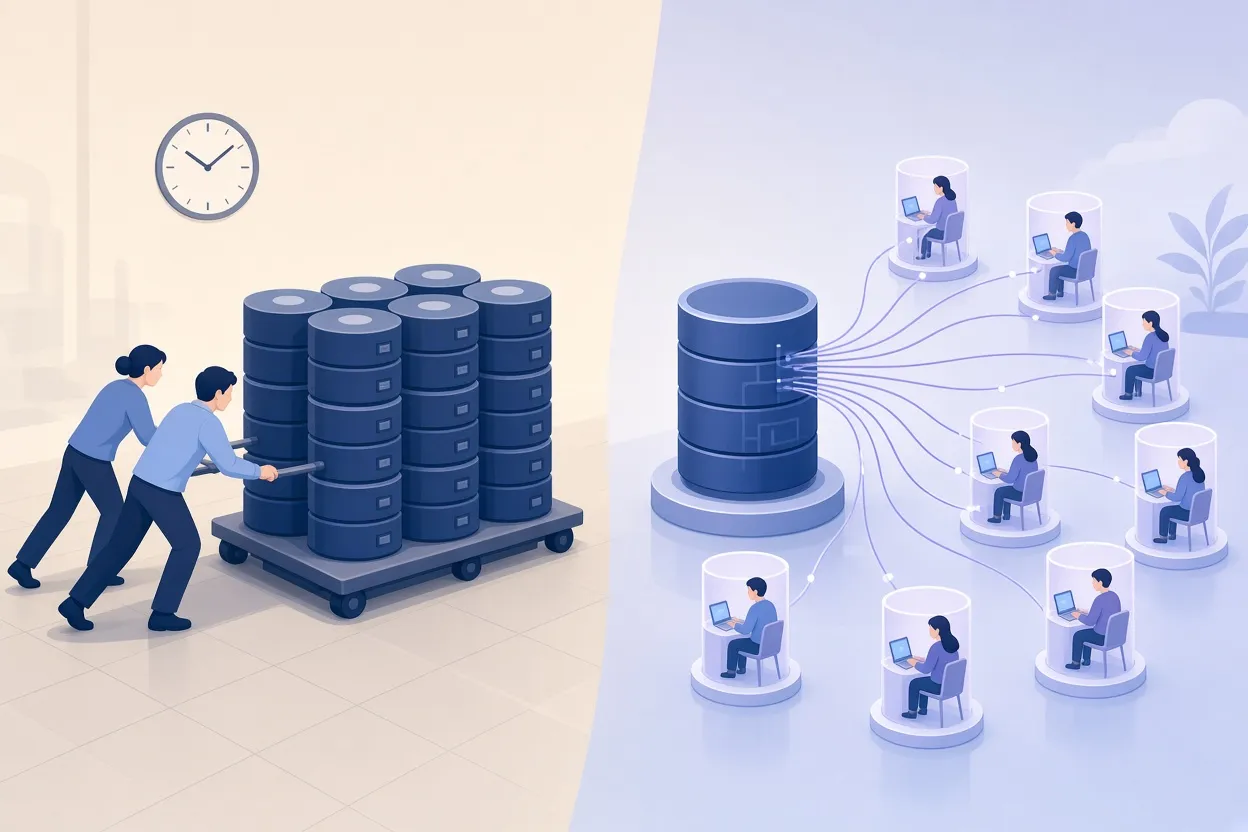
▲ Staging data copies versus copy-on-write clones
This is also why database sandboxes cannot be built the way ordinary compute sandboxes are. A compute sandbox that tries to load full enterprise tables into memory crashes immediately; database state imposes different limits on memory, disk and networking. Ardent is designed to scale horizontally, which the company says allows hundreds, thousands or tens of thousands of active clones to run at the same time.
Onboarding has been reduced to four command-line interface (CLI) commands: authenticating, connecting a database with a connector command, creating a branch with a name such as a feature label, and inviting team members. One customer wired Ardent to Linear, an issue tracker, and cloud-hosted coding agents. He dispatched a backlog of database tasks from his laptop, closed it while sitting in his car, and let the agents validate their work against real database clones in the cloud.
Who understood it, and how customers arrived
Fundraising for Ardent required a contrarian pitch. Many investors conflated database sandboxes with basic compute sandboxes, and those without hands-on infrastructure experience did not see why state changes the constraints. The investors who grasped the value quickly were former technical operators who had personally dealt with staging corruption and broken migrations. Widely shared accounts on X of an autonomous AI agent wiping a live production database helped raise awareness. The practical lesson for deep infrastructure founders is to filter for backers who have felt the problem.
Customer acquisition has been organic, driven by consistent posting and engagement on X and LinkedIn. Because developers who deploy agents tend to hit database corruption on their own, inbound prospects usually arrive already understanding the problem. When demand is real, the company argues, the first call stops being a sales pitch and becomes onboarding; one customer reportedly spent the first ten minutes of an onboarding call expressing amazement at the cloud automation.
The road to the pivot
The current product sits on top of a long run of failures. In 2023, working as a pure software engineer, the founder spent roughly a year building four products that nobody wanted. Five users would try a prototype and churn immediately. Development cycles were longer then, because automated AI coding tooling was less advanced, which made each wasted month more costly. The experience, he says, taught him the unmistakable feeling of building something nobody cares about.
The next idea came from his machine learning background: model outputs are constrained by upstream data quality. To test whether data quality was the real bottleneck, he interviewed 50 to 60 machine learning and data engineers before building. He then reversed his earlier sequence, creating a minimal prototype or landing page and trying to sell it first. As a solo founder he spent a year building and marketing the AI data engineer, raised $2.2 million on his own, and closed initial annual recurring revenue contracts.
In December he recognized that validating the outputs of the AI data engineer was the fundamental bottleneck, not just for his users but across the industry. That recognition, combined with the database collisions he had seen when running agents in parallel, drove the pivot ahead of Y Combinator. The early minimum viable product entered the program as a functional but buggy prototype. Three pilot customers paid $100 per month each and submitted branch IDs and bug reports daily, which the founder reads as a signal that the product addressed an urgent problem for them.
A one-way ticket and a year on a couch
Before any of this, the founder had finished a master's degree in Seattle and turned down corporate engineering offers. His view is that Seattle's ecosystem, dominated by mature Big Tech companies, orients people toward high salaries, homeownership and work-life balance, which can leave a founder starting from zero feeling isolated. He wanted an environment obsessed with starting companies from scratch, so he liquidated his investments and savings into $10,000, bought a one-way ticket to San Francisco, and planned to sleep on a friend's couch.

▲ A founder's year on a couch and seven rejections
To remove any chance of backing out, he posted a photo of the ticket on X. He had rarely posted before, had never sold anything online, and expected about five likes; his previous best post had reached roughly 300 views. Within two hours, prominent Bay Area accounts were quote-posting it, and the post reached 250,000 views overnight, bringing direct messages from investors, collaborators and local founders. The flight was booked three months out; he moved it to that weekend. He then spent almost a full year on a couch building the business.
That experience shaped his view of distribution. Early virality feels like luck, but with enough repetitions it becomes an engineered system; he says he learned to reliably generate 100,000 to 200,000 views on a biweekly cadence. His practical rules are to publish ordinary building experiences and honest reflections rather than waiting for a world-changing announcement, and to cross-post the same message with light reformatting to X and LinkedIn instead of crafting separate personas, which he finds unnatural and exhausting. He also cautions that a large following does not automatically translate into good hires.
Eight applications to Y Combinator
The founder applied to Y Combinator seven times and was rejected each time. Friends who were YC alumni pushed him to apply an eighth time, arguing there was no downside. After submitting, he received an interview invitation within four days and traveled in person. The acceptance email from a YC group partner landed in his spam folder, causing a day of panic until a follow-up call.
He frames the decision to give up equity for an accelerator as a strict calculation: does the network, community and capital measurably improve the odds of success? In Ardent's case, the program provided brand credibility, customer introductions and access to talent, including a CTO with 20 years of data engineering experience. Delegating technical responsibilities to that CTO let the founder parallelize execution and focus on strategy.
Market first, build second
The founder's strongest advice is to validate demand before writing serious code. His numbers: if 20 targeted potential customers confirm the pain and agree to pay recurring monthly fees, technical risk becomes secondary, and the engineering job becomes delivering on what was presold. More broadly he recommends speaking with 40 to 50 potential users before investing time and money in development. Modern tooling makes building so easy that it tempts founders to skip this step.
Sales, in this view, is discovery rather than persuasion. If you have to aggressively convince customers, the product is not good enough; customers pay readily when a product deletes a headache. He also argues for capital discipline: raise only what is strictly necessary, keep per-customer servicing costs margin-profitable, maintain low burn toward Series A milestones, and protect the equity pool so outsized grants can go to the engineers who build the business. Raising large rounds without demand, he warns, creates false momentum that is hard on morale. His stated ambition for Ardent is an exit of at least $20 billion.
What founders can take from this
The pattern that runs through Ardent's history is that the business came from a problem the founder hit himself while running agents in parallel, confirmed by customers who were already in pain. The pivot followed feedback, not a whiteboard. For founders anywhere outside a major hub, including those weighing whether to leave a comfortable corporate ecosystem, a few decision rules stand out:
- Treat your own recurring technical failures as candidate problems; the database collision that became Ardent first appeared as a bug in another product.
- Interview 20 to 50 target users and attempt a presale before building, and treat a first call that turns into onboarding as the real demand signal.
- Never point multiple autonomous coding agents at one shared staging database, and do not trust tests on small data subsets that lack production anomalies.
- Publish progress consistently; a 300-view baseline can precede a 250,000-view post, but only if you post.
- Judge accelerators and funding rounds by whether they raise your odds, keep burn low, and protect equity for key hires.
- Reapply when the downside is nothing; the eighth YC application is the one that worked.
Persistence here is not blind stubbornness. It is the willingness to keep shipping, keep listening, and keep applying while the product changes underneath you.