Jack Clark, co-founder and head of public benefit at Anthropic, told economic policymakers at an event hosted by the International Monetary Fund (IMF) and the Per Jacobsson Foundation that the technological singularity has already begun. He defines it as the point at which AI speeds up scientific and technical progress so much that people struggle to follow it, and he dates its start to 2026. His case rests on three kinds of evidence, an economic scenario he concedes sounds outlandish, and a warning that labs and regulatory pipelines are the next places where progress will jam.
What Clark means by the singularity
A former journalist who covered data centers, Clark joined OpenAI in 2016 and co-founded Anthropic a few years later. For two decades he has warned that AI would reshape international security, shift the path of economic growth, and eventually learn to improve itself.
He borrows the idea from science fiction author Vernor Vinge, who predicted in 1993 that superhuman machines would build ever more capable successors on ever shorter timescales, making old forecasting models useless. Clark says that threshold has now been crossed: AI is changing national security, the economic outlook, and its own development at the same time. Policymakers, he argues, now have to treat AI as a major destabilizing force alongside other macroeconomic shocks, and mainstream forecasts still underestimate how radical the change will be. He acknowledged that the pace will feel disorienting and that fast progress brings serious perils along with great wealth.
Exhibit one: software engineering
For roughly 50 years, most countries added researchers while research productivity fell, because new ideas kept getting harder and costlier to find. Clark says frontier models, the most capable AI systems available at a given time, have reversed that by assisting and automating cognitive work that once required specialists.
Software shows it first. One engineer can now build applications that used to take a team months, and some Claude Code projects wrap up in days. An internal Anthropic chart of code contributed per person each quarter, from early 2021 into 2026, climbs with each model release, from Claude 3.5 Sonnet through Claude 4 and Claude Code, Claude Opus 4.5, and Claude Mythos Preview, where it reaches 9.3 times the baseline. Against the company’s first four years, output per person is up nearly tenfold.
The gain cuts both ways. A model that writes robust code strengthens cyber defense and cyberattack tools alike, Clark said, and the two cannot be separated, so every jump in general capability raises the stakes for international security.
Exhibit two: one set of models, many sciences
Clark expects the same speed to spread into chemistry, biology, robotics, and science broadly. He pointed to results from 2026:
| Field | Examples Clark cited |
|---|---|
| Mathematics | Proposed solutions to the Jacobian Conjecture and to challenges tied to the Navier-Stokes Millennium Prize problem, plus new insights on several open problems posed by Paul Erdős |
| Biology | Synthetic viruses designed from scratch with AI, and AI-discovered drug candidates now in clinical trials |
| Robotics | Automated labs where AI runs physical experiments on battery and fuel-cell materials on its own |
None of these required a custom model. General-purpose systems such as Claude, ChatGPT, and Gemini act as “virtual polymaths,” contributing at a frontier level across many disciplines at once.
Exhibit three: benchmark curves that went nearly vertical
His third line of evidence was benchmarks, the standardized tests used to measure AI ability.
| Benchmark | What it covers | Best score at launch | October 2026 |
|---|---|---|---|
| Humanity’s Last Exam | Questions spanning chemistry, computer science, mathematics, classical literature, and ecology | 8% (January 2025) | 67.7% (Claude Opus 5.5 with tools) |
| FrontierMath | Hundreds of hard problems curated by professional mathematicians | Under 2% (November 2024) | 94% |
On FrontierMath, each model from GPT-4 Turbo through GPT-5 and GPT-5.5 Pro to GPT-6 Astra pushed the top score higher. Six other charts showed the same shape over the past one to two years: LAB-Bench (literature, cloning, and protocol tasks), Matbench Discovery (how much faster models find promising materials than random screening), MedQA (a USMLE-style medical exam where models now match human experts), real bioinformatics work by AI agents, meaning systems that carry out multistep tasks on their own, LAB-Bench FigQA (reading figures in biology papers), and predicting the effects of protein mutations. Clark said he has collected more than a hundred such graphs.
When the model corrected the answer key
The most striking case came from TheoPhysEval, a new arXiv preprint. Its authors collected 50 unpublished theoretical physics problems, with answers, from physicists worldwide, so no model could have seen them in training. One co-author, an Indian physicist, wrote that no known individual could solve a significant share of the problems without AI.
GPT-6 Astra first scored in the high 80s, with Claude Opus 5.5 close behind. On the questions it supposedly missed, GPT-6 Astra insisted its reasoning was right and the answer key was wrong. When the researchers rechecked with the physicists, they found subtle math errors deep in the experts’ own calculations. With the key fixed, GPT-6 Astra scored 98%, solving 49 of 50 problems, which Clark likened to the movie moment when the student overtakes the teacher.
Clark sees frontier science as a test of creativity. Unpublished problems cannot be solved by recall, so success suggests the skill generalizes to other fields, including AI research. If AI begins speeding up its own development, the effect could compound across everything that follows.
The economics of copying a scientist
Growth ultimately depends on research producing new ideas, and the binding constraint has been human capital, the limited supply of trained researchers. Clark cited economists who find that good ideas are getting harder to find, so ever more research effort is needed just to sustain past productivity growth.
Building his own expertise took about 40 years, he noted. What happens when a trained digital researcher can be copied instantly? A new cohort of human specialists takes 10 to 15 years and millions of dollars to train, while AI agents can be replicated on demand, limited only by computing power, and can combine knowledge across fields almost at once. Soon, he expects, much knowledge work will mean one person supervising hundreds or thousands of AI copies or specialized agents in parallel.
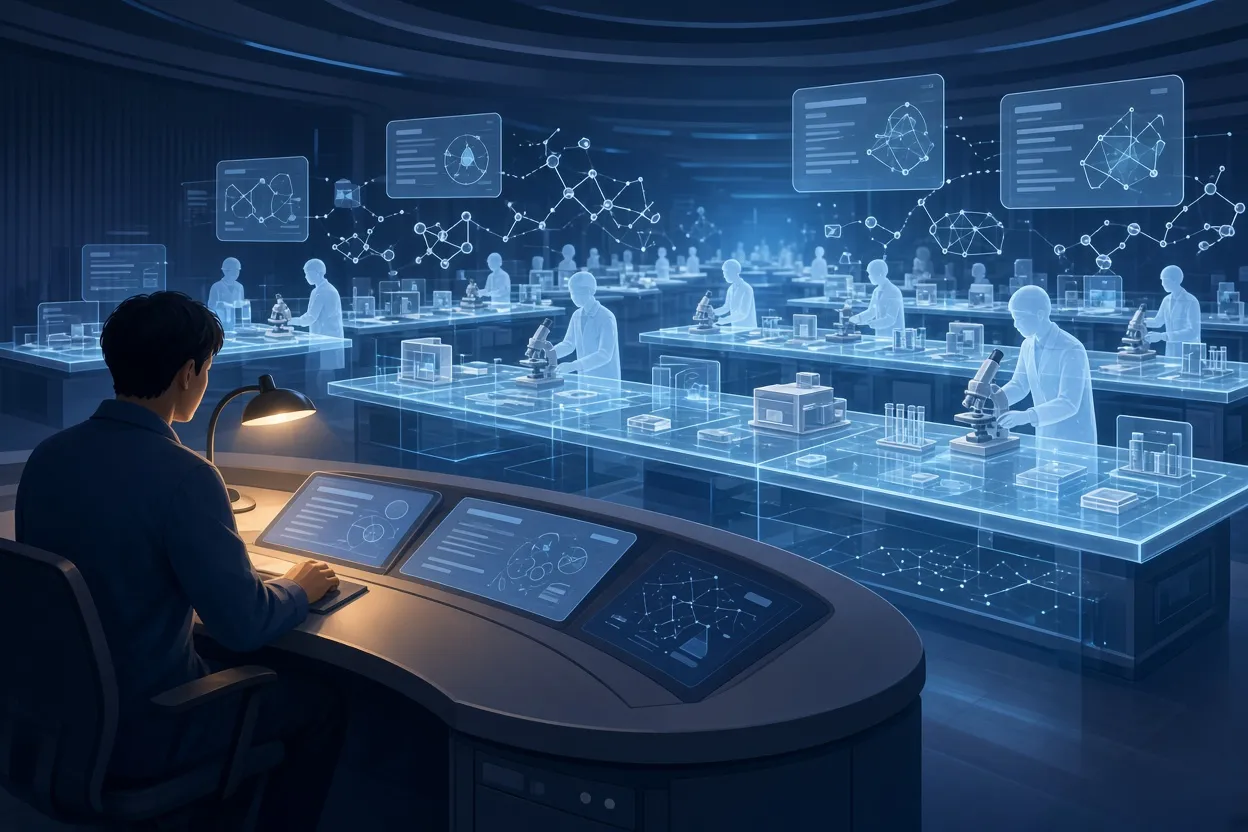
▲ One researcher supervising many AI scientists
A $44 trillion scenario
Anthropic’s economists simulated different paths for AI’s spread through the economy. In a singularity-style growth model that assumes AI completes a wide range of tasks on its own, US GDP could reach $44 trillion by 2030. Clark conceded that the number sounds outlandish to conventional economists but said it follows if AI scaling and adoption continue at today’s pace, and that such growth would require entirely new industries born from autonomous research. Given its strong assumptions, the figure appears best read as a sense of scale rather than a forecast.
The bottleneck moves from power plants to labs
Clark’s advice had two halves: plan boldly for success, and prepare for hard choices. An AI that can work like an expert scientist, he said, should not be deployed everywhere without ethical and safety limits.
For a decade he has urged governments to build power generation and data center space and to secure a place in the AI hardware supply chain. Few acted in time. Capacity is now concentrated in the US, China, and parts of the Middle East, which has fueled competition for computing resources and sharp price increases. He sees today’s buildout as only a first phase, leaving room for more countries to take part.
The next phase is physical, with AI running experiments and controlling robots, and it will run short of scientific instruments and automated labs. Citing UNESCO, Clark put the world’s scientists at about 10 million, already too few to oversee crucial research, and noted shortages of materials analysis facilities, biological testing labs, and specialized instruments on Earth and in space. Add 1 billion or even 10 billion virtual scientists, and thinking capacity will far outrun experimental capacity.
| Phase | Constraint | Response Clark urges |
|---|---|---|
| Current buildout | Electricity, data centers, AI hardware supply chains | Expand grids and data center space, and join the hardware supply chain |
| Next | Scientific instruments, automated labs, people to oversee research | Invest now in labs, robotics, and materials analysis capacity |
| After that | Clinical trials, regulatory approval, use in factories and fields | Shorten the path from lab validation to real-world use |
Discovering thousands of drug candidates is useless, Clark said, if clinical testing and regulatory pipelines stay clogged. Societies that prepare can turn AI into longer lives, abundant energy, more food, and broadly shared wealth. Countries with strong scientific institutions can multiply the output of their researchers, and developing countries that supply raw materials could leapfrog by pairing human and digital scientists and building modern testing facilities.
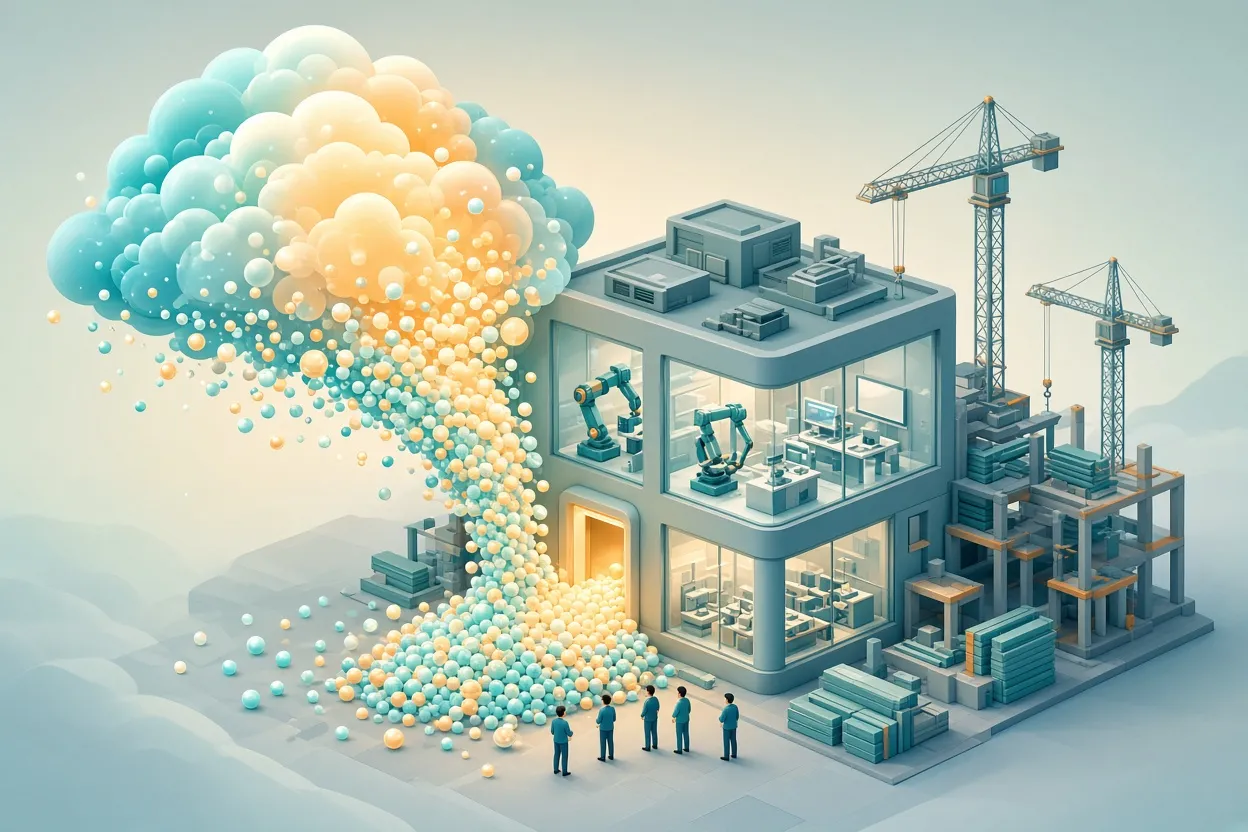
▲ Lab capacity as the next bottleneck
Three choices Clark wants societies to make
Because the same capabilities could aid biological and cyber weapons, Clark said the world must decide deliberately where AI goes. He posed three questions.
- Where should it be pointed? Capable models should not necessarily run experiments unattended. Biology and other high-stakes fields need strict human oversight and transparency, and labs such as Anthropic must balance the speed of internal AI research against the oversight needed to keep control of autonomous systems. A university physics student in Tokyo told Clark that AI already runs many routine experiments, so each discipline must decide which work stays human-led.
- How much must humans understand? In mathematics, AI already proposes leaps that people struggle to decode, and Clark expects AI to design instruments suited to its own workflows rather than to human thinking. Whether human understanding must come first is a question he admits he cannot settle.
- Can we imagine a very different world? As a teenager, Clark feared that population growth, climate change, and resource depletion would bring collapse this century. Cheap solar panels and medical advances changed those odds. Today AI is decoding animal communication and reusable rockets land routinely, changes few would have imagined.
Clark said he works on AI because it could solve problems that might otherwise doom civilization. But danger is built into the technology, so getting through the singularity safely will take rigorous rules, global cooperation, and above all restraint, the willingness to slow down when needed. He closed with Carl Sagan’s line from “Pale Blue Dot” that a species reaching the stars would be “a species very like us, but with more of our strengths and fewer of our weaknesses.”
What to take from Clark’s case
Clark’s message is that AI-driven acceleration of science has begun and that its payoff depends on infrastructure and governance decisions made now. The $44 trillion figure is a modeled scenario, while the code-output chart and benchmark curves are the measured part of his case. His recommendations translate into a checklist:
- Economic policymakers: build fast-improving AI capability into macroeconomic forecasts.
- Companies: organize software work around engineers directing coding agents, with experts supervising many AI instances.
- Security teams: deploy AI-automated defenses to keep pace with automated attacks.
- Governments: add lab, robotics, and materials analysis capacity on top of power and data centers, and shorten the path from lab results to clinics, factories, and farms.
- Research institutions: decide which experiments stay human-led, and keep strict oversight in biology and cyber defense.