Building an AI agent is the easy part. Wrap a language model in a loop, give it a few tools, and a working demo can come together quickly with existing frameworks. The hard part comes after the demo: running the agent in the cloud around the clock, recording what it does, scoring it with repeatable tests and fixing its failures one by one until it can be trusted with real work. That production work, not the agent’s core logic, is where most of the engineering effort goes.
From a human-driven loop to an agentic loop
Consider how most people use a large language model today. Say you want a React component. You type a prompt, read the answer and decide whether it is good enough. If something is missing, you ask again. You keep driving the question-and-answer cycle yourself until you are satisfied.
An AI agent takes over that cycle. You supply the starting goal, and from then on the agent decides at every step whether to give a final answer or to call a tool. When it calls a tool or produces an intermediate result, that output goes straight back into the loop as context for the next decision, with no human in between. This cycle is called the agentic loop. It may run once or many times, and it stops when the agent judges that the task is done.
| Traditional LLM workflow | AI agent | |
|---|---|---|
| Who drives the iteration | The human | The agent |
| Next step | The human types another prompt | The agent chooses an answer or a tool call |
| Intermediate output | Read and judged by the human | Fed back into the loop automatically |
| When it ends | When the human is satisfied | When the agent decides the task is done |
Two building blocks: the loop and the tools
Strip an agent down and two ideas remain.
The agentic loop
The loop is a language model wrapped in ordinary control code, such as a while loop, that keeps running until a stop condition is met. When the model emits a designated stop signal, such as the word “done,” deterministic parsing code in the host program detects it and breaks out of the loop.
Tools
On its own, a language model only produces text. Structured output, meaning responses that follow a fixed format the surrounding code can parse, changes that. The wrapper code can read the model’s output as function arguments and call real software functions with them. That is how an agent sends API requests, searches the web, queries databases or runs shell commands. The ability to pick and invoke these deterministic functions turns a text predictor into software that changes things in the real world.
Giving an agent a job: the AI employee
Once you can build a general agent, the next step is an agent built for one role, which can be thought of as an AI employee. What sets it apart is that its scope, its tools and the environment it runs in are all designed around a specific job.
- Software engineer: give it a file system, code editing tools and GitHub access to push and review code, inside an isolated environment where it can navigate repositories, change files and test its work on its own.
- Sales representative: give it a CRM, or customer relationship management system, an email tool such as Gmail and web search so it can research prospects and reach out to them.
- Customer support: the same approach applies, with tools and an environment matched to the role.
In practice, designing AI employees means studying how an organization is structured and mapping out a separate, well-equipped agent environment for each role.

▲ AI employees equipped for different roles
Why a first agent disappoints
The first agent anyone builds for a given task will almost certainly perform poorly without supporting systems around it. Turning an agent that behaves like a weak employee into one that works at the level of a senior engineer takes serious engineering discipline. That holds for every kind of agent, whether it writes code, sells or answers support tickets. The supporting work falls into seven areas.
| Area | What has to be solved |
|---|---|
| Deployment | Long-running agents are much harder to keep stable in the cloud than short-lived ones |
| Observability | You need to see whether the agent is doing its assigned task or making things up and drifting off course |
| Telemetry | An agent running 24/7 produces huge volumes of execution data, and the useful signals must be separated from the noise |
| Evals | Quantitative evaluations, paired with human oversight, show what the agent can actually do today |
| Human oversight | People review the agent’s work alongside the automated scores |
| Versioning | A/B testing in production runs two agent versions side by side to confirm an improvement before rolling it out |
| Improvement loops | The agent emits traces and spans, records of each run and of each step inside it, eval suites score them, and engineers fix failure modes one after another |
Two points stand out. First, collecting telemetry, the execution data a running system reports about itself, is not useful on its own. Without smart filtering, the volume can bury the signals you need to improve the agent. Second, the improvement loop never really ends. A production agent needs continuous evaluation, tracing and refinement for as long as it runs.
A six-step path from laptop to reliable agent
The most dependable way to learn this is by building. The path has six stages.
- Build one locally. Write an agentic loop on your own machine that can call external tools, and give it simple tasks.
- Deploy it. Move it to the cloud so it runs 24/7 and does not stop when you close your laptop. Teammates and other authorized people can then reach and monitor it at any time.
- Observe it. Set up observability that answers the basic questions: what the agent did, what path it took and whether it stayed faithful to the task.
- Evaluate it. Run a fixed battery of scenarios, for example 100 tests, to get a numeric reliability score. If the agent passes 90 of 100, the 10 failures are the cases to study.
- Improve it. Fix each failure mode you found.
- Make it reliable. Repeat the observe, evaluate and improve cycle until the agent reaches dependable production quality.
An agent that has made it through this path gives you the core skills to build your first capable AI employee.
From AI employees to an AI company
With one reliable AI employee in hand, the next step is many agents working together as an AI company. At that point the main bottleneck moves away from each agent’s logic and toward coordination between agents and the scalability of the overall design.
The key advice here is not to build each AI employee in isolation. When all agents share a common substrate and a single infrastructure layer, you avoid redoing the same work and can create, configure and run many agents consistently. That demand for coordination appears to explain why many technology companies are investing heavily in dedicated AI agent platforms.
The organizations that result are likely to be hybrids, with work split by comparative advantage. AI employees are strong at high-volume back-office tasks such as parsing, summarizing and synthesizing large amounts of data. People focus on creative, strategic and uniquely human work, and they supervise how the agents collaborate toward the company’s goals.
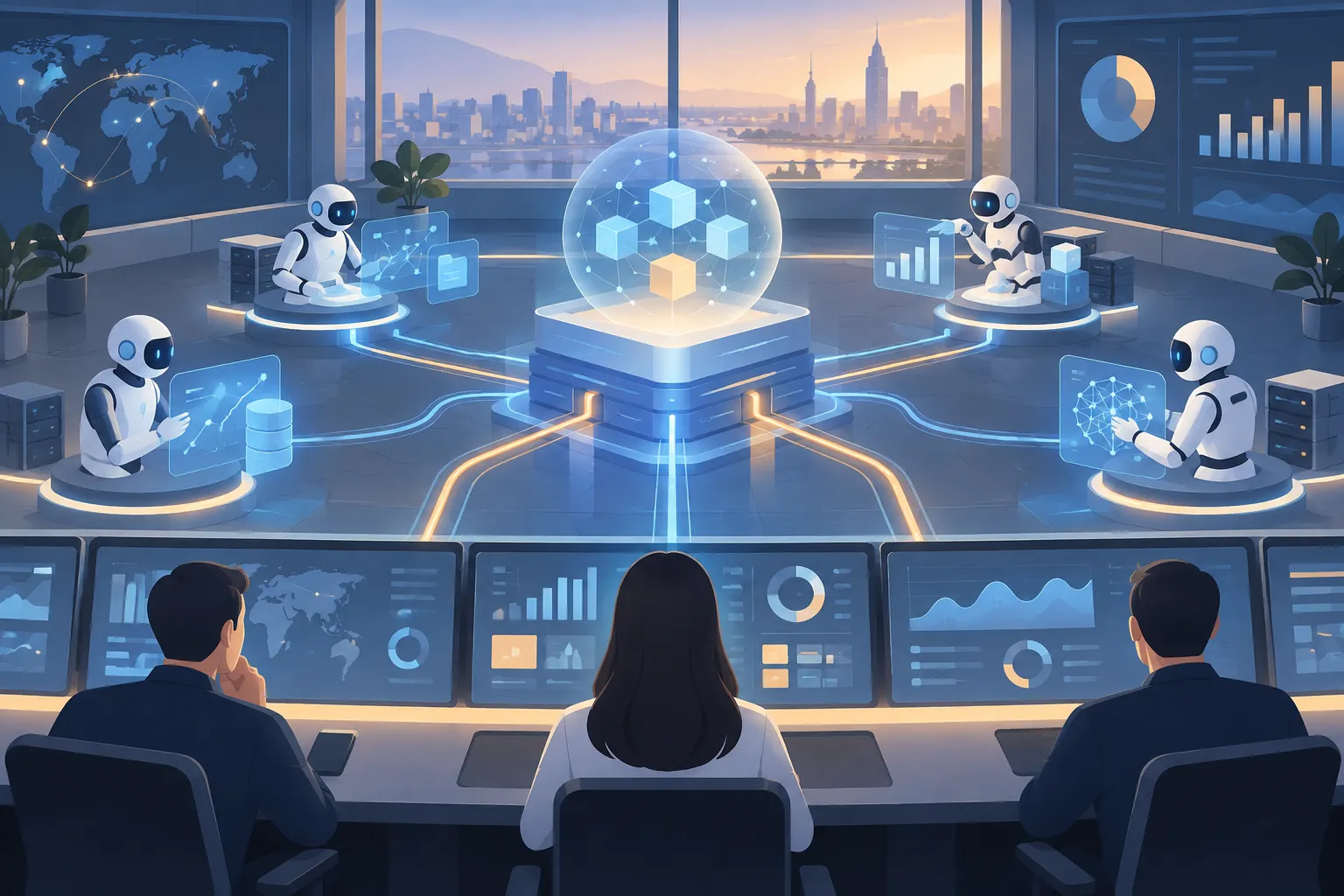
▲ An AI company built on a shared platform
A job-search platform shows what this coordination can look like. A resume coach agent reviews an uploaded resume, flags missing details such as graduation dates or school information, and rewrites sections. Separate interview agents handle coding, system design and behavioral rounds, and the coding screen uses 2 questions, a 60-minute limit and 3 supported programming languages. Another agent reverses the usual roles: it plays a novice student, the user has to teach it a concept such as binary search, and it scores the user’s code fluency, communication and correctness. The goal is to link these agents into one end-to-end flow that guides a candidate from application to job offer.
What to do next
An AI agent is a language model inside a loop with access to tools, and that structure is simple. The real difference between a demo and a dependable system lies in everything around it. If you are building agents, a practical order of work looks like this:
- Write a small agentic loop with tool calling on your own machine first.
- Move it to the cloud early so it runs 24/7, and capture traces and spans for every run.
- Build a repeatable eval suite, track a score out of 100 and fix the failures it reveals.
- Compare each new version against the previous one with A/B testing before switching over.
- If you expect to run several agents, design a shared foundation for them from the start.
A working demo is a starting point, not a finish line. Putting observation, evaluation and improvement systems in place early appears to be the faster route to an agent you can actually rely on.