Researchers now face a threat they did not have to think about a few years ago: AI-generated papers published under their own names, in journals they have never heard of, without their knowledge. At the same time, AI is compressing experimental biology that once took a year and a half into half an hour, regulators in England are warning universities about fines for unchecked AI cheating, and universities and education schools are rolling out new rules and tools for teaching in the AI era. Here is what changed this week for people who work in research and higher education, and what to do about it.
Papers you never wrote, published under your name
A Times Higher Education investigation found that obscure open-access journals have been publishing low-quality AI-generated papers while crediting respected professors as authors. The academics did not write, submit or approve the papers.
In one case, an associate professor of computer science at the University of Gothenburg found an AI-written article on sustainable development listed under his name on Google Scholar. When he asked the journal to remove his name, the journal did not withdraw the paper. It simply swapped his name for another researcher's, and then for a third, in sequence. Stanford University computer science professor Jure Leskovec confirmed that a journal had listed him as an author on a paper he had never submitted or seen. A postdoctoral fellow at Virginia Commonwealth University discovered his name on the editorial boards of predatory journals he had no connection to.
The motive appears straightforward. Predatory journals borrow the credibility of recognizable names to make their venues look legitimate, which helps lure PhD students and early-career authors into submitting manuscripts and paying publication fees. The named academics become unwitting advertising.
The defense: watch your own name
The most practical countermeasure costs nothing. Set up a Google Scholar alert for your full academic name. Any time a new paper appears with your name on it, you receive a notification and can act before the item spreads through citation databases and search results. For anyone whose career depends on a clean publication record, this is a quick task worth doing today.
AlphaGenome 2 reproduces 18 months of bench work in 30 minutes
A Nature report describes AlphaGenome 2, Google DeepMind's updated model for predicting how non-coding DNA sequences, the stretches of the genome that do not directly encode proteins, affect gene expression.
The headline test involved inflammatory bowel disease, or IBD. In 2024, a team of geneticists and immunologists at the Francis Crick Institute spent 18 months on wet-lab experiments to pin down a gene variant, ETS2, as a driver of the disease. DeepMind researchers then used AlphaGenome 2 to replicate key aspects of that finding. It took about 30 minutes and no pipettes.

▲ Eighteen months of bench work versus thirty minutes of AI
| Approach | Time to the ETS2 finding |
|---|---|
| Wet-lab experiments at the Francis Crick Institute (2024) | About 18 months |
| AlphaGenome 2 computational replication | About 30 minutes |
The immunologist who led the original work said that having an AI model confirm the team's experimental results was reassuring from a scientific standpoint.
Should bench scientists feel threatened or comforted? The honest answer may be a bit of both. Faster routes to disease mechanisms are good news for anyone waiting on treatments. But models of this kind can still hallucinate, meaning they can produce confident outputs that are wrong, so human verification remains essential. Seen that way, AlphaGenome 2 looks less like a replacement for the lab and more like a powerful second layer of verification: a fast way to check whether a hypothesis or an experimental result holds up before committing more months of bench time. It is worth keeping in mind that this was a replication of a result the lab had already established, so it says more about verification speed than about discovery.
What 207,000 research sessions reveal about how scientists use Claude
Anthropic published a study titled "AI for scientific discovery: How researchers use Claude," based on more than 207,000 research sessions on Claude and Claude Code, the company's command-line coding agent.
Adoption varies sharply by field. Computer science, engineering and biomedical or clinical science researchers use the tools heavily relative to their population size. Library science, the humanities, nutrition and dietetics, and religion show much lower relative use.
The task breakdown is more revealing:
- Data analysis dominates. It accounts for roughly 45% of Claude Code research sessions and about a third of standard Claude research sessions.
- Writing and communication is the second-largest category.
- Ideation, hypothesis generation and theoretical analysis remain relatively rare uses.
Survey responses in the same study show that fully autonomous AI use is uncommon. Researchers mostly work in assistive or shared modes, keeping a human in the loop rather than delegating entire tasks.
One reading of the low ideation numbers is that researchers are choosing to keep the creative core of their work for themselves. Coming up with the question is where much of the personal satisfaction in science lives, and the data suggests scientists are not eager to hand it over. Whatever the reason, the pattern offers a sensible template: lean on AI for analysis, data gathering and first drafts, and keep ownership of the hypotheses.
Regulator warns universities over AI cheating on take-home work
In England, the Office for Students (OfS), the higher education regulator, has warned that universities could face financial penalties if they fail to deal with AI cheating, according to a report in The Telegraph. The OfS notes that students frequently complete unsupervised take-home assessments in minutes using chatbots and earn grades equal to, or better than, peers who worked without assistance. The regulator cautions that this undermines both student engagement and public confidence in the value of a degree. A Department for Education spokesperson said universities must take the integrity issue seriously and enforce the standards they already have.
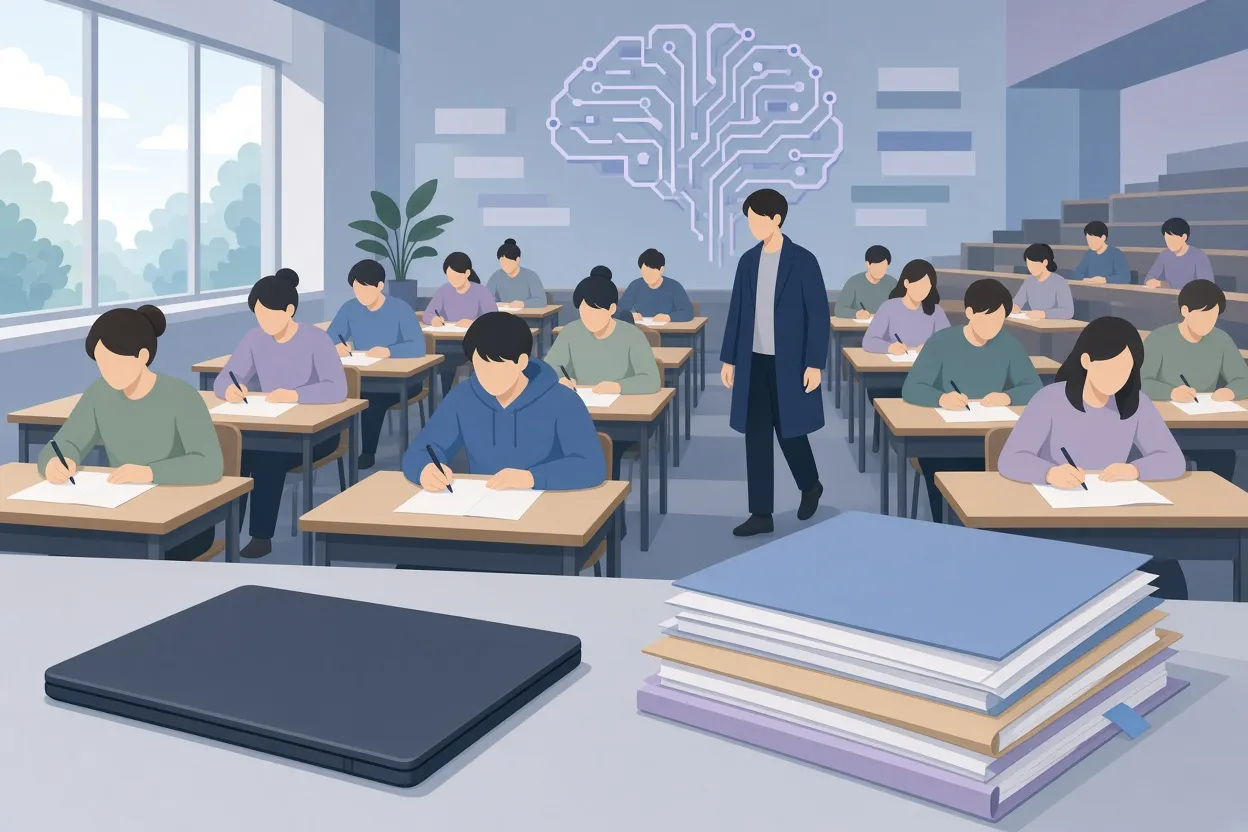
▲ Shift from take-home essays to supervised assessment
The uncomfortable part for institutions is that the obvious technical fixes do not work. Commercial AI detection software and text watermarking are unreliable and easily circumvented, producing an adversarial cat-and-mouse game that institutions are unlikely to win. If detection cannot be trusted, then an unsupervised take-home essay no longer tells an instructor much about what a student knows.
That leads to a conclusion some faculty may resist: fines target a symptom, but the root problem is the assessment format itself. Take-home essays can no longer serve as reliable proxies for learning, and assessments need to change. Invigilated written exams, oral examinations and other supervised formats are the realistic alternatives for verifying that a student understands the material.
Harvard's Compass Collaborative maps AI help and harm by age
For educators looking for structure rather than prohibition, the Harvard Graduate School of Education has released Compass Collaborative, an interactive resource subtitled "AI Guidance by Age."
The tool works through three dropdown choices:
- Select your role, for example a higher education educator.
- Select a developmental domain, such as cognitive foundations or language and literacy.
- Select an age bracket, such as 18 to 25 or 26 to 40.
The output includes a short "Quick Take" overview, concrete recommendations, key developmental processes and milestones for that age, and color-coded lists of ways AI can hinder or help development.
For language and literacy among 18- to 25-year-olds, the tool warns that relying on chatbots to draft or rewrite essays hinders the development of original thought and an independent voice. On the help side, it points to using AI for targeted critique: asking it to identify structural weaknesses and logical gaps without fixing them, so the student still does the revising and learns critical reading in the process.
One caveat: the recommendations are grounded in the human development literature and framed as evidence-based hypotheses, not as settled empirical findings. Even so, they offer educators something concrete to translate into classroom prompting policies, for instance a rule that AI may review a draft but may not rewrite a sentence.
University of Chicago mandates an AI-free writing course
Inside Higher Ed reports that the University of Chicago will require all incoming first-year undergraduates to take a strictly AI-free writing course. The university's writing center runs the course, with the goal of establishing foundational habits in composition and reasoning before students begin using AI tools. Alongside it, the university is setting up writing labs and campus partnerships where faculty and students can experiment with both traditional and modern writing technologies.
The logic resembles the way mathematics education has long handled calculators: students sit a non-calculator section to prove they understand the underlying operations, then a calculator-permitted section where the tool extends what they can do. Whether every university should adopt a mandatory AI-free foundation year is an open question, but the approach offers a clear model for teaching the skill before teaching the shortcut.
What to do now
The week's developments point in two directions at once. AI is speeding up the mechanics of research, from genomic prediction to data analysis, while also destabilizing the trust structures of publishing and assessment. A few concrete steps follow:
- Set up a Google Scholar alert for your name so you learn quickly if a journal lists you as an author without consent.
- Use AI where the usage data suggests it is most valuable, in data analysis, data gathering and early drafting, and keep hypothesis generation in human hands.
- Treat AI outputs that confirm experimental results as a verification layer, not a substitute for the experiment, and keep a human in the loop.
- If you teach, stop relying on AI detectors and watermarks, and move high-stakes assessment toward supervised or oral formats.
- Bookmark Compass Collaborative and use its hinder-versus-help lists to write explicit, age-appropriate AI policies for your courses.
- Consider whether an AI-free foundation stage, in the spirit of the University of Chicago's writing requirement, makes sense for your program before students are allowed to augment their work with AI.