Anthropic has set the terms for its initial public offering. According to a CNBC report, the company plans to sell 825 million shares at $70 to $78 each, price the deal on November 18, and begin trading on the Nasdaq on November 19 under the ticker symbol ANT. At the top of the range, the offering would raise up to $64.35 billion and value the company at roughly $1.405 trillion on a fully diluted basis. The numbers are enormous, but the filing behind them raises questions that go beyond Anthropic itself: how much of the AI sector's funding is being passed to the public market, how thin the returns are for the investors who got in last, and whether the whole structure is starting to look like a bubble.
The deal at a glance
| Item | Figure |
|---|---|
| Price range | $70 to $78 per share |
| Shares offered | 825 million |
| Pricing date | November 18, 2026 |
| First trading day | November 19, 2026 |
| Exchange and ticker | Nasdaq, ANT |
| Maximum proceeds | $64.35 billion |
| Fully diluted valuation at top of range | About $1.405 trillion |
| Previous private valuation (May 2026) | $965 billion |
| Retail allocation | About 20% of the offering |
Earlier talk had Anthropic heading toward a historic $2 trillion valuation. Expectations have since moderated to the $1 trillion to $1.4 trillion range, and estimates swung from $1.02 trillion to $1.405 trillion within days before the range was set. That volatility is a reminder that public-market valuations are built from negotiation and sentiment as much as from spreadsheets.
An unusually large slice for retail investors
The most distinctive feature of the deal is the retail tranche. Anthropic is targeting roughly 20% of the offering for individual investors, compared with the 5% to 10% that is typical for an IPO. That is double to quadruple the norm, and it mirrors the approach SpaceX used in its record-setting IPO five months earlier, which raised $85.7 billion with a similarly large retail component.
There are two ways to read this. The charitable reading is that Anthropic wants ordinary people to share in the upside, which echoes language in its prospectus that calls every shareholder, individual or institutional, an active partner in its mission. The more skeptical reading, and the one this analysis leans toward, is that a large retail slice helps manufacture demand where institutional appetite may be softening.
Foundational AI companies are well suited to that strategy. Consumers interact with chatbots every day and carry decades of science-fiction imagery about artificial intelligence, so many feel they understand the business in a way they never would for an enterprise networking vendor such as Juniper Networks or a legacy provider such as IBM. But familiarity with a chat window is not the same as understanding neural networks, vector databases, retrieval-augmented generation (RAG, a technique that lets a model pull in outside documents before answering), latency, or storage arrays. That gap is where retail investors can get hurt.
What the filing's numbers actually show
Anthropic's financial disclosures contain both a remarkable growth story and a headline loss that needs careful unpacking.
| Metric (nine months ended September 30, 2026) | Figure |
|---|---|
| Revenue | $33.24 billion |
| Year-over-year revenue growth | About 1,200% |
| Net loss | $104 billion |
| Net loss, same period in 2025 | $25.1 billion |
| Non-cash charges within the 2026 loss | About $80 billion to $82 billion |
| Run-rate revenue at end of October 2026 | About $81 billion |
| Sequential monthly increase in run rate | About $10 billion |
The revenue line is striking on its own: $33.24 billion in nine months, up roughly 1,200% from the prior year, with annualized run-rate revenue reaching about $81 billion by the end of October after a $10 billion jump in a single month.
The $104 billion net loss looks catastrophic next to that, but the bulk of it is not cash leaving the building. Roughly $80 billion to $82 billion comes from fair value adjustments on convertible notes and derivative liabilities. Convertible debt is a common startup financing tool: investors lend money that later converts into equity. When a company's enterprise value soars, accounting rules require the company to revalue those instruments, and the resulting charge flows through the income statement even though no cash changes hands. Strip that out, and the operating picture is closer to the $25.1 billion loss reported for the comparable period in 2025, still a large number but a very different one.

▲ Revenue growth versus accounting-driven losses
The practical lesson for readers is to separate operating losses from non-cash accounting charges before reacting to a headline figure. The reverse also applies: a huge run-rate revenue number should not be allowed to obscure the real cash burn underneath it.
Compute partners buying in at the IPO price
Alongside the public offering, Anthropic has signed private placement agreements worth $26 billion with AMD, Broadcom, Google, Micron, Microsoft, NVIDIA, and TSMC, who will buy Class N common stock at the IPO price. These are the companies that supply the chips, memory, networking, and cloud capacity that AI labs consume at enormous scale.
That arrangement is worth weighing in the bubble debate. Suppliers of compute are becoming shareholders in an AI lab, which can be read as a show of confidence from the companies closest to the technology. In this reading, though, it also means that part of the capital flowing into Anthropic comes from the same firms that sell chips and capacity to the sector, so the money is more tightly looped together than the headline fundraising figure suggests.
The math for the investors who came last
The most sobering calculation involves the institutions that backed Anthropic in May 2026 at a $965 billion valuation.
- If the stock settles near a $1 trillion valuation, those investors gain roughly 4%, barely enough to cover transaction costs.
- If it trades at the top of the range, around $1.405 trillion to $1.5 trillion, they realize about 1.5 times their money, or roughly a 50% gain.
Venture and late-stage institutional funds typically underwrite foundational technology bets expecting returns of 10x or more, not a 4% to 50% markup. Compressed returns for the final private round suggest that much of the easy appreciation may already have been captured before the public ever gets a chance to buy.
This is where what might be called lemming behavior becomes a risk. Retail buyers tend to assume that earlier investors made fortunes and that entering at $1.4 trillion is safe because the valuation will surely reach $3 trillion or $4 trillion later. When the previous round is nearly flat, that assumption rests on hope rather than precedent.
Narrative versus hardware: the SpaceX comparison
The SpaceX listing offers a useful recent test case for how a hyped, retail-heavy IPO trades once the public gets in.
| SpaceX share price | Level |
|---|---|
| Initial listing price | $135 |
| First-day price when retail could buy | $150 to $155 |
| Peak during initial surge | $221 |
| Low after correction | $104 |
| Recent level | About $141 |
Investors who bought on day one at $150 to $155 are still down roughly 8% to 10% even after the recovery to about $141. Timing, not conviction, determined the outcome.
Yet SpaceX has something Anthropic does not: physical infrastructure. It owns launch rockets, the Starlink satellite constellation, and proprietary data processing systems, and it is developing orbital data centers and its own microprocessors. Whether space-based AI data centers are a rational idea is open to debate, and SpaceX may well be overvalued against its fundamentals, but its core aerospace business delivers concrete achievements that justify at least some of the excitement. Anthropic's excitement centers largely on software, with Claude Code, its agentic coding tool, as the flagship. Software can be enormously valuable, but it does not provide the same tangible moat as a rocket on a launch pad.
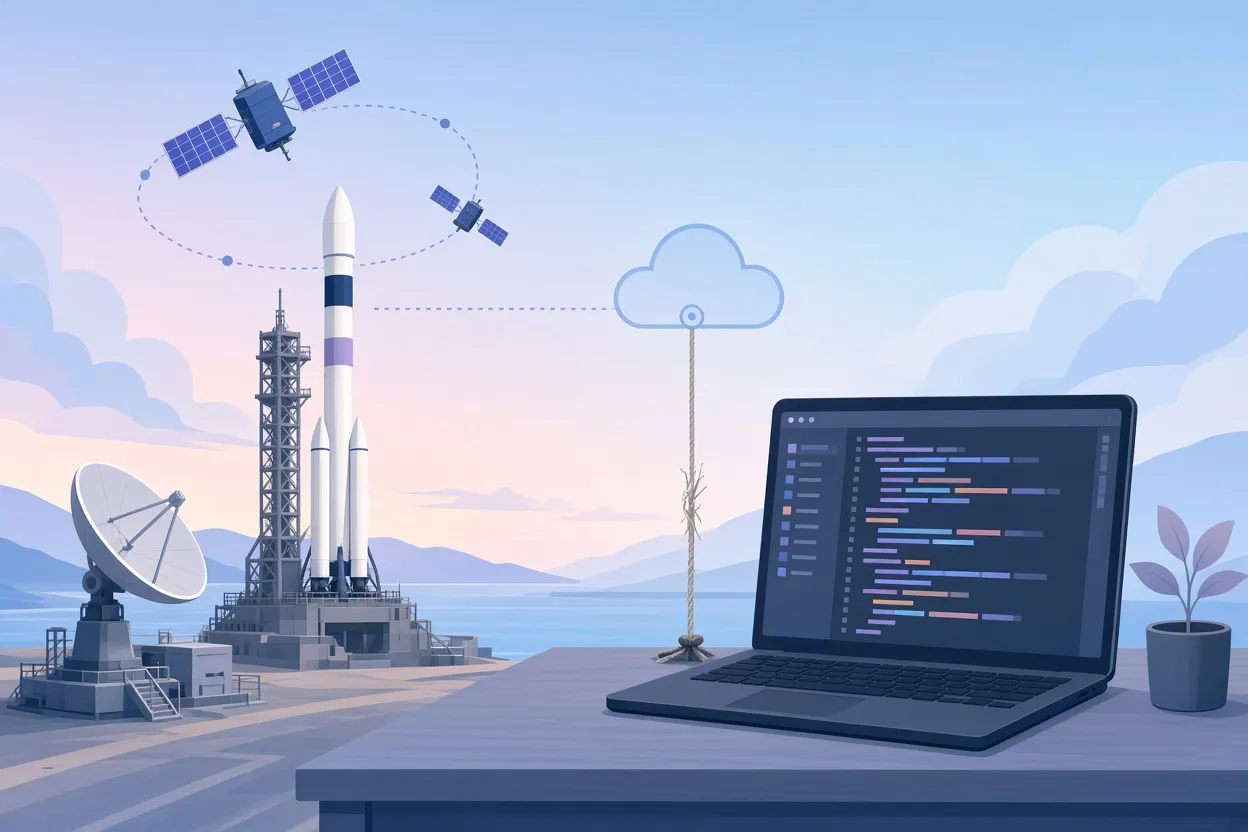
▲ Physical infrastructure versus software valuation
The other difference is the role of personality. Tesla's valuation has long detached from conventional metrics because investors are effectively betting on Elon Musk as a visionary. One illustration: a Cybertruck owner who paid $110,000 for the vehicle explained that build quality and practicality did not matter, because he wanted to back someone who takes big swings. That kind of loyalty is irrational by consumer logic, but it is real and it moves markets. Anthropic's prospectus appears to be reaching for a similar narrative premium, inviting shareholders to fund an epochal vision rather than simply buy equity in a company that rents compute. It is hard to see, however, that a comparable personality-driven retail following has formed around Anthropic's leadership, and CEO Dario Amodei's frequent public warnings about AI's dangers make the pitch a more complicated sell to mainstream investors.
Miracles and extinction in the same document
That tension runs through the prospectus itself. Anthropic's co-founders describe a mission to guide humanity safely through technological change, unlock new frontiers, and usher in an "age of miracles." The same filing acknowledges catastrophic risks, including the potential eradication of humanity.
By traditional financial standards, that is a bizarre combination: a document that asks the public for tens of billions of dollars while stating that the product could end human civilization. An age of miracles is appealing, but survival is a prerequisite for enjoying it. Whether a reader is enthusiastic or skeptical about AI, the pitch is unusual, and it may explain the general sense of public indifference around what should be one of the most consequential listings in years.
What this signals for the AI funding cycle
Put the pieces together and a pattern emerges. A late-stage round priced close to the IPO. A retail tranche far above the norm. Compute suppliers taking equity in their customer. A net loss dominated by accounting effects of prior financing. Cautious wording even in mainstream reporting, which framed the listing conditionally with phrases such as "should Anthropic reach the Nasdaq this month."
None of these facts proves a bubble on its own. Together, in this reading, they suggest a sector in which private capital has pushed valuations about as far as it can and is now turning to the public market to absorb the next leg. The concern is that if demand disappoints, the broader tech sector could face an abrupt reckoning of the kind associated with Bear Stearns in 2008. That is a risk scenario, not a forecast, but it is the scenario that the structure of this deal invites people to consider.
Key takeaways and what to do
- Anthropic plans to list on November 19 at $70 to $78 a share, raising up to $64.35 billion at a valuation of about $1.405 trillion.
- Revenue growth is extraordinary, but the $104 billion loss is mostly non-cash revaluation of convertible debt; read the operating line separately.
- The May 2026 round at $965 billion would earn only 4% to 50% at IPO prices, a thin margin for venture-style risk.
- A 20% retail allocation and $26 billion of supplier purchases are worth noting as signals about where demand is coming from.
- SpaceX's post-IPO trading shows early retail buyers can remain underwater even after a recovery.
For readers considering the offering, the prudent course is to watch rather than rush. Check whether a company's valuation rests on physical infrastructure or on narrative enthusiasm, compare the last private round with the IPO price, and look past both the growth headlines and the loss headlines to the cash the business actually generates and consumes. This article offers analysis, not investment advice, and the decision belongs to each reader and their own financial circumstances.


