OpenAI's new GPT-6.1 Terra model changes the arithmetic of vibe coding, the practice of describing software in plain language and letting an AI agent write the code. In a controlled comparison of eight software builds, Terra working through Codex CLI finished the full set for $7.64 in API fees, while Anthropic's Claude Opus 5.5 working through Claude Code finished the same set for $60.19. Terra was also about twice as fast. The trade-off is quality at the high end: on complex 3D scenes, game mechanics and polished visual design, Opus 5.5 still produced clearly better results. For developers deciding where to spend a token budget, the question is no longer which model is smarter but which share of their work actually needs the expensive one.
The price list behind the shift
GPT-6.1 Terra sits below GPT-6.1 Sol and Astra in OpenAI's lineup, and its standard API pricing is the reason it matters for cost planning:
| Token type | GPT-6.1 Terra price |
|---|---|
| Input | $1 per million tokens |
| Cached input | $0.05 per million tokens |
| Output | $5 per million tokens |
OpenAI positions Terra at roughly 50% lower API cost than both GPT-5.6 Terra, the previous generation, and GPT-6.1 Sol. For agentic coding, where a model can generate hundreds of thousands of output tokens across a handful of projects, the output price is the figure that dominates the bill.
How the eight-build test was run
The comparison was designed to isolate model behavior from tooling differences. Both models received identical prompts and identical tool access, ran at the same time, and used their maximum reasoning effort. Each ran inside its native coding harness, meaning the command-line agent built by its own maker: Codex CLI for GPT-6.1 Terra and Claude Code for Claude Opus 5.5.
The aggregate results across the eight builds:
| Metric | GPT-6.1 Terra | Claude Opus 5.5 |
|---|---|---|
| Average build time | 23 min 43 sec | 43 min 52 sec |
| Total output tokens | 506K | 1,558K |
| Output token cost | $2.53 | $31.17 |
| Total API cost incl. input | $7.64 | $60.19 |
Terra generated roughly one-third of the output tokens Opus 5.5 did, and it did so at a lower price per token. Those two effects compound into the one-twelfth cost ratio. Speed followed the same pattern: on every build with a reported time, Terra finished in half of Opus 5.5's time or less.
Where Terra's cheaper output held up
The individual builds show where the savings come without a quality penalty and where they do not.
Stormwatch: a 3D weather globe
The first project was a real-time interactive observatory tracking global weather systems. Terra produced it in 10 minutes and 40 seconds: a rotating Earth with daylight cycles, wind direction vectors, and hurricane tracking cards. Clicking a storm such as Hurricane Orion, Vela or Nami brings up projected paths, coordinates, wind speeds and atmospheric pressure.
Opus 5.5 took 43 minutes and 16 seconds and built toggleable layers for wind, clouds, storm tracks and city lights, plus deep zoom into vortex centers rendered with swirling fluid particles. Even so, Terra's overall globe rendering and color palette appear more cohesive, and it reached that quality in about a quarter of the time. This is the strongest case for Terra: a visually rich but structurally conventional web application.
The Long Night: a sea storm simulation
The second project depicted a ship near an offshore lighthouse in a North Sea setting. Terra finished in 21 minutes and 31 seconds with a storm slider running from calm seas to hurricane and camera angle controls. Its water, however, shows visible tiling artifacts and repeating grid patterns.
Opus 5.5's version, titled Skerry Light, took 41 minutes and 6 seconds and added volumetric light beams, dynamic lightning strikes and a cinematic ship-deck camera mode. Its lighting and ocean motion were clearly superior, though neither model produced photorealistic water physics.
Minecraft after dark: a voxel sandbox
Both models handled the obligatory block-world test easily. Terra built terrain generation, river valleys, foliage and real-time block placement and destruction. Opus 5.5 produced a warmer scene with procedural sunrise lighting, a held sword and placeable glowing light blocks. The more useful finding is that basic voxel mechanics appear to be a saturated benchmark: current frontier models handle them without difficulty, so this kind of task no longer separates models or justifies premium pricing.
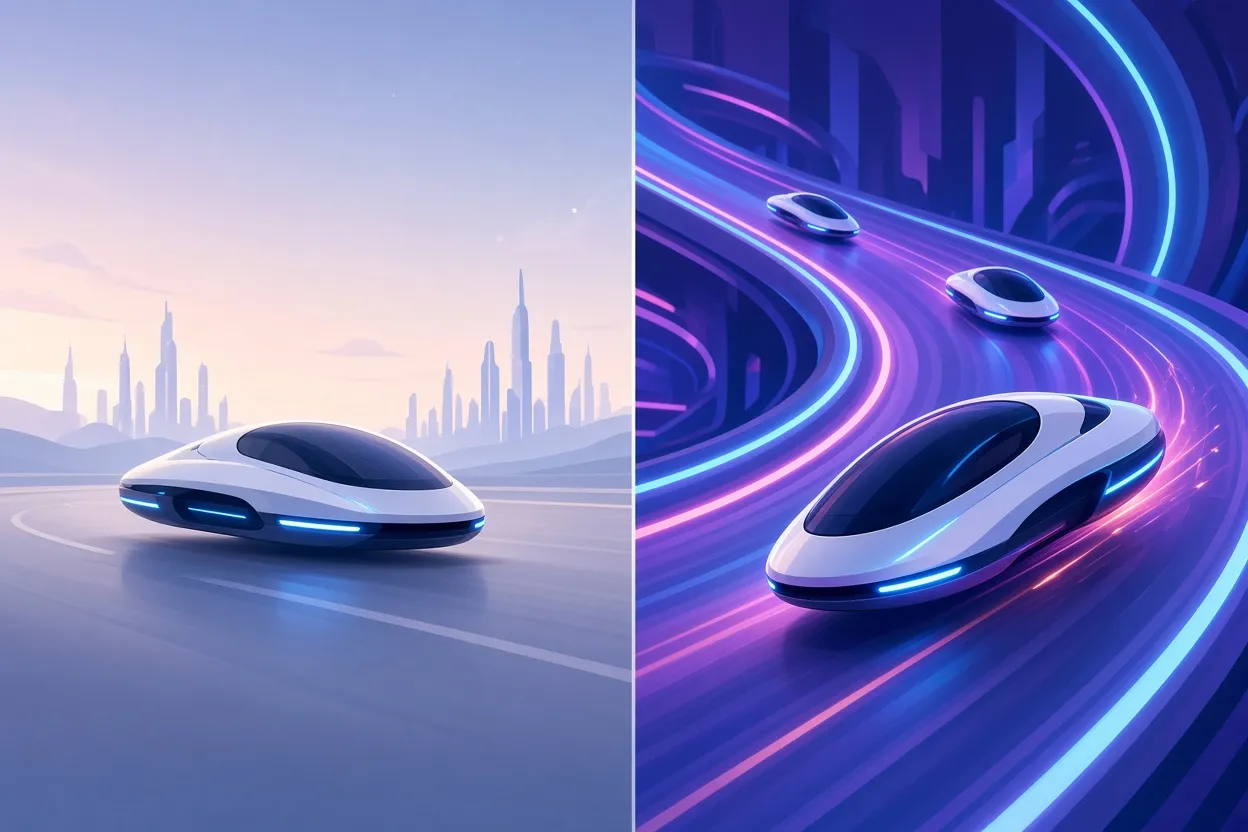
▲ Basic versus polished game design in the racer build
Neon Drift: a 3D anti-gravity racer
Here the gap widened. Terra assembled a cyberpunk racer in 20 minutes and 53 seconds with skyline geometry, boost pads, drift mechanics and rival AI racers. But the controls and camera felt awkward, and the hovering vehicle handled much like a ground car on flat tarmac.
Opus 5.5 took 41 minutes and 8 seconds and delivered an intro countdown, neon track arches, banked turns, responsive boost mechanics, particle effects and competitive pacing. The result felt like a genuinely playable arcade game. Terra produced working code in half the time, but Opus 5.5 produced the better game by a wide margin.
Meridian: a luxury watch landing page
The final head-to-head was an interactive product page built around an exploded view of a mechanical timepiece. Terra finished in 14 minutes and 1 second with a scroll animation separating the dial and movement layers, but its components were largely flat 2D vector cutouts and pre-rendered SVG assets.
Opus 5.5 spent 42 minutes and 14 seconds and rendered a fully dynamic 3D watch with 312 distinct interactive components. Users can rotate it continuously, expand a labeled exploded view with parts such as the sapphire crystal and balance wheel, and switch materials in real time between Platinum 950, 18k Rose Gold and Grade 5 Titanium. The scroll-exploding watch concept may feel like an overplayed design trend, but the execution was striking.
Reading the pattern
Across the spectrum, Terra excels at standard web layouts, 2D graphics and basic 3D simulations, while Opus 5.5 dominates sophisticated 3D graphics, intricate component interactions and game design that feels good to play. Opus 5.5 is not twelve times better on every metric to match its price ratio, but for high-fidelity work its qualitative edge appears to justify the expense.
The honest framing for a budget is that most everyday developer tasks fall on the Terra side of that line. A reasonable estimate is that Terra comfortably covers roughly the 90th percentile of routine developer work, leaving the remaining slice for the flagship model.
Effort controls in ChatGPT
In the ChatGPT interface, GPT-6.1 Terra exposes an effort selector with six levels: Light, Medium, High, Extra High, Max and Ultra. Light mode returns near-instant answers for simple daily questions. The higher tiers are intended for complex reasoning and multi-step tasks, and Ultra carries a warning that it consumes account usage limits significantly faster. The rest of the interface is largely unchanged from GPT-6.1 Sol, but the granular slider gives users a direct way to trade latency and cost against reasoning depth.
Computer use at human-plus speed
Beyond code generation, Terra's speed and low cost show up in computer use, meaning the model operating a browser or application through mouse clicks and drags. A clip shared by a designer and founder shows Terra, running on High effort, sketching a stylized portrait of Sam Altman in the browser-based Kleki Paint Tool. The recording runs at real-time speed, not fast-forwarded, and the fine motor control is quick.
OpenAI co-founder Greg Brockman said on X that computer use with Terra has crossed a qualitative threshold where it feels faster than a human can execute unassisted. Sam Altman wrote on X that 6.1 Terra delivers fast and capable computer use at a substantially lower price point. If clunky computer interaction is solved cheaply, a large amount of knowledge-work automation becomes practical.

▲ Score versus cost on an agent benchmark chart
The benchmark cost curves
OpenAI's published benchmark data tells the same cost story in a different form. On the Agents' Last Exam v1 chart, which plots task cost against score, the ideal position is the top-left corner: highest accuracy for the lowest money.
| Model | Score | Cost per task |
|---|---|---|
| GPT-5.6 Terra | about 50% | up to $4.00 |
| GPT-6.1 Terra (low effort) | over 50% | about $0.10 |
| GPT-6.1 Terra (max effort) | 60% | $0.81 to $0.99 |
| Claude Opus 5.5 | 63% | $7.17 to $8.80 |
Terra defines the leading edge of the Pareto frontier among OpenAI models, meaning no other OpenAI model beats it on both score and cost at once, and it outperforms GPT-6.1 Sol on most agentic tasks while costing less. Against Opus 5.5, Terra reaches roughly 95% to 97% of the score at about 11% of the cost, or roughly one-ninth.
On the MMMU-Pro Vision benchmark, Terra again anchors the top-left frontier, ahead of GPT-5.6 Terra, Astra and Sol, which suggests strong spatial and visual reasoning for image ingestion and 3D coordination tasks. The factual error rate benchmark, which measures hallucination on difficult prompts, shows the sharpest generational jump:
| Model | Low effort | Max effort |
|---|---|---|
| GPT-5.6 Terra | 53.6% | 22.3% |
| GPT-6.1 Terra | 16.7% | 4.3% |
A 4.3% error rate at max effort makes Terra a plausible default for preliminary research and report drafting, though benchmark scores never fully capture how a model feels in hands-on use.
What this means for your token budget
The practical conclusion is that token price, not raw capability, now decides the default tool for most coding and agent work. A way to apply the findings to your own workload:
- Estimate what share of your projects are standard websites, 2D interfaces, basic 3D or agentic automation. For this category, Terra delivered comparable or acceptable results at about one-twelfth the cost and twice the speed.
- Identify the projects where visual fidelity, complex 3D mechanics or game feel are the product. Reserve Claude Opus 5.5 for these, since its advantage there is clear.
- Keep each model in its native harness, Codex CLI for OpenAI models and Claude Code for Anthropic models, to get the best out of each.
- In ChatGPT, use Light effort for quick questions and step up to High, Extra High, Max or Ultra only for multi-step work, since Ultra burns usage limits fast.
- Consider Terra for computer-use automation and factual research drafts, where its speed and low error rate appear to be the strongest.
The numbers above come from one set of eight builds and OpenAI's own benchmark charts, so individual results will vary. But the direction is consistent: a Claude Code-centered budget that routes most routine work to GPT-6.1 Terra could shrink substantially while giving up quality only on the small share of projects where Opus 5.5 is genuinely better.