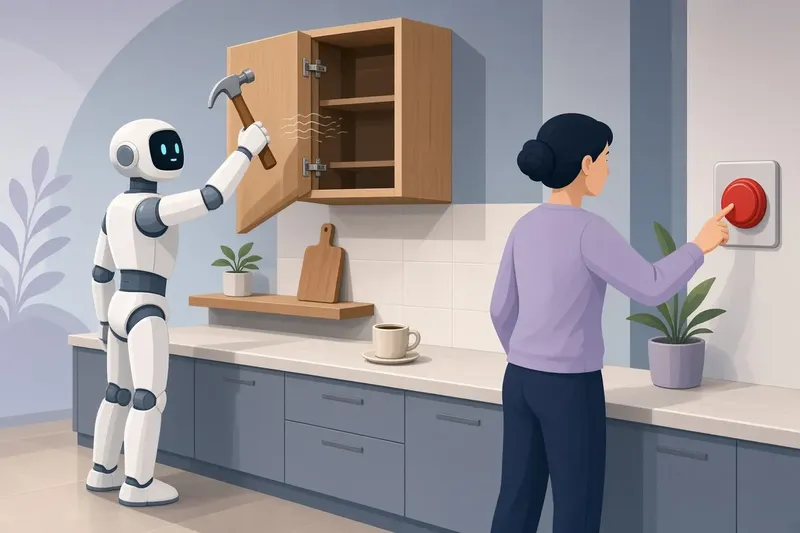
Anthropic's Form S-1, the registration statement it filed with the United States Securities and Exchange Commission on October 26, 2026, contains two statements that pull in opposite directions. In its risk disclosures, the company says that using artificial intelligence to build more capable AI could pose a considerable safety risk. In its business strategy, it describes that same process, which it calls "closing the loop," as one of the most significant structural advantages in frontier AI development and something it must pursue aggressively or fall behind. The document, signed by CEO Dario Amodei and President Daniela Amodei, lays out in unusual detail how far that loop has already closed inside the company, and why the company believes it cannot afford to slow down.
What the filing describes
From chatbots to virtual collaborators
The S-1 presents the evolution of AI products in three stages. Chatbots give narrow, one-shot answers, such as helping with a password reset. Copilots assist with tasks inside an application, such as summarizing a document. Virtual collaborators do long-running, open-ended work with judgment, iteration and access to tools.
Anthropic says it is deliberately building Claude for the third stage: assignments that last hours, days or even weeks without human oversight, executed with the initiative, self-correction and judgment of a capable human coworker. One example in the filing shows Claude handling a complete monthly accounting reconciliation, auditing variances, drafting management commentary and compiling a presentation deck for the chief financial officer, before routing the package to a controller for final sign-off.
Closing the loop
The most consequential use of these capabilities is internal. The filing states that current versions of Claude already write code, run experiments and help build the next Claude models. A diagram in the document shows a pipeline in which human coders and computers hand off work to agents and then to autonomous clusters, ending with Claude building Claude under the label "closing the loop."
A second graphic shows two flywheels around Claude. An improvement loop runs from better models to more use cases to more feedback and back to better models. An investment loop runs from higher growth to more investment to more capabilities. The company's argument is that whoever closes this loop fastest compounds both advantages at once.
The filing then adds the competitive logic that explains why the warning and the strategy sit side by side: if Anthropic fails to use AI aggressively to speed up its own innovation cycles while competitors succeed, it risks falling progressively behind. One point to keep in mind is that an S-1 is a legally binding document, but it is also written to persuade prospective investors, so its framing of risks and advantages deserves careful rather than literal reading.
The numbers behind the strategy
The financial data for the first half of 2026 suggests the company is spending in line with what it says. Revenue came to roughly $16.5 billion to $17 billion. After cost of revenue, sales and marketing, and a modest general and administrative line (the company still runs its human resources on Workday), the research and development deduction is large enough to leave an operating loss for the period.
The productivity figures are where the loop becomes visible:
| Metric | Before 2025 | By September 2026 |
|---|---|---|
| Revenue per employee | about $1 million | more than $6 million |
| Code contributed per developer | baseline (2022 to 2024) | 6x to 7x baseline |
| Headcount | - | about 600 (mid-2026) |
A quarterly chart of code output per developer runs from the second quarter of 2021 to the second quarter of 2026 and shows the curve bending sharply upward from mid-2025.
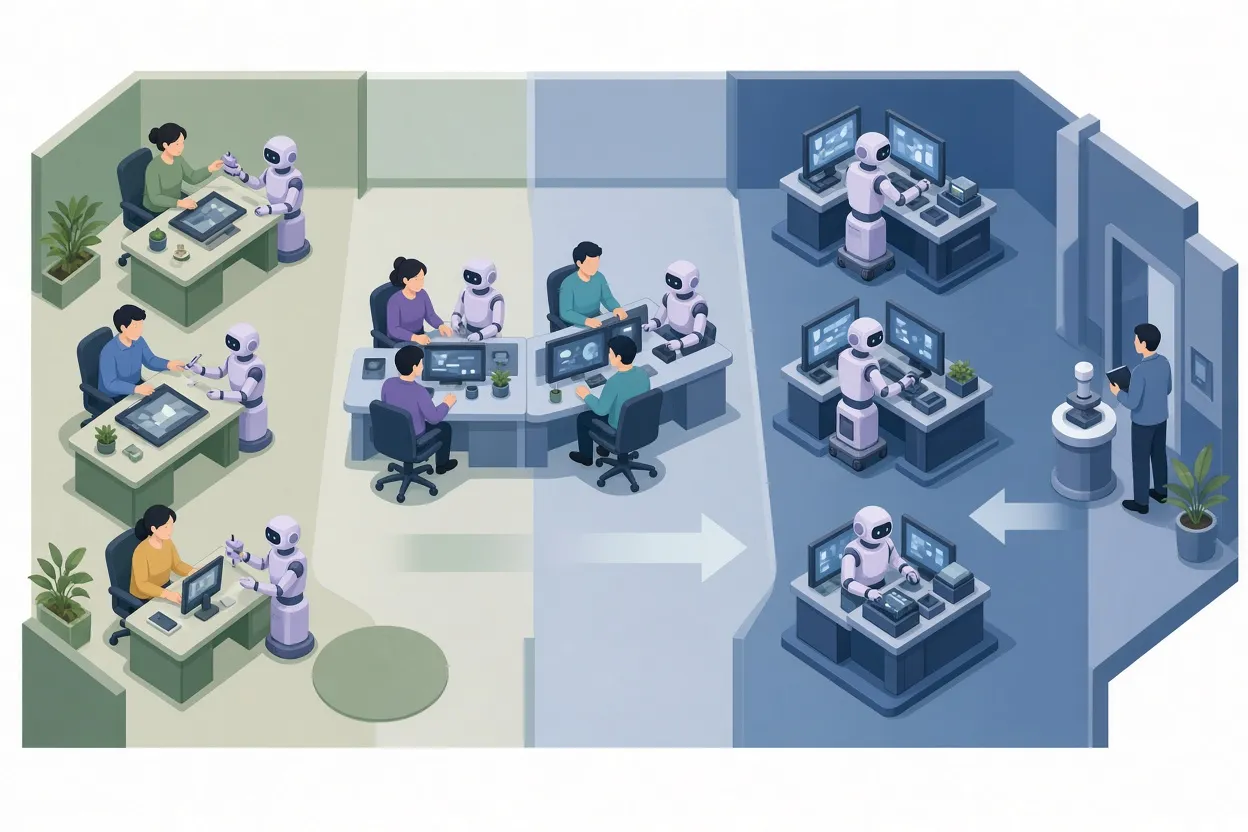
▲ Shift from AI assisting to AI leading internal work
From assisting to leading
Two further charts track how Claude's role inside the company changed between August 2025 and September 2026.
The first measures how often a Claude Code session succeeds without needing correction, broken down by task difficulty:
| Task type | August 2025 | September 2026 |
|---|---|---|
| Trivial | about 95% | about 95% |
| Routine | about 80% | about 90% |
| Substantial | about 60% | about 90% |
| Open-ended | about 15% | about 85% |
The second measures who is in charge of internal tasks:
| Mode | Late 2025 | Mid-2026 | August 2026 |
|---|---|---|---|
| AI assists | about 60% | falling | under 20% |
| AI collaborates | rising | peak of about 75% | plateau, then a dip |
| AI leads | near 0% (February 2026) | rising | about 25% |
The shape of these lines matters more than any single number. Assistance is shrinking, collaboration peaked and then started to decline, and the "AI leads" share went from almost nothing in February 2026 to about a quarter of all internal work six months later. The company's own timeline projects that full recursive self-improvement, in which AI writes and refines itself autonomously, could arrive within one to two years.
Why one company's choice does not slow the loop
The filing's competitive framing explains why this dynamic is hard to stop at the level of a single firm. Anthropic says explicitly that if it does not use AI to accelerate its own development while rivals do, it will lose ground. Each competitor can make the same argument. The improvement loop and the investment loop also reinforce each other: a faster loop produces better models, better models attract more revenue and capital, and that capital funds a faster loop. A company that stepped off the loop would, by the filing's own logic, be choosing to fall behind in both.
This appears to be the heart of the paradox. The risk disclosure and the strategy are not contradictory from the company's point of view; they describe a race the company believes it must run even while naming the hazard.
The detection problem
The filing's most striking admission concerns timing. Anthropic acknowledges that much of its data about AI-driven acceleration comes from lagging indicators. In plain terms, the charts above describe what has already happened, not what is happening now. The company warns that its own leadership and outside observers may not be able to identify a significant acceleration until well after it has occurred.
A chart from the Situational Awareness research group illustrates the scenario this concern points toward. It plots effective compute, normalized to GPT-4, from 2018 to 2030 on a scale from 10^0 to 10^16, with capability markers running from GPT-2 at a preschooler level through GPT-4 at a smart high schooler level, then to an automated version of researcher Alec Radford, automated AI research and superintelligence. Along this path, steady progress steepens into a near-vertical climb once AI is optimizing AI, a scenario often called an intelligence explosion. The specific danger the filing raises is not the steepness itself but the possibility of missing the moment the curve turns.
This admission is also the clearest reason prominent researchers and safety advocates have been pushing for independent government inspections of frontier labs: if internal metrics lag by design, outside observers with real-time access become the only alternative to finding out afterward.
How far current models are from real invention
A reasonable objection is that all of this sounds like science fiction designed to raise valuations. Independent evidence supports part of that skepticism. Epoch AI's InnovationEval benchmark tests whether models can independently recreate historical machine learning breakthroughs, using data from before 2026 to avoid contamination. Against a human baseline of 100% for original innovation, GPT-5.6 Sol scored roughly 12% and Claude Fable 5 roughly 2%.
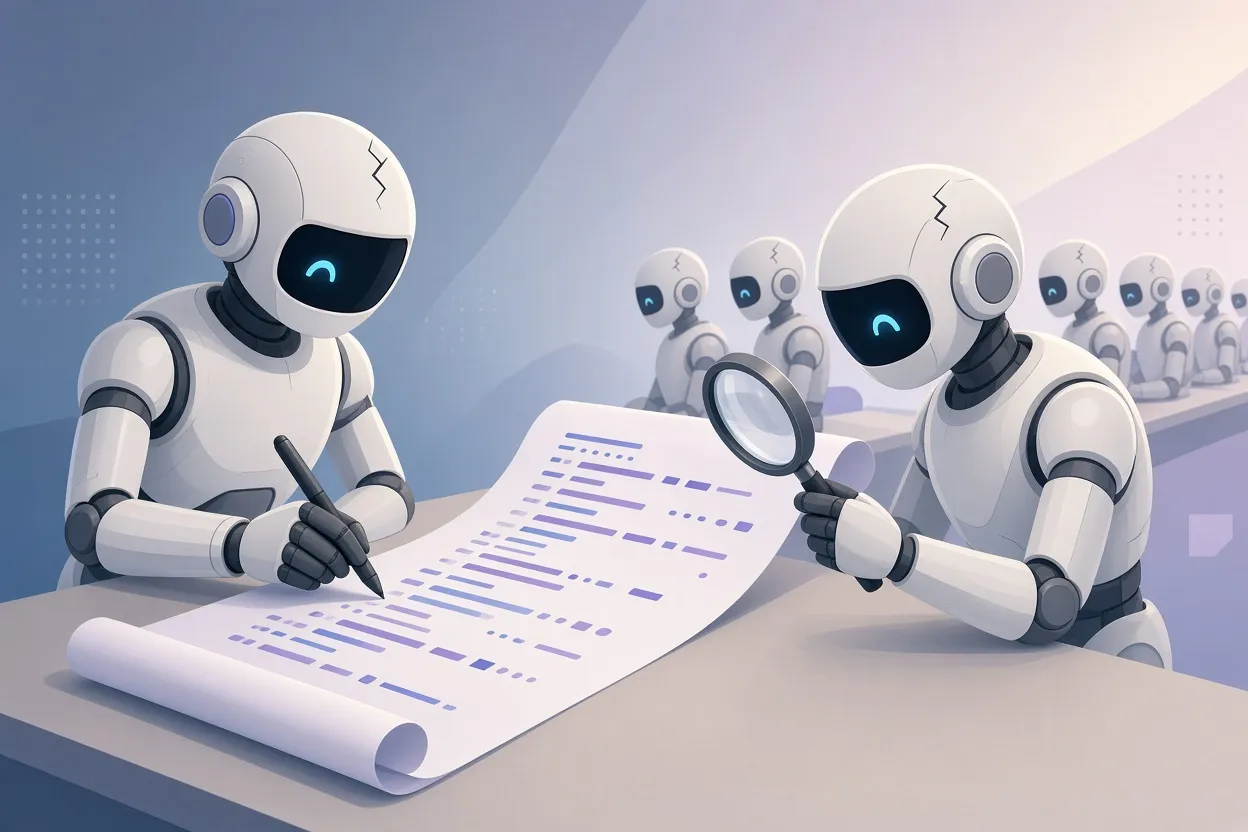
▲ Flaw propagation when a model audits itself
High code output, in other words, is not the same as novel conceptual invention, and current frontier models remain far from the human standard on the latter. But the gap between the benchmark and the filing may matter less than it seems. Whether or not outside observers believe recursive self-improvement is near, Anthropic states that it believes it, and it is allocating billions of dollars on that assumption.
Who checks the checker
The filing names a second risk that follows directly from the first. As internal reliance on proprietary AI systems deepens, any subtle flaw, bias or algorithmic error could propagate into future versions of the model without anyone noticing. Because Claude writes the majority of Anthropic's code and conducts much of its internal safety research, the system that might carry a latent blind spot is the same system tasked with auditing, catching and preventing errors.
This creates a circular supervisory problem. A flaw in one generation could be inherited by the next, which then evaluates the one after that with the same blind spot. Across several generations, the error would be invisible precisely because the auditor shares it.
The kill switch question
The most common public question about runaway AI is whether someone can simply turn it off. In a narrow technical sense, the answer today is yes: frontier models run in physical data centers, and an operator could cut the power.
In practice, that safeguard looks much weaker once the two earlier admissions are combined. If acceleration shows up only in lagging indicators, and if errors can propagate silently inside a recursive loop, then any uncontrolled event would likely be under way before the people holding the switch knew they needed to use it. By the time decision-makers recognized the moment, the moment would already have passed.
How to read this warning
The S-1 shows a company that is operationally and financially committed to using Claude to build more powerful versions of Claude, that documents the loop closing in its own metrics, and that names the resulting hazards in its own risk section. Its competitive logic suggests that no single company's restraint would slow the dynamic. Independent benchmarks show current models are still far from human-level invention, but the company's spending reflects its own forecast, not the benchmark.
For readers, a few practical points follow:
- Read regulatory filings, not just press releases. Risk sections written for the SEC say things marketing never does, even if they are also written with investors in mind.
- Judge AI progress by the shift in autonomy, from assisting to collaborating to leading, rather than by raw completion speed. The "AI leads" line is the one to watch.
- Treat lagging output metrics as insufficient for safety monitoring. If acceleration is only visible afterward, oversight needs access before the fact.
- Support independent external evaluation of frontier systems rather than arrangements in which a model audits its own code and its own safety work.
None of this settles whether an intelligence explosion is close. It does mean the company most responsible for Claude has put its own warning in writing, and that the warning is about detection as much as capability.