A Seeed Studio tutorial shows how MeshCore Open makes it possible to share something that looks like a photo across a low-bandwidth LoRa radio network without sending the photo itself. Local AI converts the original into compact descriptive data; AI at the other end uses that data to create a visually similar image. The distinction matters in places without an internet connection: this method can convey a scene across a narrow radio link, but it cannot preserve every detail in the original.
The photo becomes a small message
A full image file is impractical to transmit over the LoRa network described in Seeed Studio’s MeshCore Open tutorial. The link has limited capacity, and radio packets—the small units in which data travels—constrain what can be sent. The project changes the task from moving image pixels to moving information an AI system can use to make a new picture.
The workflow uses the Wio Tracker L1 and a MeshCore radio network:
- A local AI encoder on a mobile phone processes the original image into compact binary prompt data.
- The system sends that data in small packets across the LoRa mesh network, a network of connected radio nodes.
- A local AI decoder at the receiving end uses the transmitted information to generate an image that resembles the original.
The radio path carries the compact description, not the full photograph. Local processing at both ends is central to the approach: the AI does the work of interpreting an image before transmission and rendering one afterward. That division lets the radio link handle a much smaller payload than a raw image file would require.
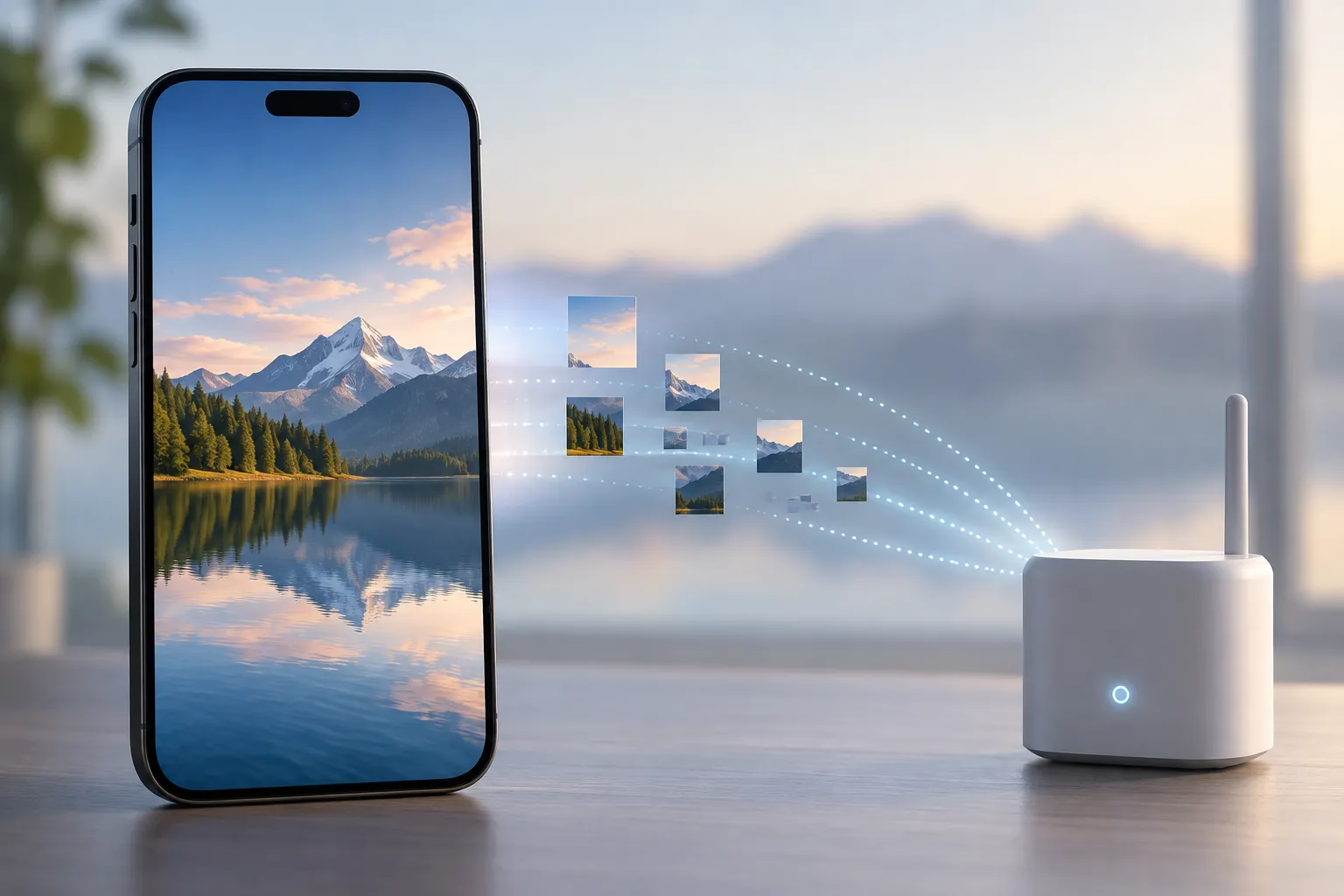
▲ A photo reduced to compact prompt data
Similar does not mean identical
Consider a landscape photo sent through this process. Its broad composition may survive well enough for the recreated picture to convey the scene. Small features, however, may change. The receiving AI generates an image from limited information rather than recovering the original pixels, so fine details can be altered or invented.
That makes “image transmission” a useful shorthand, but an incomplete description of the result. MeshCore Open transmits the information needed for an AI reconstruction. It does not deliver a pixel-perfect photograph. Comparison images in Seeed Studio’s tutorial illustrate the point: an original and its AI recreation can look alike overall while differing in particulars.
This trade-off may be acceptable when the goal is visual situational awareness—getting a sense of what a remote location looks like over a link that cannot carry a full image. It is a poor fit when a reader needs to inspect exact visual evidence. A plausible-looking detail in the generated picture is not proof that the detail appeared in the source photo.

▲ Original image and AI reconstruction
What the limited link changes
The practical question is not simply whether LoRa can carry a picture. It is which parts of a picture need to cross the network. MeshCore Open uses AI to select a compact representation and leaves the receiving AI to fill in the visual result. This makes the method relevant to off-grid communication, where the radio connection is narrow and an internet route is unavailable.
The design also puts a clear limit on how to interpret what arrives. A recipient gets a generated view of the scene, not an archive of the sender’s camera image. Better visual resemblance does not remove uncertainty about individual objects or textures. Anyone using the result has to keep that difference in mind, especially if small details matter to the task.
Seeed Studio provides a step-by-step setup guide for the Wio Tracker L1 workflow on its wiki, and it is worth a look for amateur radio operators and others who experiment with off-grid communication. The guide’s most important lesson is the choice of payload: instead of forcing a complete image through a constrained link, the system sends compact data that supports a local recreation.
Choose the result you actually need
MeshCore Open demonstrates a way to exchange visual context over a low-bandwidth LoRa mesh without transferring full photos. Its strength is conveying an approximate scene; its limit is fidelity. Before using this approach, decide whether a similar image is enough. Compare the original and reconstructed pictures during testing, and do not treat uncertain fine details in the AI-generated result as details captured by the camera.