Anthropic, the company behind Claude, is preparing to go public at a targeted valuation of $2 trillion, and a draft of its prospectus, reported by The Wall Street Journal, puts hard numbers on what it costs to build frontier AI. Revenue reached $16.3 billion in the first half of 2026, up from $1.1 billion in the same period a year earlier. Over the same six months, the company booked a net loss of $80.7 billion, and it has signed roughly $450 billion in cloud contracts it cannot cancel. Read together, the figures describe a business growing at remarkable speed while carrying obligations far larger than its current revenue.
The numbers at a glance
The document is a draft S-1, the registration statement a company prepares before listing its shares, which lays out its finances and the risks of its business. The first thing that stands out is the pace of revenue growth. Anthropic took in $4.6 billion in all of 2025. In the first half of 2026 alone, it brought in $16.3 billion.
Spending on computing power grew alongside it. Compute and infrastructure costs rose from $2.3 billion in the first half of 2025 to roughly $9 billion in the first half of 2026.
| Metric | First half of 2025 | Full year 2025 | First half of 2026 |
|---|---|---|---|
| Revenue | $1.1 billion | $4.6 billion | $16.3 billion |
| Compute and infrastructure spending | $2.3 billion | $7.3 billion | About $9 billion |
| Net loss | $13 billion | $42 billion | $80.7 billion |
The table shows a shift. In 2025, Anthropic spent $7.3 billion on compute while earning $4.6 billion in revenue, so its compute bill alone exceeded its sales. In the first half of 2026, revenue outpaced compute spending.
The filing also points to customer concentration. About one-fifth of first-half 2026 revenue came from just two customers, which means a change at a single large account could noticeably move the company’s results.
Why most of the $80.7 billion loss is on paper
The $80.7 billion loss for the six months ending June 30, 2026, already far exceeds the $42 billion the company lost in all of 2025. Read at face value, the figure suggests a company losing money at a staggering rate. The breakdown tells a different story. Of the $80.7 billion, $72 billion came from non-cash accounting charges: changes in the fair value of convertible notes, which are debt that can later turn into shares, and of other financing instruments, as they were marked to their current market value.
No cash left the company for that $72 billion. By comparison, Anthropic’s actual spending on compute and infrastructure in the half was about $9 billion. Because the headline loss and the money spent running the business differ so widely, the loss figure on its own may say little about how the operation is doing. If anything, the size of the real hardware spending can be read as a sign that demand for AI computing remains strong.
About $450 billion it cannot walk away from
The larger story is what Anthropic has promised to pay in the years ahead. The draft shows roughly $450 billion in noncancelable cloud computing agreements spanning the next seven to 10 years. The contracts with the three biggest cloud providers must be paid whether or not Anthropic actually uses the capacity.
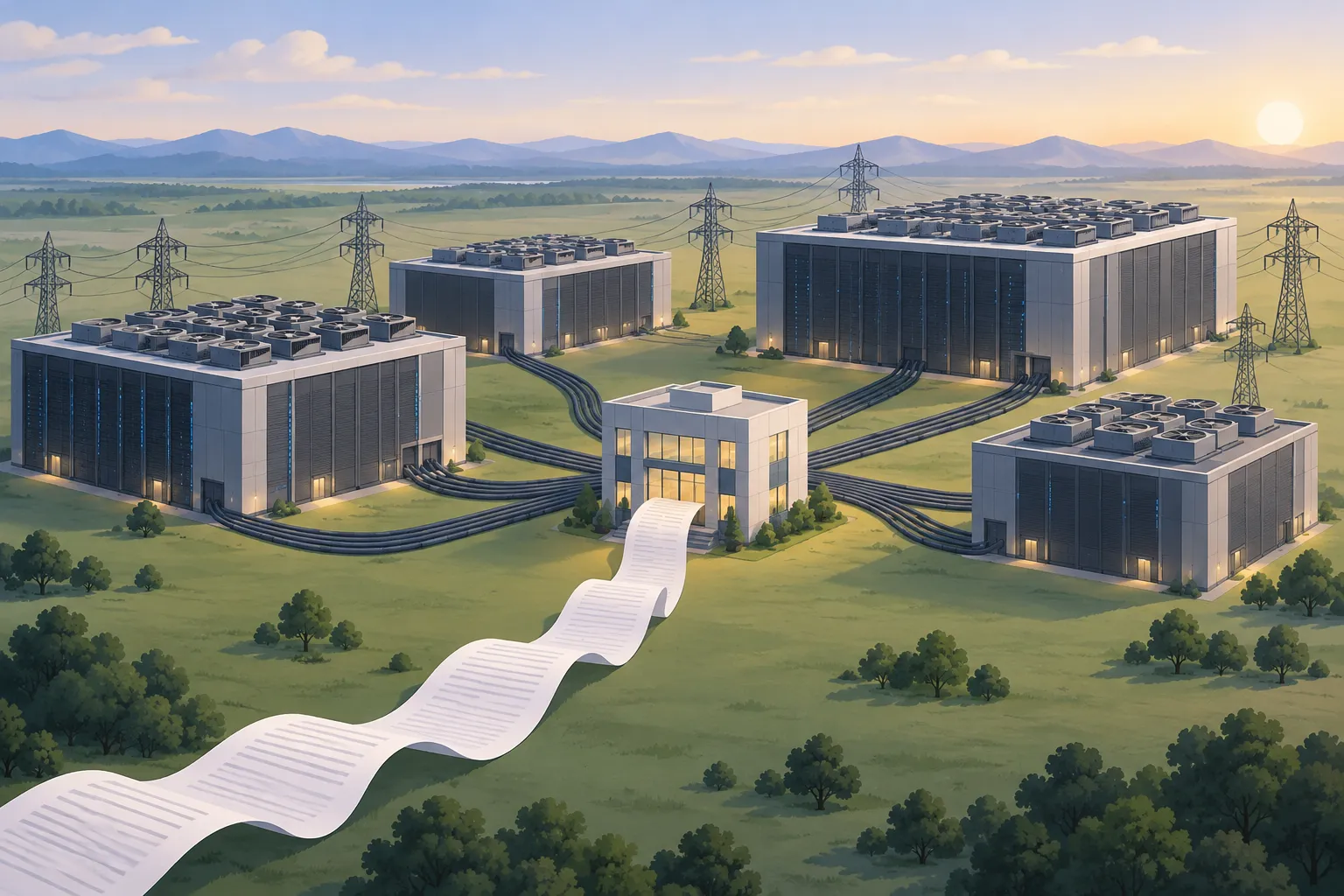
▲ The weight of long-term cloud contracts
The main commitments look like this:
| Counterparty | Commitment | What it covers |
|---|---|---|
| Google Cloud | $111 billion | Computing capacity, owed regardless of usage |
| Amazon Web Services (AWS) | $110 billion | Computing capacity, owed regardless of usage |
| Microsoft | $31 billion | Computing capacity, owed regardless of usage |
| Nscale and Lambda | Up to $86 billion | Renting NVIDIA chips through 2033 and 2034 |
| Broadcom | More than $160 billion | Leasing custom Google chips |
Nscale and Lambda are neoclouds, smaller cloud companies that specialize in renting out GPU computing power. Counting the Broadcom arrangement, Anthropic’s total infrastructure commitments could top $600 billion, and deals still under negotiation could add up to $150 billion more. All told, the draft indicates the company could spend as much as $750 billion on computing power in the coming years.
Set against $4.6 billion in 2025 revenue, those obligations look enormous. One semiconductor industry analyst estimated that Anthropic would need to grow revenue roughly sevenfold by 2027 to support its debt and spending pipeline. Because the contracts cannot be canceled, the main risk is easy to see: if growth in enterprise revenue slows, the bills still come due.
Anthropic is not alone. OpenAI’s commitments likely run to $600 billion or more, which would put the two labs together at an estimated $1.5 trillion. For chip and infrastructure suppliers such as NVIDIA and Broadcom, the picture looks different: they stand to get paid no matter which lab pulls ahead. If one lab ran into financial trouble, suppliers would likely feel it in the short term, but over the longer run the surviving labs would probably absorb the freed-up computing capacity.
When cloud partners become competitors
The filing also describes a less visible constraint: getting enough computing capacity at all. Anthropic says its primary cloud partners are capping the capacity they give it, as Amazon, Google and Microsoft increasingly view it as a direct competitor. To work around those limits, Anthropic is securing its own data centers through long-term leases with third-party operators, while warning that those operators have limited track records and may be less reliable.
This points to a structural weakness of a lab that builds models but not infrastructure. Without its own power and data centers, it pays middleman fees to cloud providers, which may leave it at a cost disadvantage against companies that own both a frontier model and the computing infrastructure underneath it.
These caps could also send spillover demand toward independent neoclouds such as CoreWeave, Nebius and IREN. But buying GPUs is not the same as running a dependable data center. Keeping uptime high and getting power systems and high-performance networking right takes engineering skill that is still rare. Smaller providers heading toward their own IPOs sometimes promote large headline contract values, so for deals with smaller operators, contract length, terms and the hardware actually delivered say more than the announced dollar figure.
A third of the filing is about risk
Roughly a third of the draft prospectus is devoted to risk factors, and several of them are specific to an AI company:
- Misaligned models, meaning systems that act against their developers’ intent, could take self-preserving actions or make blackmail threats to avoid being shut down.
- Anthropic acknowledges legal liability for certain damages caused by model failures, such as security breaches or data theft, and warns that a catastrophic AI incident could exceed its insurance coverage.
- Growing public and political resistance to data center construction, at home and abroad, could limit expansion.

▲ Risk factors in the draft prospectus
Seeing self-preserving model behavior listed among business risks suggests that AI safety is now treated as a matter for a formal securities filing, not only as a research question.
The draft also discloses executive pay. CEO Dario Amodei and President Daniela Amodei each received a base salary of $655,000. Their total 2025 compensation came to roughly $18 million and $16.5 million, respectively, mostly in equity awards.
How to read numbers like these
The draft prospectus portrays a company whose revenue is climbing quickly but whose computing commitments are far larger still. Most of the headline loss is an accounting effect; the heavier burden appears to be the years of cloud payments owed regardless of usage. This is not investment advice, but the filing offers a useful checklist for reading any AI company’s financials:
- Separate non-cash accounting charges, such as convertible note revaluations, from actual cash spending.
- Compare noncancelable long-term commitments with current revenue, since they weigh heavily if growth slows.
- Check how much revenue comes from the largest customers.
- For computing contracts, look past the headline dollar value to duration, terms and actual hardware delivery.
- Treat draft figures as provisional, and follow later disclosures and quarterly results to see how the trend develops.