Roughly five years after AlphaFold 2 changed protein structure prediction, the popular claim that protein folding is “solved” leaves out most of the problem. Pushmeet Kohli of Google DeepMind stresses that AlphaFold learned to predict the static structures that scientists had already determined and deposited in the Protein Data Bank (PDB), a public archive of experimental protein structures. How proteins actually move and shift between shapes inside living cells is still largely unknown. Getting from there to AI that truly understands biology, he and a researcher at Chan Zuckerberg Biohub (CZ Biohub) argue, takes more than adding compute and data. It also depends on choosing the right data, deciding how much scientific knowledge to build into models, and knowing when a model’s output can be trusted.
What AlphaFold actually solved
Headlines have often declared protein structure prediction finished. Working structural biologists and biophysicists see it differently. For them, protein dynamics, the different shapes a protein can take (its conformational states), protein function and de novo design, meaning creating entirely new proteins from scratch, remain largely open problems.
Kohli explains that scientific breakthroughs usually work by isolating one simplified facet of a complex system so that progress can be measured and reproduced. AlphaFold’s facet was the static coordinates of crystallized proteins stored in the PDB. Predicting those snapshots has been genuinely useful in drug and biology research. But predicting a frozen picture is not the same as understanding how a protein behaves over time.
- Proteins are not rigid building blocks. They are flexible molecules whose shape depends on conditions in the cell.
- Many proteins contain intrinsically disordered regions that have no fixed shape at all.
- Neither researchers nor models yet know the true range of structures a protein adopts across different biological environments.
For that reason, Kohli warns funders and scientists not to pull back from structure and dynamics research on the mistaken belief that the underlying biophysics is done. In his view, biology has only scratched the surface.
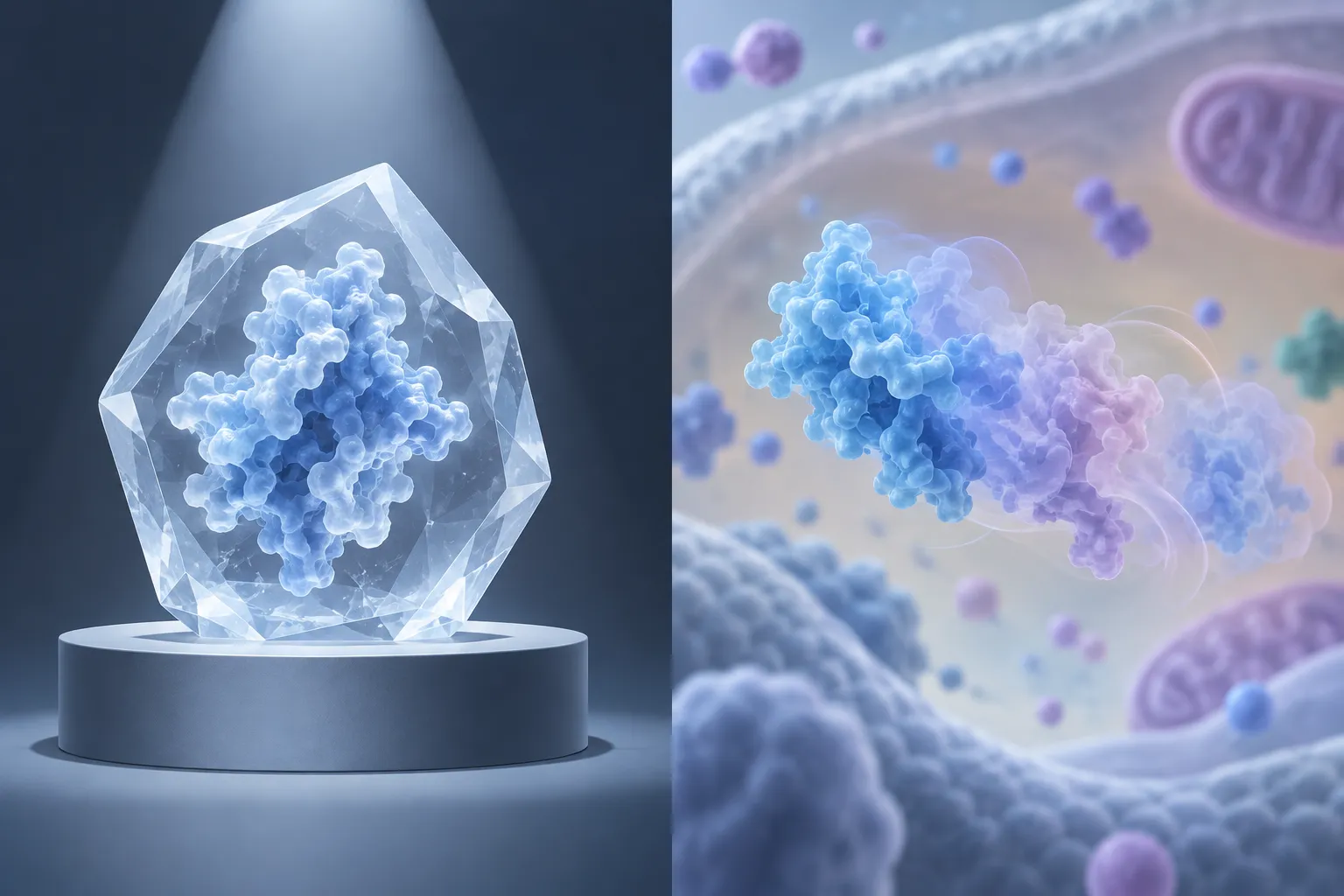
▲ Static structure versus a protein in motion
Does scale alone win in biology?
AI researchers often cite Rich Sutton’s essay “The Bitter Lesson,” which holds that general methods that scale with compute eventually beat approaches built on human-designed rules. The natural question is whether a similar rule applies to biological data.
The CZ Biohub researcher cautions against assuming that scaling laws, the steady gains that come from growing models, data and compute, show up automatically in every field. Much of the real research work is finding the specific model design and data setup where scaling starts to pay off. Once that regime is found, improving the model becomes a manageable engineering pipeline. Having the right data distribution, he says, is a precondition for any model to generalize.
Protein language models offer a telling example. Instead of training only on clean, full-length protein sequences, researchers fed in huge amounts of fragmented and incomplete metagenomic sequences, which are genetic data collected from mixed microbial samples in the environment. Despite the mess, this data substantially improved the models’ ability to design new proteins. The opposite trap also exists: piling up synthetic or low-value data simply because it is easy to generate can lead to dead ends. He also notes that modelers tend to use whatever datasets are already public instead of asking what data the problem actually needs.
Kohli, who was at DeepMind when Sutton gave internal talks on the essay, reads the lesson differently. He sees it less as a narrow claim about data and more as a warning against dogma. Researchers who label themselves only as modelers or only as lab data producers end up tuning algorithms on benchmarks with little scientific relevance. The problem should choose the method, not the other way around.
| Project | Data situation | Choice |
|---|---|---|
| AlphaFold | Producing ten times more lab structures was not feasible | Train on existing PDB structures |
| Single-cell biology and a “virtual cell” | Public repositories were fundamentally insufficient | Shift resources to generating new biological data |
How much human knowledge belongs in the model?
Early breakthrough systems such as AlphaFold included careful, handcrafted design in nearly every component. The broader trend in machine learning has moved toward general methods powered by large amounts of compute and data. The two scientists weigh this tradeoff slightly differently.
Kohli argues from first principles that building in knowledge from biophysics and biochemistry was never an accident. If you understand how amino acid residues physically influence one another, you can encode that understanding as an inductive bias, an assumption built into the model’s architecture. That gives the model an “unfair advantage” in data efficiency because it does not have to relearn basic physics from scratch. He adds that curating a dataset is an art in its own right. Copying the same data at greater volume brings little gain; progress depends on diversity and coverage.
The CZ Biohub researcher agrees that inductive biases are essential when data is scarce, but he points to a tipping point. As datasets grow, models can find complex patterns that no scientist anticipated. A flawed or overly rigid assumption can block that discovery and cap performance. He also rejects the idea that scaling is mindless. Scaling biological foundation models reliably requires deep algorithmic and systems engineering, including changes to standard transformers so they fit biological structures and run efficiently.
The next data frontier: raw cryo-EM images
As for what could unlock progress on protein dynamics, Kohli, drawing on his background in computer vision, points to raw micrographs from cryo-electron microscopy (cryo-EM), a technique that images frozen molecules with an electron beam. Today’s models learn from a single processed PDB structure per protein. Training directly on the raw, varied cryo-EM images could let models capture the full landscape of shapes a protein takes and the transitions between them.
The CZ Biohub researcher adds that current static prediction tools are remarkably useful for tasks like structure-guided design, yet they cover only a thin slice of biology. He compares them to precisely modeling one spoke of a bicycle wheel, when biologists ultimately need models that can design and evaluate the whole bicycle, or even something as complex as a pickup truck.
Richard Feynman’s line “What I cannot create, I do not understand” takes on a new twist here. AI systems can now produce working protein designs before anyone fully understands the mechanisms behind them.
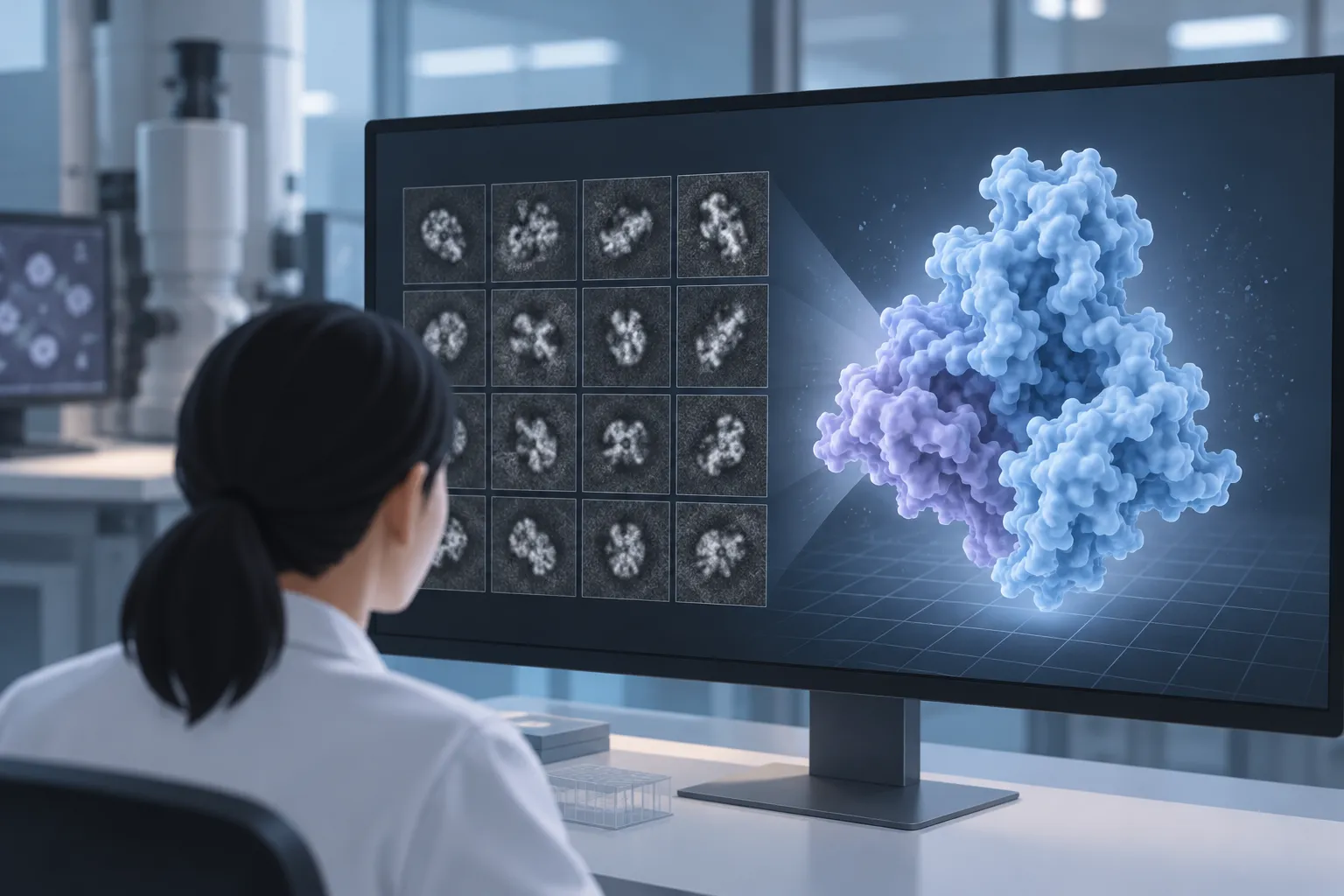
▲ Learning from raw cryo-EM images
Is a black box good enough?
If a model could design a very tightly binding protein in a single step, would it matter that no one knows how? The CZ Biohub researcher notes that bioengineers used black-box design methods long before modern AI. Still, he argues that extracting real understanding from models matters. Protein language models do more than generate valid sequences. They absorb structural constraints, physical dynamics and evolutionary information, and analysis of their internal representations has revealed functional sites and shape changes. He describes these models as compressed world models of evolution, holding information researchers have not yet decoded.
Kohli separates two kinds of interpretability: explaining a model’s internal mechanics, and characterizing its behavior, meaning where it works and where it fails. He emphasizes the second, and uses AlphaFold 2 as the example.
- At its first release, AlphaFold 2 scored about 90 on GDT, the Global Distance Test that measures how closely a predicted structure matches the real one.
- A hypothetical model scoring 95 would still be dangerous and unusable if its pLDDT values, the per-prediction confidence scores, were uncalibrated.
- With miscalibrated confidence, a lab could spend months or even a year chasing a confident but wrong prediction.
- Because AlphaFold 2’s confidence was well calibrated, scientists could trust it, and the community later discovered an unplanned use: identifying intrinsically disordered regions.
Kohli also suggests that interpretability depends on who is doing the interpreting. Human working memory is limited, and multiscale biology may resist intuitive human explanation. He raises the possibility that future frontier AI models could inspect the internal layers of specialized models and form mechanistic hypotheses beyond human reach. Both scientists agree that a thorough understanding of a model’s capabilities and limits is essential to avoid sending experimental resources in the wrong direction.
How far is the clinic?
Kohli considers it somewhat ill-posed to ask when AI will change clinical outcomes, because AI and machine learning already assist every stage of preclinical drug discovery. What he distinguishes is today’s incremental use versus 10x to 100x acceleration in target discovery, lead optimization and toxicology. That kind of leap, he argues, will come from solving fundamental problems in cell biology and disease mechanisms through comprehensive foundation models, not from optimizing narrow existing assays.
The CZ Biohub researcher draws on an engineering lesson from his time at Google: aiming for a 10x improvement is often more tractable and more impactful than chasing a 10% gain, because it forces you to drop flawed assumptions and rethink the problem from first principles. CZ Biohub’s stated goal is to help cure, prevent or manage human diseases, and he says that requires balancing near-term practical gains with long-term leaps.
These are changes to the research pipeline, not tools for individual diagnosis or treatment. Any health decision belongs with a medical professional.
What to take away
AlphaFold solved one facet of protein biology: predicting static structures. Understanding motion, function and whole cells is just beginning. For researchers and engineers working on biological AI, the points above suggest a practical checklist:
- Define the biological question and the concrete milestone before choosing an architecture.
- Identify early whether progress needs more compute, more model capacity or new lab data, and drop unpromising directions fast.
- Favor data diversity and coverage over raw volume, and test messy natural data such as metagenomic sequences.
- Build physics into models when data is scarce, and revisit rigid assumptions as data grows.
- Check that confidence scores match real accuracy before trusting a model in the lab, and map where it fails.
- Look beyond static archives to primary experimental data such as cryo-EM.