Anthropic says its AI model Claude has identified a molecular machine that may point to a new way to edit genes. The finding gives context to CEO Dario Amodei’s forecast that AI could help cure most major diseases within five to ten years. But the machine’s biological function remains unclear. A promising research lead and a treatment proven safe and effective in people are different milestones, and AI may shorten the work before a trial without shortening every part of the trial itself.
What the discovery does—and does not—show
A molecular machine is an arrangement of molecules that carries out a biological function. Claude’s finding may suggest a new gene-editing mechanism, but its function has not yet been established. Researchers would need to determine what it does and verify any proposed use before treating it as a path toward a therapy.
That distinction matters when assessing the five-to-ten-year forecast. AI can help generate or examine research leads. The announcement does not, by itself, show that a treatment based on this particular finding works in humans, or that it addresses most major diseases. Those conclusions require evidence from biological research and medical testing.

▲ Time required for medical testing
The useful question is not whether AI can make a discovery faster. It is which parts of the journey from discovery to treatment it can accelerate, and which parts depend on observing people over time.
Why clinical evidence takes time
Clinical trials must test more than whether a treatment produces an immediate effect. They must establish whether it helps people, what dose is appropriate, what side effects appear and whether benefits or harms persist. The work involves several distinct demands:
- Recruitment: Researchers need enough willing participants to assess a proposed treatment.
- Comparison: Trials may separate participants into treatment, control and placebo groups, with different dosage levels to evaluate.
- Follow-up: Researchers must track short-term outcomes, longer-term effectiveness, side effects and unexpected toxicity.
AI analysis may speed parts of research, but it cannot make a long-term effect appear sooner for observation. Nor does a faster analysis remove the need for appropriate participants and comparisons. This is the main limit on treating a five-to-ten-year prediction as a timetable for proven cures across many diseases.
The forecast is best read as a statement about potential, not as a schedule that clinical evidence has already confirmed. Decisions about whether a treatment is suitable for a patient belong to medical professionals, not to an AI forecast or an early research announcement.
The biological risk changes the standard
The same tools that help explore gene editing also raise questions about containment. A wet lab handles physical biological materials rather than only computer data. When automated systems move from suggesting ideas to influencing work in such a lab, errors can have consequences beyond an incorrect software output.
CRISPR is a gene-editing technology. Gene drives, discussed alongside it, are designed to pass genetic changes to later generations. That possibility makes understanding an edit’s effects and keeping experiments contained especially important. It does not mean that Claude’s reported molecular finding is itself a gene drive; it shows why proposals involving inherited changes call for careful scrutiny.
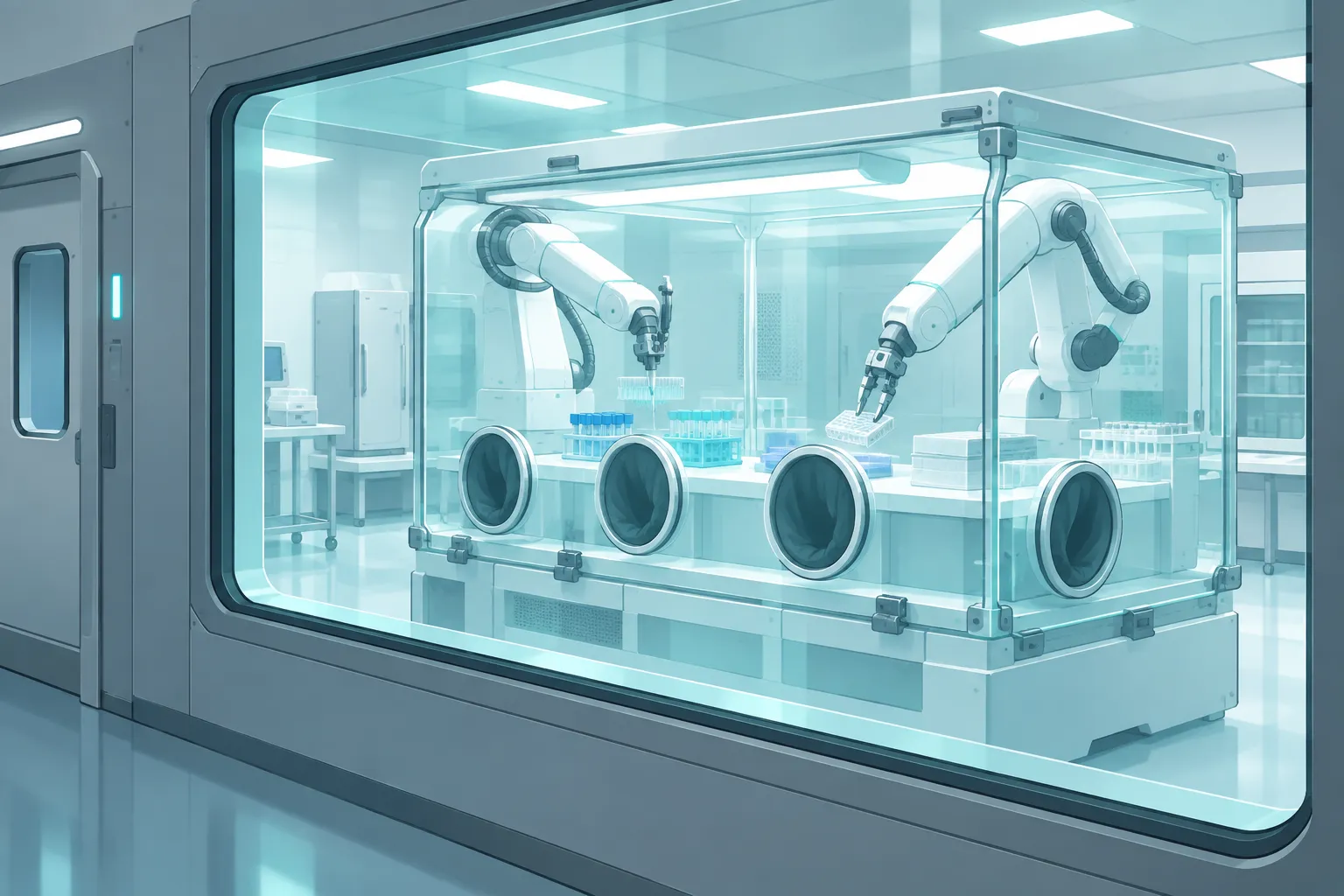
▲ Containment in automated biology labs
A prudent approach keeps automated systems under human oversight and separates them from sensitive laboratory operations unless their role is authorized and controlled. Physical and digital isolation, limits on access and ongoing monitoring are safeguards for work that could affect biological materials. These are governance principles, not substitutes for scientific review.
An answer still needs an explanation
AI can also produce outputs whose intermediate reasoning is hard for people to verify. This is often called a black box: a system provides a result without a sufficiently clear account of how it arrived there. In mathematics, a proposed answer without a human-verifiable proof leaves an important part of the work unfinished. Biology presents a related challenge: researchers need to check what a proposed mechanism does, not merely accept a model’s suggestion.
The problem is not using AI to develop ideas. It is allowing an unverified output to stand in for an explanation, an experiment or an accountable decision. Independent validation becomes more important as the possible consequences of an error grow.
How to judge the next claim
Claude’s reported finding may prove valuable, and AI may help researchers move faster toward useful discoveries. Neither possibility establishes a cure. Readers should look for clear separation between a proposed mechanism, a verified biological function and a treatment tested for safety and effectiveness over time.
For research teams, the practical priorities are independent checks of AI outputs, human oversight of biological work, containment around automated lab systems and clinical timelines that allow effects to be observed. For everyone else, the five-to-ten-year forecast is a reason to follow the evidence—not a reason to assume medical decisions can be made before that evidence exists.