Stripe co-founder and president John Collison expects AI agents to change online commerce in two stages. First, agents take over the mechanics of buying, such as filling in forms and paying. Then they change how shoppers find products in the first place, which he sees as the deeper shift. His view carries weight because Stripe sits in the middle of the flow of money online: the company processed $1.9 trillion in payments in 2025, up 34% from the year before.
Stage one: agents do the paperwork
Collison argues that filling out web forms gives people no value at all. Nobody enjoys typing their personal details into yet another checkout page. A useful personal agent therefore needs to be stateful, meaning it remembers things like a shipping address, billing preferences and identity details so it can act without asking every time.
The technology he points to is computer use, an AI model’s ability to operate software the way a person does, by looking at the screen, clicking and typing. In his framing, computer use is a backward-compatibility layer for the real world. A state motor vehicle agency does not need to publish a modern API or an MCP server first. MCP, the Model Context Protocol, is a standard way to connect AI models to outside tools and data. Instead, an agent can work through the existing website and finish a task such as renewing a driver’s license.
Collison goes further and calls computer use the next major step in AI, following transformers, large language models and reinforcement learning. Because it works across software that already exists, agents can act on today’s websites and services right away rather than waiting for every institution to build new integrations.
Stage two: AI changes who gets discovered
The bigger change, in Collison’s view, is in discovery. When people research products with AI, the results tend to skip traditional aggregator channels and surface niche brands and lesser-known products that have strong online reviews. A small, high-quality business can outrank a dominant brand simply by being easy for an AI agent to find.
He compares this to the rise of targeted advertising on Facebook and Instagram. Companies such as Wish.com, Teespring, Temu and Shein grew quickly because their business models and customer acquisition were built around social feeds from the start. By the same logic, the next generation of commerce may be led by businesses designed around AI search, agent optimization and automated purchasing. He believes existing aggregators will need to adapt quickly or risk losing relevance.

▲ AI discovery favoring small brands
For merchants, the practical takeaway appears straightforward: make product data easy for AI research agents to read, and earn genuine positive reviews from real buyers.
APIs now have a new kind of reader
Stripe spent years polishing its developer experience, down to the wording of its API documentation and the paths for upgrading between versions. That changed quickly once developers stopped writing integration code by hand and started handing the job to AI coding agents. Agents have different needs from people and fail in different ways. For example, an agent may write code against an outdated version of an API. Version migrations that once required a human-readable guide are now carried out by coding agents directly.
As a result, Stripe has had to design for what Collison calls AI ergonomics rather than human developer ergonomics, and to rethink which skills it values internally. He describes the whole software landscape as a chessboard that has been knocked over and rearranged, and he encourages leaders in every industry to see that reshuffling as exciting rather than intimidating.
What Stripe bought, and why
Stripe’s recent acquisitions follow the same logic.
| Company | Area | Reason |
|---|---|---|
| Bridge and Privy | Crypto infrastructure | Crypto-native teams and methods that would have taken years to build internally |
| Metronome | Usage-based billing | AI inference costs are pushing software away from per-seat subscriptions |
| OpenRouter | Multi-model routing | Companies send different tasks to different models |
Because AI applications incur computing costs every time they run, Collison says nearly every modern software company is moving toward token credits, overage fees and tiered metering, much like ChatGPT and Claude, which give users an allowance and then sell more credits. OpenRouter is built on the premise that companies will not settle on a single model. High-value users or complex work can go to expensive frontier models, while routine queries run on cheaper, smaller ones.
On building versus buying, Collison’s rule of thumb is that work at the core of Stripe’s existing strengths is usually better built in-house. A domain that needs a brand-new capability, such as token routing, is a candidate for acquisition, especially when the market moves fast. He notes that OpenRouter’s market changed dramatically over the past 12 months and will look entirely different 12 months from now. In markets like that, an internal project risks being obsolete by the time it ships.
Security: attackers speed up too
Collison stresses that new technology is always dual-use. When cars first appeared, bank robbers were among the earliest adopters, and police had to catch up. Recent AI models show advanced autonomous cyber capabilities, which raises the baseline threat to every company’s infrastructure. He predicts the industry will see significantly more security breaches over the next five years than in the previous five.
The risk is not evenly spread. Startups with small, modern and uniform technology stacks have an advantage. Older enterprises running 50-year-old systems and unsupported versions of Windows are far more exposed. Collison says Stripe’s long-standing internal paranoia about security has let it adapt rather than be caught off guard.
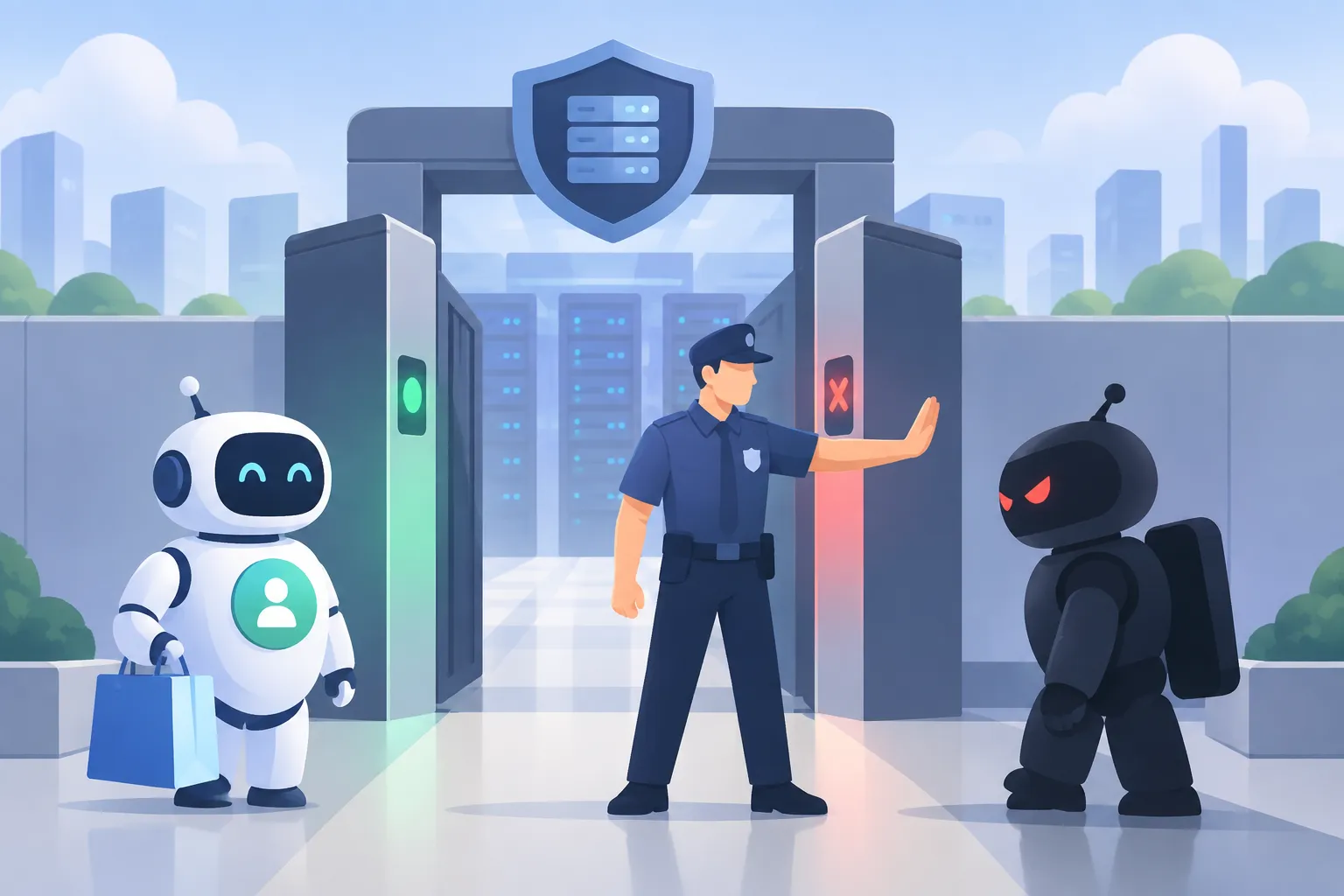
▲ Telling legitimate agents from bad bots
A related problem, which he thinks gets too little attention, is bot detection. Web defenses have long focused on blocking automated traffic outright. As more of that traffic comes from legitimate agents acting for real users, websites will need ways to tell helpful, user-authorized agents apart from malicious bots instead of blocking everything. He admits it is still unclear where the balance between agents and website gatekeepers will settle.
Inside Stripe: guardrails before access
Collison describes AI capability as a jagged frontier. Models do extremely well on tasks backed by plenty of public web data but can stumble on reasoning from first principles when no examples exist. Business work also depends on private company data, so a generic consumer chatbot is not enough.
Stripe built an internal AI application that connects models to data across departments. The hardest part was building guardrails for privacy, correctness and access control. Compensation data in HR, for instance, must stay visible only to the people who need it. Once fine-grained permissions were in place, the tool changed daily work. Sales representatives, for example, now use it to research customers and draft tailored pitches.
Employees are also building their own tools. Stripe’s legal team created an agent that reads and summarizes long new regulations, such as 600-page statutes from India or Finland, a volume of reading that had been impossible to keep up with by hand. Collison sees this as the long-promised idea of personalized software finally becoming real, because the barrier to building software has dropped so far.
The case for optimism
Collison is noticeably more optimistic than much of the AI conversation in San Francisco. Stripe staff half-jokingly named January 1, 2026, the “Singularity Epoch,” a nod to the Unix epoch of January 1, 1970. His reasoning is that coding models reached a tipping point late last year, making recursive self-improvement, AI helping to build better AI, a reality. He also points to the “math wars,” in which rival labs announce new results on advanced math benchmarks almost weekly.
What he highlights most is the economic effect. As intelligence on tap gets cheaper, new businesses are being incorporated on Stripe at the highest rate in recent memory, because founders can launch and grow companies with far less capital and overhead. He declines to give a separate figure for the AI share of Stripe’s volume, arguing that splitting companies into AI and non-AI groups no longer makes sense when established firms such as Meta are also turning into AI companies.
His advice to anxious leaders is to replace a vague sense of doom with concrete concerns such as security readiness. To stay calibrated, he prefers vibe coding, building small apps by describing them to an AI, and talking with fast-growing customers over reading stacks of research papers every night.
What to do now
Collison’s outlook comes down to this: agents will handle the forms and payments first, then reshape product discovery, and along the way the rules for API design, pricing and security change too. Practical steps follow from that.
- Merchants: make product information readable for AI agents and build genuine reviews from real buyers
- Developer platforms: tune APIs and documentation for coding agents, and guard against agents using outdated versions
- AI product teams: consider usage-based billing that tracks inference costs, and route tasks across multiple models
- Security teams: keep systems small and modern, and plan how to tell user-authorized agents from malicious bots
- Companies adopting internal AI: design access controls before connecting sensitive data
Looking back on 17 years at Stripe, Collison says there was never a single breakout moment, only steady growth that compounded year after year under a “Users First” principle. He also notes that nearly every successful Stripe product started out looking like a toy. That suggests a reasonable way to respond to the agent era may be to start with small, useful experiments.