Alex Imas, Director of AGI Economics at Google DeepMind and a professor on leave from the University of Chicago Booth School of Business, makes a case that cuts against the loudest predictions in AI circles. Even if millions of autonomous AI agents end up running whole companies, he argues, the headline growth rate of the economy is unlikely to reach double digits. The reason is not that the technology will fall short. It is that competitive markets push the price of anything that becomes cheap to produce toward its cost, and when prices collapse, measured GDP does not balloon the way raw output does. People may live through a transformation that feels bigger and faster than the Industrial Revolution while the official statistics stay within historical bounds.
Two curves that do not match
The starting puzzle is a mismatch between two sets of numbers. AI capability benchmarks look like hockey sticks that bend toward vertical. Macroeconomic indicators such as the monthly jobs report and labor productivity look calm and steady. Imas's research paper "Organizing Intelligence," co-authored with Shane Legg and another researcher, tries to explain what has to happen for the first curve to show up in the second.
Its central move is to change the unit of analysis. Most AI discourse fixates on the individual agent, whether a human worker or a synthetic one. Imas argues that the entities actually competing in real markets are organizations, and that a model of AI's economic effect has to start there.
Firms as existing superintelligences
Organizations, in this framing, are machines for exploiting comparative advantage. A company hires a strong software programmer to write code, not to cook in the kitchen. By sorting people into the domains where they are strongest, a firm assembles what the paper calls "mosaic intelligence," a collective problem-solving envelope far wider than the average ability of the people inside it.
Imas goes a step further and suggests that well-run organizations are already a form of superintelligence. The paper then builds a formal economic model to study what happens when AI enters this structure, whether as a tool that augments the existing mosaic or as a replacement for parts of it. The model covers a range of competitive scenarios, including autonomous organizations run primarily by AI agents.
The agriculture lesson
The clearest historical case for why output and GDP can diverge comes from farming. Work Imas conducted with economist Benjamin Moll examines why rapid growth in physical output does not automatically translate into rapid growth in GDP. Agriculture is the textbook example.
| Measure | Before heavy automation | After heavy automation |
|---|---|---|
| Agriculture's share of GDP | Roughly 40% | Roughly 2% |
| Physical food output | Baseline | Multiplied dramatically |
| Price of food | High | Radically cheaper |
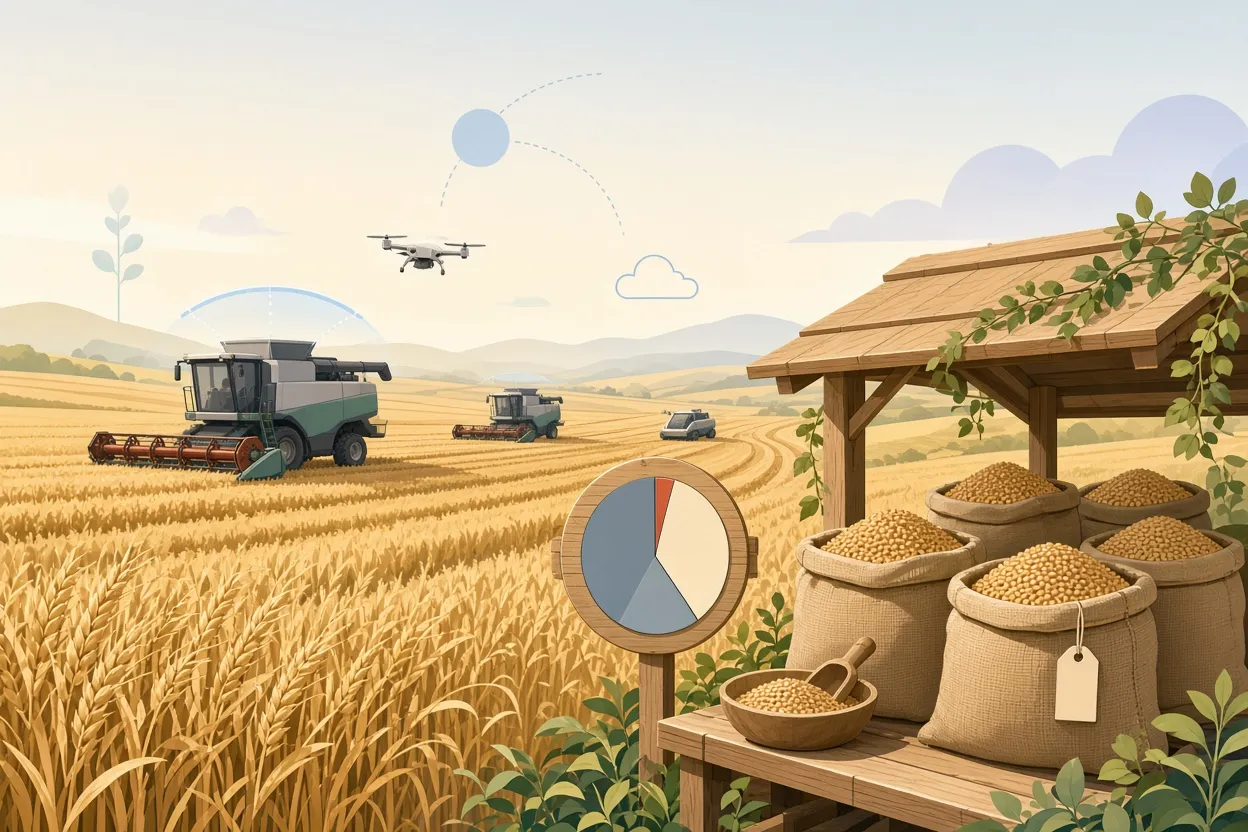
As productivity surged, food became cheap, and the sector's nominal share of the economy shrank even as the quantity of food exploded. Applied to AI, the implication is that heavily automated industries will produce enormous volumes of cheap output, and that cheapness is exactly what keeps their contribution to measured GDP from spiking.
▲ Abundant output, falling prices, shrinking GDP share
What the growth bet is actually about
This argument sits inside a public bet between two camps. A moderate-growth group includes Imas, Moll, Robin Hanson and Philippe Aghion among others; an explosive-growth group includes Will MacAskill and Dwarkesh Patel among others. Imas is careful to locate the disagreement. It is not about whether the models will get good. He describes himself as very bullish on technical progress and has no trouble imagining millions of autonomous agents at work.
The crux is market structure and demand under competitive capitalism. For GDP to grow at double-digit rates, output would have to surge without crushing prices, which requires enough consumer purchasing power to absorb all that new supply at prices that hold up. In Imas's reading, double-digit forecasts quietly assume insensitivity to price, effectively unlimited demand and zero political friction. He also adds a caveat that cuts both ways: if markets stop being competitive or capitalistic, the standard machinery for modeling prices and GDP no longer applies at all.
A revolution that feels bigger than it measures
None of this means life will feel ordinary. Imas expects people to experience a transformation that is more disruptive and momentous than previous technological shifts, potentially larger and faster than the Industrial and Agricultural Revolutions combined. History offers a precedent: during industrialization, daily life shifted dramatically while measured GDP grew at roughly 3% a year.
He considers sustained growth of 4% to 5% annually fully feasible under aggressive AI adoption, and he stresses that compounding makes such rates extraordinarily powerful. An extra one or two percentage points of persistent real growth would, in his view, effectively resolve the major fiscal and debt problems that developed nations face today. A sustained addition of two to three points would match the cumulative impact of the Industrial or Agricultural Revolution. The point is that these numbers are historic, even though they look small next to singularity forecasts.
Working backward instead of forecasting
Set against Robin Hanson's "The Age of Em," which describes a society of brain emulations and growth regimes in which a singularity could develop within a few calendar years, Imas's position stands out for what it refuses to do: compete on forecasting. Economists, he says, have no proprietary insight into technical timelines. His comparative advantage is backward induction: take a proposed end state and ask what assumptions and conditions must hold for it to happen.
Run that exercise on runaway growth and the binding constraint turns out to be political economy rather than engineering. Imas sees no severe technical bottleneck in post-training or compute paradigms that would halt rapid AI progress. What he does see is empirical evidence that an unemployment spike of roughly two percentage points typically produces overwhelming political backlash against whatever caused it. Democratic governments intervene when displacement happens fast, and singularity scenarios often leave that reaction out of the model entirely.

▲ Political institutions as the throttle on AI deployment
Wages will split, not simply fall
The model also complicates the common assumption that AGI uniformly pushes wages down. Imas distinguishes two kinds of markets:
- Deep, scalable markets for standardized goods and routine services, where automation puts intense downward pressure on human wages.
- Newly unlocked frontier markets where demand is high and supply of capable people is scarce, where human wages can rise sharply.
Human labor can migrate from the first category to the second. On this reading, whether a minimal-AGI world would require aggressive redistribution looks less like a foregone conclusion and more like a question of how much of that migration actually happens.
How agent swarms changed one economist's research
Imas offers his own work as a small case study. As a behavioral economist, he can now conduct rigorous research that spans macroeconomics, sociology and computer science without going back to graduate school for each field. His method is to frame the research questions, set the mathematical structures and parameters himself, and delegate literature gathering, data synthesis and exploratory modeling to swarms of AI agents.
He still drafts prose and synthesizes the overarching argument by hand, which he sees as essential to preserving authorial integrity. He also draws a distinction between scholars who use AI to publish more papers and those who use it to publish different ones. The real value, in his view, is the cross-disciplinary breadth, not the volume.
What to take from this
The core lesson is that believing in rapid AI progress does not logically commit anyone to believing in double-digit GDP growth. Three points follow for anyone trying to think clearly about the AI economy:
- Watch prices, not just capabilities. When automated output gets cheap, its share of measured GDP shrinks, as agriculture's did from about 40% to about 2%.
- Treat 4% to 5% sustained growth as the ambitious scenario. Compounded over years, Imas argues, it would rival past industrial revolutions and ease sovereign fiscal pressure.
- Expect politics to set the pace. A two-point rise in unemployment has historically been enough to trigger strong pushback, which makes institutional response the main throttle on deployment speed.
For readers planning careers or businesses, the model suggests looking toward newly created markets rather than competing in deep, standardized ones. For researchers, it suggests using agent swarms to widen the range of questions you can ask while keeping the problem definition and the argument in your own hands.