Synopsys, the company whose software engineers use to design and verify computer chips, is building a chip-design AI model with OpenAI called GPT-Synopsys. At its Investor Day, Synopsys also disclosed a multi-year chip design licensing deal with Amazon Web Services (AWS) worth more than $1 billion. Investors reacted quickly: Synopsys shares jumped more than 13% during the trading session, putting the stock near the top of the Nasdaq 100 and on track for its highest close in months. Taken together, the announcements suggest that the companies building AI models and the companies whose tools design AI chips are becoming each other’s customers.
Why chipmakers depend on EDA software
Synopsys sells electronic design automation (EDA) software, the tools used to design, test and verify a chip before it is manufactured. Every modern processor has to be checked in software first: whether its circuits behave correctly, whether its structure holds up and how it handles heat. The scale of that job keeps growing. Transistor density has risen about a millionfold over recent decades, from roughly 200,000 transistors to about 200 billion.
Synopsys CEO Sassine Ghazi says the custom chips built by hyperscalers, the largest cloud providers, cannot be made without Synopsys design and validation software. He points to Google’s Tensor Processing Units (TPUs), the AI chips Google designs in-house, as an example. The checks cover not only the silicon itself but also the chip’s physical structure and thermal behavior.
There was once a fear that generative AI, by writing code on its own, would make many software products less necessary. Specialized EDA software has instead proved hard to replace, and these deals appear to reinforce that position.
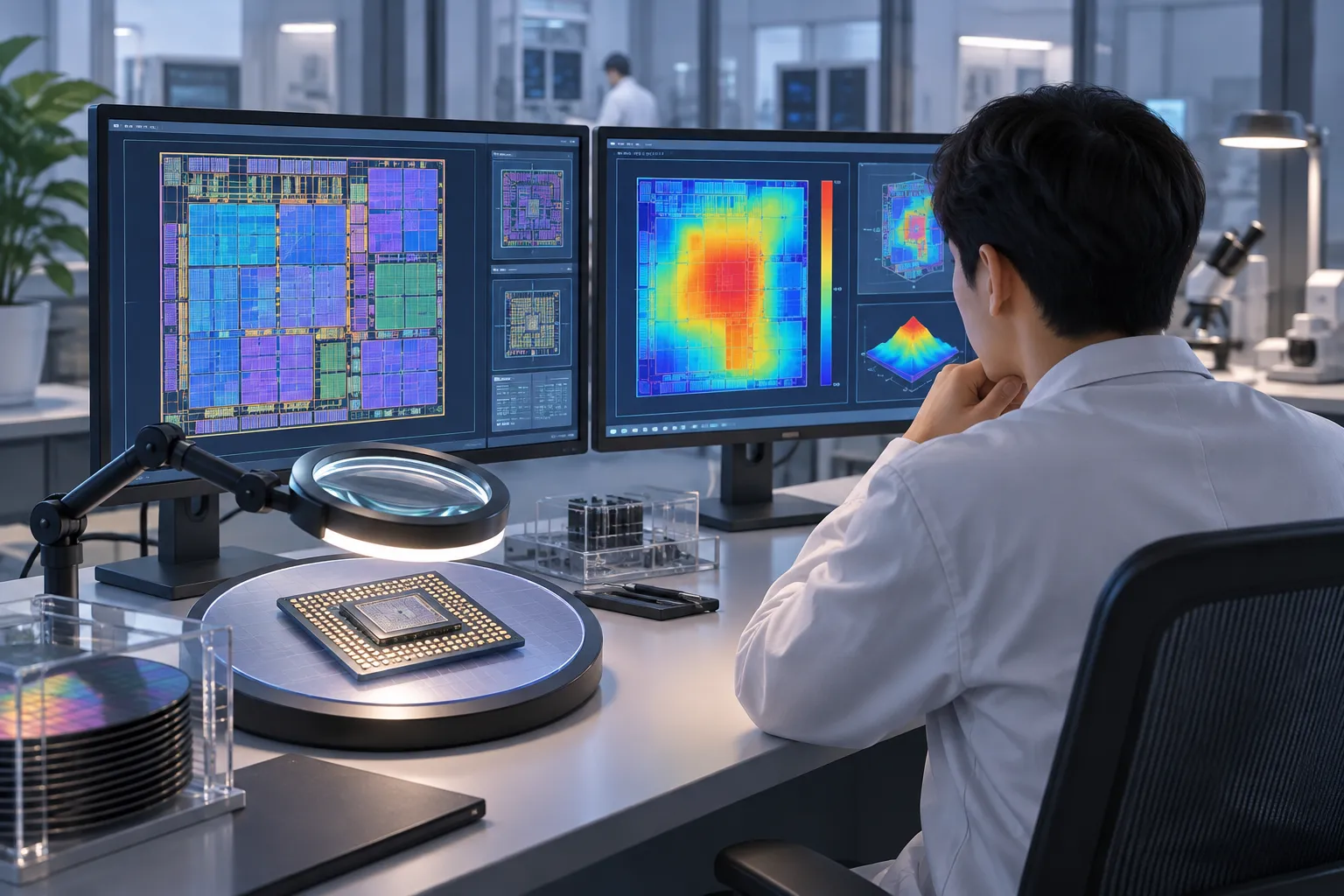
▲ Verifying a chip during the design stage
What GPT-Synopsys is meant to do
For the AI industry, the most notable piece of news is GPT-Synopsys. Synopsys and OpenAI plan to bring reasoning-capable AI models directly into electronic design automation and into engineering work that spans several disciplines.
Ghazi frames the partnership around three points:
- Frontier models, the most advanced large AI models, have strong reasoning abilities, but they need deep domain knowledge before they can meaningfully help chip engineers.
- OpenAI chose to work with Synopsys because of the company’s leadership in digital design software across key engineering disciplines.
- Frontier models in turn need customized chips to run efficiently, because each algorithmic stack has different demands.
Large AI developers are increasingly designing their own silicon instead of relying only on established chipmakers such as NVIDIA and AMD. A partnership in which an AI model helps design chips, and those chips then run AI models, looks like a natural extension of that trend. So far, though, the announcement describes a direction more than a finished product. Which design steps GPT-Synopsys will handle, and how engineers will use it, remain open questions.
Ghazi also expects that if generative AI developers such as OpenAI and Anthropic go public, their stronger balance sheets would speed up their investment in chips. That is a forecast from Synopsys’s chief executive, not an announced plan.
The AWS deal: licensing plus royalties
The AWS agreement covers the design of custom silicon, chips built for a specific purpose, optimized for cloud infrastructure and AI workloads. The goal is to reduce reliance on general-purpose processors.
| Item | Detail |
|---|---|
| Value | More than $1 billion |
| Term | Multiple years |
| Purpose | Custom chips for cloud infrastructure and AI workloads |
| Revenue model | Upfront licensing plus recurring royalties as production grows |
The revenue model is what stands out. Synopsys collects licensing fees at the start, then earns royalties as AWS scales up production across successive chip generations. Investors appear to have welcomed that structure because it offers steady, predictable revenue over time.
Designing around memory shortages
Rising demand for AI chips has raised concerns that supplies of high-bandwidth memory (HBM), the fast memory stacked next to AI processors, along with power constraints, could limit growth. Ghazi argues that Synopsys software eases the problem by giving chip designers architectural options.
In practice, a hyperscaler can design a chip’s interconnects so that it works with memory from Micron, Samsung or SK Hynix interchangeably. If one supplier cannot deliver, the design leaves room to switch to another. Building that flexibility in from the start is how chip designers can avoid being locked into a single source.

▲ Digital twins for physical AI
Ansys and the push into physical AI
Synopsys is also integrating Ansys, the engineering simulation software company it is acquiring for $35 billion. Some investors had worried about the integration risk and the heavy debt load tied to the deal.
Ghazi describes Ansys’s simulation tools as essential for modeling physical behavior in industries from automotive to aerospace. Engineers can build digital prototypes of everything from airplanes and tennis rackets to advanced car systems before anything is manufactured.
He argues that physical AI, meaning AI systems such as robots that act in the real world, depends on digital twins: detailed software replicas of physical objects. Before hardware is built, a digital twin can simulate structural mechanics, fluid flow, electromagnetics and thermal behavior together. By combining chip design tools with physics simulation, Synopsys aims to offer one software ecosystem that covers both a chip and the machine it ends up in.
Google’s TPUs head to orbit
AI chips made news in another way the same day. A SpaceX Falcon 9 rocket lifted off through thick coastal fog from Vandenberg Space Force Base in California and carried a refrigerator-sized test satellite called MVP into orbit. The satellite is part of Project Suncatcher, a long-term Google research effort with Planet Labs that tests whether data centers can operate in space. It carries four Google TPUs to test orbital computing power comparable to a server in a data center on Earth.
Key takeaways and what to watch
The announcements come down to three moves:
- OpenAI and Synopsys are developing GPT-Synopsys to bring reasoning models into chip design work.
- AWS signed a multi-year deal worth more than $1 billion to use Synopsys tools for its custom chips, with royalties that grow with production.
- Synopsys is adding Ansys physics simulation to its chip design tools to target physical AI.
If you follow AI infrastructure, watch for details on which design steps GPT-Synopsys will actually take on and how much it changes engineers’ daily work. If you design chips or hardware, consider moving design verification and multi-physics simulation earlier to catch defects before costly manufacturing runs, and build supplier options into your architecture so that memory or fabrication bottlenecks do not tie you to a single source.