A solo-built AI tool for turning long-form content into social posts reached a reported $1 million in annual recurring revenue (ARR), the yearly value of recurring subscriptions. The more useful story for other founders is how the product took shape: its founder tested interest before coding, cut a broad idea down to one core task, and later watched how customers used it. The revenue figures describe this business, not results others should expect.
Interest came before the product
The starting idea was to turn material such as blog posts and YouTube videos into shorter posts for other platforms. On August 1, 2024, the founder described that proposed workflow in a TikTok post and asked whether it addressed a real problem. More than 200 people commented with interest.
Those comments were a reason to investigate, not proof that people would pay. The founder followed up through direct messages and held fewer than 20 discovery calls and chats. Questions covered how people currently repurposed content, which tools they used, what they spent, and which platforms mattered to them. This gave the project a more specific starting point than the founder’s own need alone.
A smaller first version made the idea testable
The original product plan was expansive: it included connections to content sources, information about a customer’s brand voice, AI filtering, and publishing across many platforms. Before building, the founder crossed secondary features off a paper wireframe. The resulting minimum viable product, or MVP—the smallest version designed to test the central task—accepted one piece of text and generated posts for Facebook and Twitter, along with images made using OpenAI’s DALL-E 2. The image results appeared rough, but the first version could test the workflow.
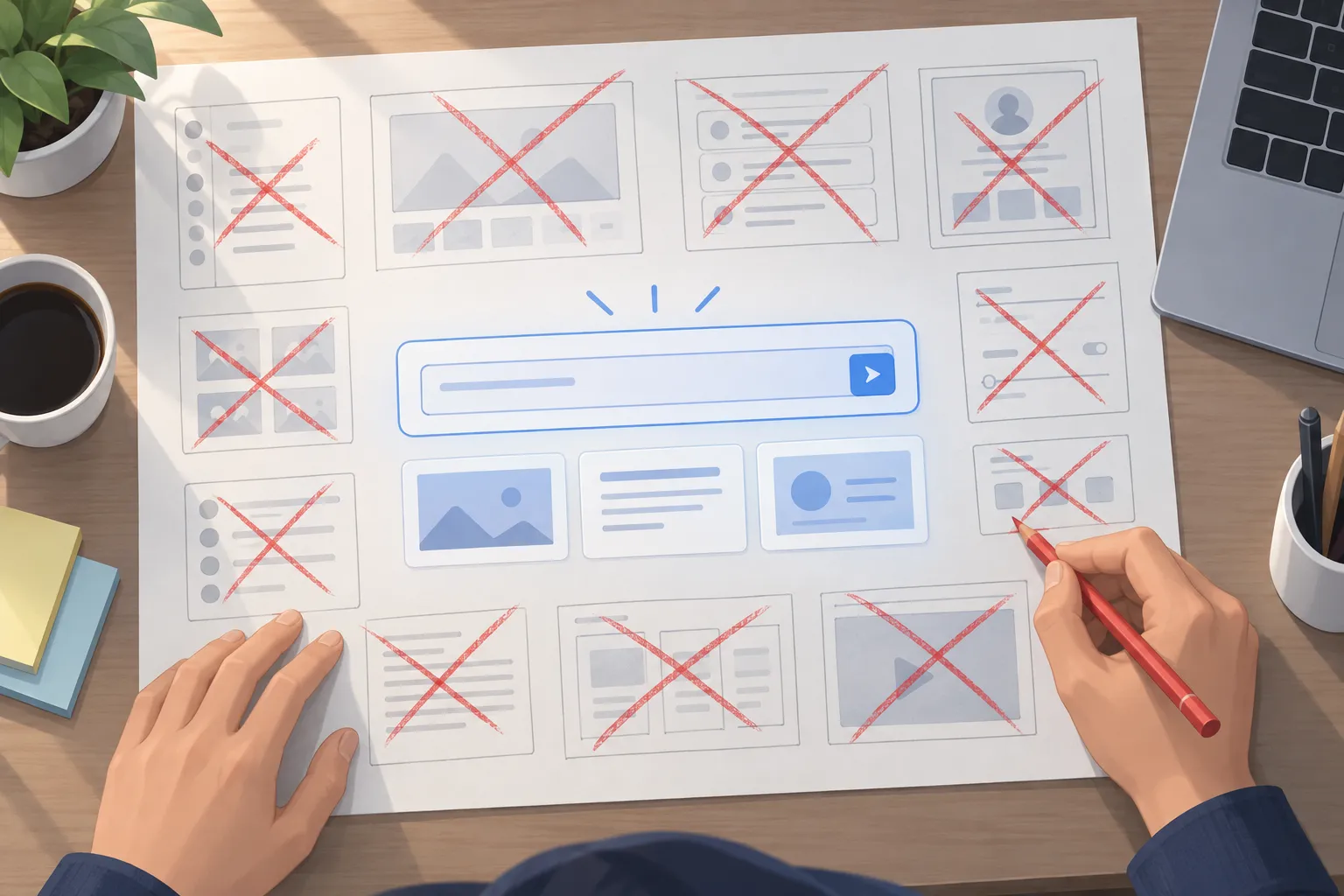
▲ A narrowed first-product wireframe
The founder used the AI code editor Cursor to generate the first version’s code. This was an example of vibe coding: using AI to produce much of a prototype quickly, rather than starting with a carefully designed codebase. A $60 Webflow template supplied the initial landing page. The narrow scope and inexpensive setup helped get a working product in front of people without first building the full vision.
An early adopter program complicated that plan. On October 1, 2024, the founder offered a lifetime discount and priority support to the first 50 applicants through a Google Form. The survey asked about posting platforms and workflow bottlenecks, but stated needs sometimes differed from observable behavior. In one case, a person described cross-posting between Instagram and LinkedIn, while their visible activity centered on TikTok and showed no repurposed posts. Requests across the group also pulled toward different products, including podcast clipping and faceless automation.
That experience suggests a limit to treating a waitlist as a single customer profile. The founder came to favor a public launch over prolonged attempts to reconcile the group’s competing requests. It does not mean every survey answer was wrong; it means stated preferences alone did not settle what this product should do.
A simple launch tested willingness to pay
The public launch on October 20, 2024, used a five-minute YouTube walkthrough, an email to an existing newsletter audience, a TikTok post, and a LinkedIn post. That existing audience was an important part of the case: it gave the product immediate exposure that a founder starting without one would not have.
The launch was far from polished. A broken link in the email prevented readers from opening the intended walkthrough. The mobile layout displayed poorly, Apple Pay and Amazon Pay checkout options failed, and calendar invitations lacked meeting links. These problems created extra work and friction. They also made customer actions—following links, trying to sign up, and attempting to pay—more informative than expressions of interest on a form.
Within 10 days of the public launch, the product reached a reported $10,000 in monthly recurring revenue (MRR), the monthly value of recurring subscriptions. Its initial price was $49 per month before a later reduction aimed at international customers and bootstrapped founders. Neither the early MRR figure nor the later $1 million ARR milestone establishes that a similarly simple launch will work without this product’s audience, customer need, or continuing marketing.
Usage guided the rebuild
After launch, the founder used PostHog session recordings—playbacks of how people move through a product—to find where users stalled between onboarding steps. During the first two months, the main engineering focus was smoothing that path. The founder also handled support through an Intercom chat widget, while finding that individual onboarding calls took too much time to sustain.

▲ Reviewing friction in user onboarding
Paying users changed the approach to code. The AI-generated first version had served as a demand test, but its structure was not a sound long-term plan. The founder rebuilt the backend with Next.js, Fastify, Supabase, and Heroku, adding deliberate architecture, tests, clearer naming, and documentation. The Webflow site, whose cost had risen to $600 per month, was replaced by an Astro site designed with Claude and deployed on Vercel. Moving support from Intercom to an automated n8n workflow saved roughly $1,300 per month in this business.
The distinction is between using AI to get a testable product out and using AI within a more supervised engineering process once customers depend on it. The later rebuild was not part of the initial proof of demand; it followed that proof.
Growth required continued work
The reported revenue path rose steadily rather than in a sudden surge. It included plateaus between late December and January, when the founder paused marketing activity for skiing. The founder also continued to make tutorials and social content to attract customers. In this case, recurring revenue did not mean acquisition ran on its own.
The practical sequence is to test a specific problem with prospective customers, build only enough to let them try the central task, and observe what they do after launch. If customers pay, use that evidence to decide where better engineering and lower operating costs matter. Read the milestones alongside the conditions that produced them—especially the existing audience and ongoing content work—rather than as a revenue target for a new AI business.