Researchers at Anthropic think AGI, or artificial general intelligence, could realistically arrive within the next couple of years. In their view, the clearest sign of how fast things are moving is a change in their own daily work. About 18 months ago, they still typed nearly every line of code by hand. Today they can hand an AI model a day or two of engineering work and let it run on its own, much as they would with a junior colleague. The researchers also see AI moving past work people already know how to do and toward new knowledge, with mathematics leading the way.
Eighteen months, three ways to write code
One Anthropic researcher calls the change in programming the most visceral sign of how fast the technology has accelerated. The shift happened in three stages.
| Stage | What the engineer does | What the AI does |
|---|---|---|
| About 18 months ago | Types almost every line by hand | Helps one line at a time |
| A few months later | Steps in every few minutes to fix errors or ask for the next function | Writes code under close direction |
| Today | Assigns one to two days of engineering work | Carries out the work independently, like a junior team member |
The key variable is how often a person has to step in. That interval has stretched from minutes to days. In practice, the model now acts as a coding agent, meaning an AI system that carries out a programming task from start to finish instead of suggesting one line at a time. That is why the researchers compare it to a junior teammate.
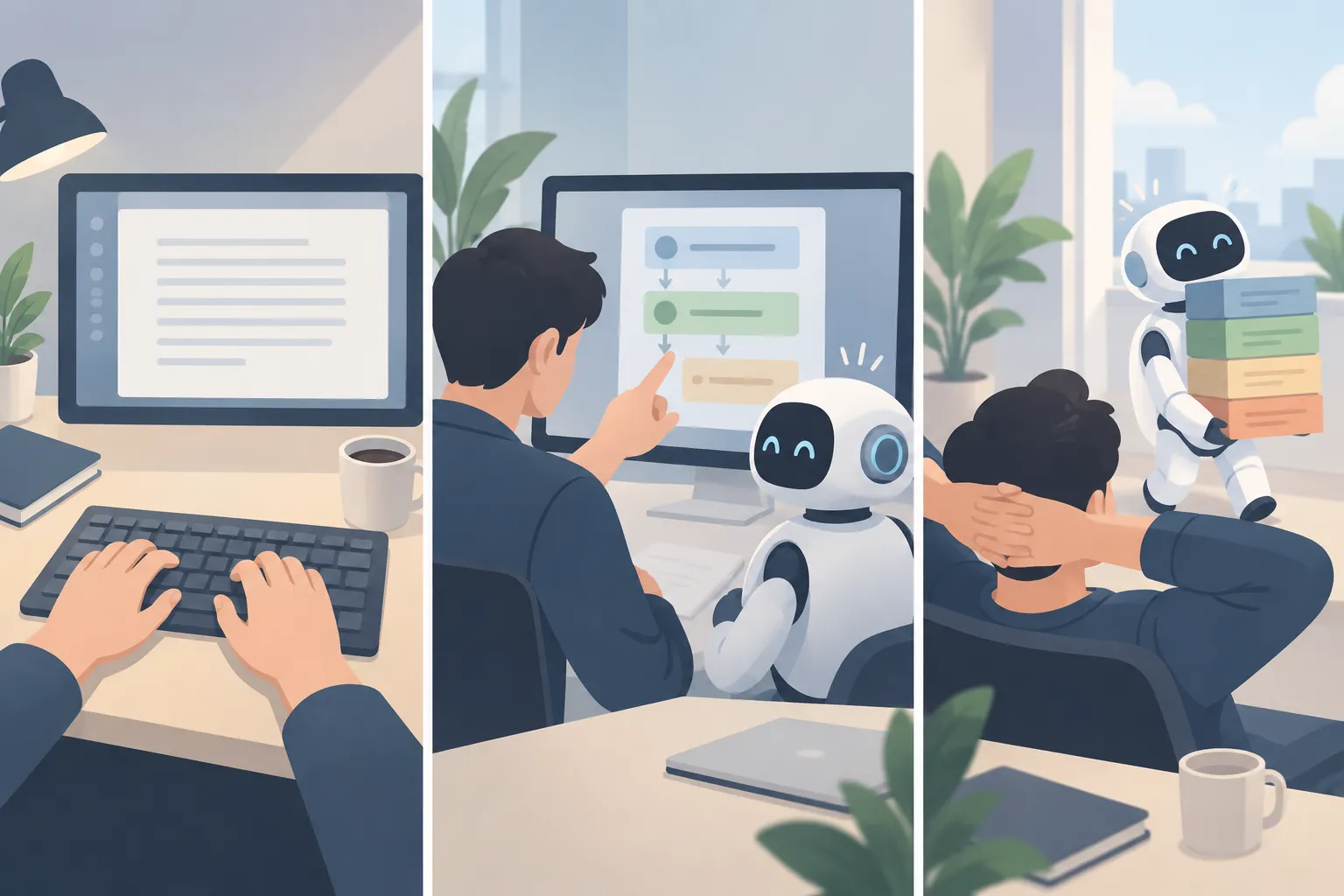
▲ Three stages of the engineer’s role
From known tasks to new knowledge
The first wave of AI development focused on automating mental work that people already understood and did well. That gave developers extra leverage on work they could already do. The newer goal is different: using AI models to push beyond existing intellectual frontiers, for example by finding new mathematical proofs. Building another web app is a task humans already know how to do. Discovering a proof no one has found before extends human knowledge.
A natural question is whether these results simply come from computers grinding through calculations too large for a human mathematician. One of the researchers offers a different account of how progress works. Breakthroughs rarely depend on completely alien ideas. More often, they come from combining ideas that already exist in a way nobody tried before. Human achievement has always built on earlier milestones, and AI models are now connecting those dots across fields to produce real discoveries, not just more of the same software.
FrontierMath: from zero to roughly half in a year
Benchmarks, the standardized tests used to measure AI capability, show how fast this is moving. FrontierMath is a set of difficult problems written by leading university professors across many areas of mathematics. Frontier models started at a score of 0% on it. In roughly one year, they reached accuracy of 40% to 60%.
Looking back, the arrival of GPT-3 in 2020 can be seen as the point when human-level AI began to shift from speculation to something that looked inevitable. Tests like FrontierMath now put numbers on how quickly that shift is happening.
Why math and code moved first
The researchers describe two engines behind modern AI progress.
- Pre-training: the model learns from a massive body of text gathered from the internet.
- Reinforcement learning: the model works on tasks, its answers are checked against an objective ground truth, and it improves from that feedback.
Reinforcement learning works best when there is a clear way to tell whether an answer is right. Math proofs and code have that property, which helps explain why those two areas advanced fastest.
A second researcher adds a human explanation. The pioneers of machine learning research had strong backgrounds in math and computer science, so they built evaluations and training sets in the fields they knew best. Evaluating a model and fine-tuning it, that is, training an existing model further for a specific job, takes a great deal of human time spent reading and interpreting what the model produces. That work is easier in a familiar field.
| Domain type | Examples | Building evaluations |
|---|---|---|
| Verifiable | Math, coding | Answers can be checked against objective ground truth |
| Subjective | Social interaction, romance, artistic expression | Much harder, because there is no clear right answer |

▲ Verifiable domains versus subjective ones
A company that keeps outgrowing itself
The same acceleration shows up inside Anthropic. The company scales so quickly that it feels like a brand-new organization every 60 to 90 days. Eighteen months ago, the team had to concentrate hard on coding benchmarks to prove it could build world-class models. As revenue and computing scale have grown, Anthropic has widened its target to general intellectual ability across many fields.
What AGI means here, and what is at stake
In this framing, AGI means AI models that are as capable as, or more capable than, every human at intellectual tasks done on a computer. Once robotics matures, the definition eventually extends to physical work as well. According to the researchers, Anthropic considers this a realistic prospect for the next couple of years.
One researcher describes AGI as having two sides.
| Upside | Risk |
|---|---|
| Fitting centuries’ worth of scientific and intellectual progress into a much shorter period | Extreme risks to society and to humanity’s survival |
Anthropic sees its core mission as guiding the world safely through those risks so that people can capture the large benefits of superintelligent systems. The two-year horizon is a forecast from the researchers, and they pair it with a clear warning that the risks call for careful stewardship.
Tool or entity?
There is an active debate in the industry over whether advanced AI should be thought of as a tool or as an autonomous entity. One Anthropic researcher argues that the entity framing is more accurate and more useful for frontier models.
A traditional tool needs a person operating it the whole time. A frontier model can be instructed once and then left to act in the digital world on the user’s behalf, taking initiative and doing complex work over long stretches. Evolution has wired people to treat conversation partners as human-like and to mirror their emotions, so calling AI an entity can sound like projection. The researcher’s point is practical: because these systems now act on their own, the entity framing describes what they actually do.
What to take from this
Software development has moved from close supervision to delegation in about 18 months, and Anthropic researchers think AGI could follow within a couple of years, alongside serious risks. Whether or not that timeline holds, a few lessons apply now.
- Delegate whole tasks. Give capable models independent, multi-step work instead of steering them line by line.
- Watch the verifiable work first. AI has improved fastest where results can be checked against objective answers, so the parts of your job with clear right answers may change first.
- Put experts on review. Have people who know the subject read the model’s traces, the step-by-step records of what it did, along with its intermediate work, to catch subtle edge cases.