OpenAI’s September 2026 claim about the Navier-Stokes Millennium Prize Problem rests on a specific mathematical construction: a fluid velocity field that becomes unbounded in finite time even though it begins smoothly, uses smooth external forcing and retains finite kinetic energy. OpenAI has presented both an analytical paper and a proof formalized in Lean, a system for checking mathematical arguments against explicit rules. Independent review is still needed before the result can be treated as an officially resolved Millennium Prize Problem.
The condition the claim addresses
The Clay Mathematics Institute set out seven Millennium Prize Problems in 2000, each with a $1 million prize. Before this announcement, only one had been officially resolved. The Navier-Stokes problem asks what the equations of fluid motion permit under carefully stated conditions—not simply whether a striking spiral can be produced in a simulation.
OpenAI’s paper addresses Statement C of the official problem description. Statement C calls for a breakdown of a smooth solution in three-dimensional space, written as R³, after a finite amount of time. The construction must start with a smooth, divergence-free velocity field and use a smooth external force while meeting the problem’s finite-energy requirement. “Divergence-free” expresses incompressibility: a small parcel of the modeled fluid does not change volume as it moves.
In OpenAI’s construction, the fluid starts at rest. A designed force then drives its velocity toward a singularity—an unbounded value—at time t = 1. That is a counterexample to the idea that smooth solutions under these conditions must remain smooth for all time. It is not a demonstration that an ordinary liquid could reach infinite speed.
Why a moving parcel matters
The Navier-Stokes equation applies Newton’s force-equals-mass-times-acceleration idea to fluid, whose velocity varies from place to place and moment to moment. A parcel can accelerate because the velocity at its current location changes over time. It can also accelerate by moving into a region where the velocity is already different. That second effect is called convective acceleration.
For a fluid whose density is normalized to one, the equation balances those two kinds of acceleration against three forces: viscosity, which spreads differences in velocity through the fluid; pressure differences; and an external force. The velocity is a vector field, meaning it assigns a direction and speed to each position at each time. Tracking a moving parcel, rather than checking only one fixed position, is essential to understanding what the equation says.
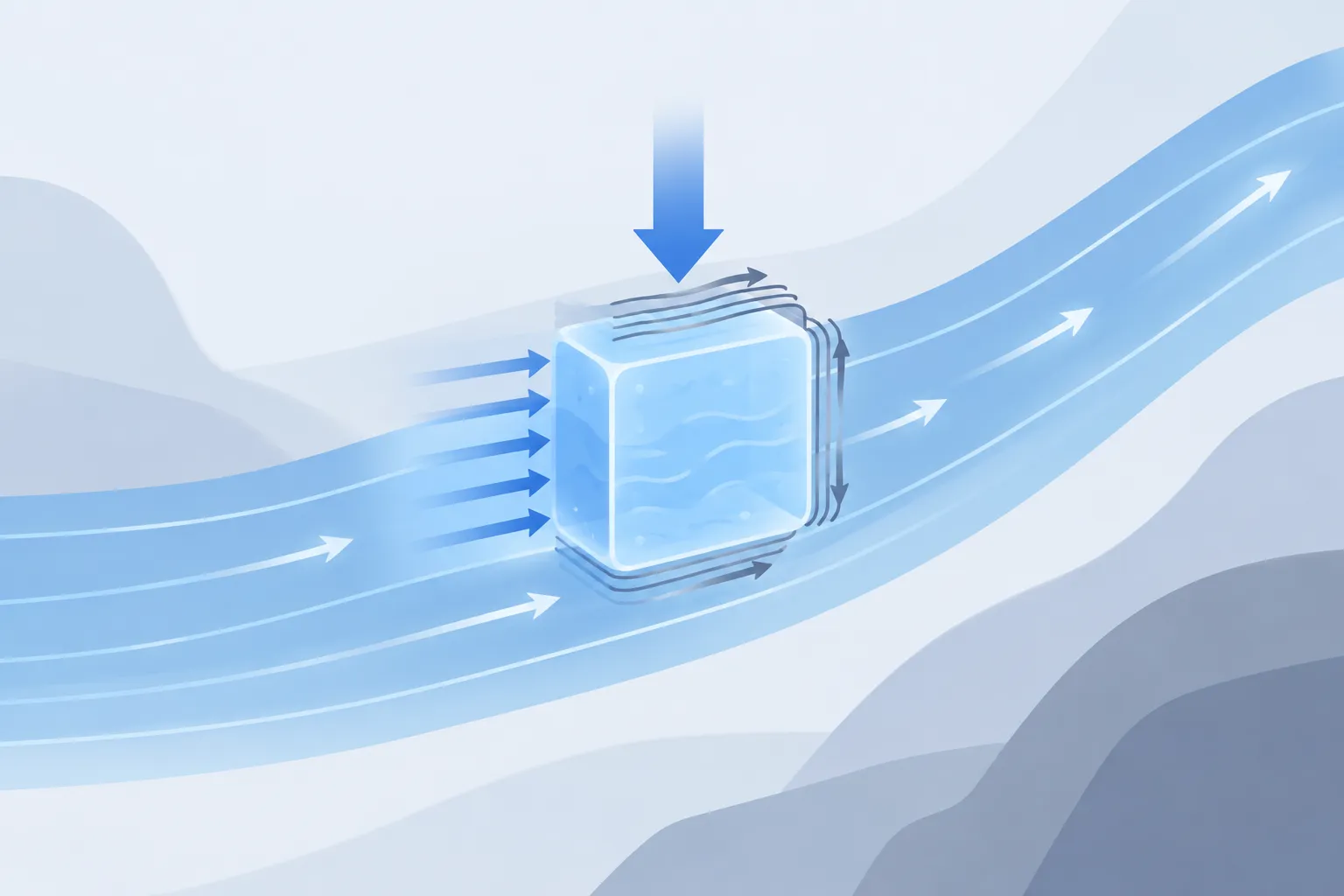
▲ Forces on a moving fluid parcel
The proof’s central difficulty lies in the external force. One can propose a velocity field that blows up and then calculate the force the equation would require. But an arbitrary choice may demand a force that also blows up or becomes irregular. That would not satisfy Statement C.
OpenAI’s approach designs a sequence of velocity pulses that oscillate across space and are localized in radius, height and time. The pulses are calibrated so problematic nonlinear terms in the calculated force cancel. The resulting construction is intended to make the velocity singular while keeping the required external force smooth and bounded.
What the spiral picture leaves out
A widely circulated spiral rendering is a publicity illustration, not a figure generated directly by the proof. Figure 1 of OpenAI’s roughly 100-page paper is a more restrained schematic. It depicts flow spiraling inward in a plane while stretching along a vertical axis in opposite directions.
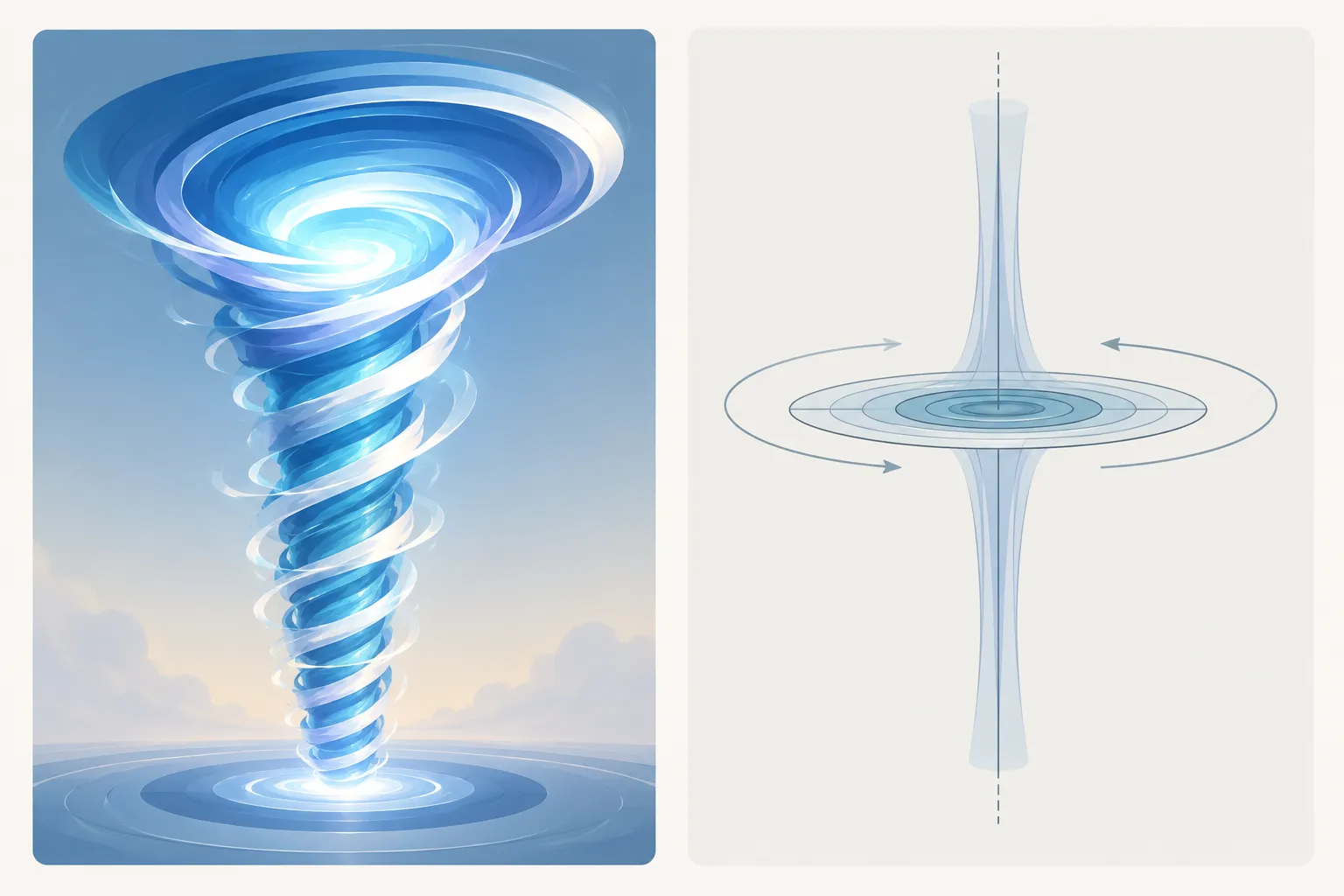
▲ Publicity rendering and technical schematic
Even the technical schematic exaggerates the feature’s vertical height for clarity. The paper gives an aspect-ratio scaling parameter below 1/100, so the core becomes much flatter and smaller than the drawing suggests. A useful way to picture the approach to the singularity is to define tau as 1 − t: as tau falls toward zero, the spinning structure contracts toward the origin while its velocity grows.
That combination explains how the construction can retain finite total kinetic energy as it approaches blowup. The region carrying the extreme velocity shrinks rapidly enough that the energy integrated over space remains finite. An illustrative 3D animation of this geometry can make the inward spiral and axial stretching easier to grasp, but it cannot substitute for the analytical argument or its formal check.
What has—and has not—been established
OpenAI reports that it used 10,000 automated AI agents working concurrently to develop the result. The reported run involved 2.7 million messages and 130 billion output tokens. Community calculations put its API-equivalent computing cost between $10 million and $40 million; that range is an estimate, not a prize amount or a measure of mathematical validity.
The Lean formalization is a substantial part of the claim, but independent mathematicians and the Lean community have not completed their review. The Clay Mathematics Institute also requires publication in qualifying journals and a two-year verification period before considering an award. A public announcement, a formal proof and an official prize decision are distinct milestones.
Other mathematical work appeared on the same date as OpenAI’s announcement. Two mathematicians released three preprints establishing finite-time blowup for the three-dimensional incompressible Euler equations with smooth forcing. Euler removes the viscosity term from Navier-Stokes, so those results concern a closely related equation rather than, by themselves, settling the viscous case.
The claimed Navier-Stokes result also has a sharp boundary between mathematics and physical prediction. Under the extreme conditions represented by the construction, an actual liquid would vaporize before reaching the modeled singularity. The question being tested is whether the equations allow a breakdown under the prize problem’s stated assumptions, not whether a laboratory fluid can reproduce it.
How to read the next breakthrough claim
Automated proofs may deliver answers faster than explanations of why a construction works. This result may meet a formal target while leaving mathematicians with further work to make its underlying ideas understandable and useful. The distinction matters: a checked conclusion and a clear conceptual account are both valuable, but they are not the same achievement.
For this claim, readers can take three concrete steps:
- Check the official problem statement. Identify the exact alternative being claimed—here, Statement C—and its requirements for initial conditions, forcing and energy.
- Compare illustrations with the paper. A publicity rendering can convey a theme without accurately showing the construction’s proportions or serving as evidence for the proof.
- Follow independent verification. Look for scrutiny of the analytical argument and Lean formalization, then for the publication and review milestones required before any prize decision.
OpenAI’s construction appears to offer the kind of finite-time counterexample Statement C asks for. Whether it earns official acceptance remains open. The most useful response is to examine the precise claim, the mechanism that keeps its force smooth, and the independent checks—not to mistake a dramatic vortex image for the result itself.